-
Information Retrieval & Algorithmic Search vs Visual Design & Brute Force
Yesterday I posted some feedback about recent changes in WordPress Reader (see “WordPress.COM Reader Design Feedback (about Featured Image & information usability)” [ search.tech.blog/2022/10/15/wordpress-com-reader-design-feedback-about-featured-image-information-usability ] ). My own feedback comes from my own reading habits, which are very text-based and also oriented towards natural language search (including algorithmic information retrieval) technology. I realize that most people generally seem to lack such literacy skills (or they are very rudimentary and relatively unskilled).
On the other hand, many people seem to be much more visually oriented than I am. I have little doubt that in the long run algorithmic natural language-based information retrieval methods will be much more efficient (and therefore sustainable) than the more “brute force” methods involving very intense information processing and very large files (and exorbitant amounts of data processing & data transfer) such as the visual data contained in image files. The only thing I am somewhat uncertain about in this regard is whether that long run will arrive while I am still alive.
Today, in “popular” media such as Google (and YouTube), Facebook (and Instagram and Whatsapp) and Tiktok, teenagers with only limited literacy skills are bathed in inordinate amounts of visual data. While in the long run the cost-benefit ratio is quite obviously far too high, in the short run these teenagers can be sold to large numbers of (for the most part) equally illiterate marketers (who do not yet realize how worthless these followers, bots and whatnot are). As George Carlin (in one of his last famous appearances) said: “It’s a big club, and you ain’t in it” (here I am alluding to the membership fee that must be paid to take part in this nonsense-media cf. “irrational media” in “Hope & Change: Flipping the F-word & Removing the Old-Fashioned R-word” [ remediary.com/2020/11/06/hope-change-flipping-the-f-word-removing-the-old-fashioned-r-word ] ).
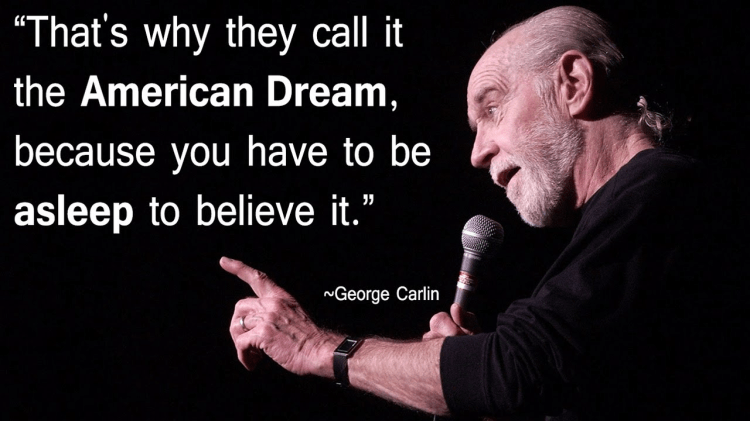
George Carlin “American Dream” Well, I mention this because I am sad that WordPress appears to have taken a step away from its more literate past towards a more illiterate (or at least differently literate) future. The long-run economics of this decision are obviously not sustainable, but the short-run boost to profits seem to be more influential on the people who are making these decisions.
-
Decentralization of Marketplaces
At this moment in Germany, perhaps the very last “department store” chain is on the verge of bankruptcy. That isn’t very remarkable — unless you consider that the business model is essentially the same as the business model which is replacing it: Amazon is basically a department store. The main advance in technology introduced by Amazon is the integration of spyware (i.e., measurement, data science, etc.) into each & every step of the store’s procedures.
About a decade ago, I asked a question on one of the most popular platforms for questions (and answers), Quora. Actually, back then I asked several questions, including a question about whether “quora” could be considered to be the plural form of “quorum”. Many of my questions were moderately controversial. The question I am referring to here had to do with whether Google could be considered to be the Pope of the Internet. There were several quite adamant opinions expressed — my favorite comment was one which stated that the Pope offers free bread and wine, but Google doesn’t. The link seems to be here: http://www.quora.com/How-is-trust-in-Google-similar-to-or-different-than-trusting-the-Pope — CAUTION: in my humble opinion, this site is also heavily laden with spyware (which is one of the reasons I no longer use it [very much 😉 ] ).
Image via “Some Market Price is Probably More or Less Accurate at Some Moment in Some Marketplace (& Socio BIZ Rule #2)” https://socio.business.blog/2022/08/28/some-market-price-is-probably-more-or-less-accurate-at-some-moment-in-some-marketplace-socio-biz-rule-2 Throughout most of my life (at least: so far 😉 ), marketplaces were central. They were the places where people meet. Oddly, while at one marketplace, I never thought very much about other marketplaces. I bought my apples here, chatted with local people, perhaps friends or acquaintances, waved hello and goodbye. Not each and every town has a marketplace, but bigger towns might, and large cities may have several, perhaps even every day of the week. Oddly, I have yet to see one in America. There, the automobile has pretty much completely annihilated foot traffic.
I very strongly doubt that Amazon or Google will ever control the entire world. I often get quite upset and concerned about how many people trust Google the way people might have trusted Popes in previous centuries — especially considering how manipulative both of those institutions have been at times (see e.g. “Google Campaigns Against Donald Trump’s Re-Election in 2020 Campaign as President of USA (vs Joe Biden)” [ https://campaign.politics.blog/2020/11/14/google-campaigns-against-donald-trumps-re-election-in-2020-campaign-as-president-of-usa-vs-joe-biden-2020 ] ).
The thought I am pondering this morning, however, is the other side of this coin: What is the risk of decentralization? I think perhaps the greatest risk is that there might be several localized optima, and these optima might become so path-dependent that they become the “most efficient” solutions for only very specific constraints — for example: automobile technology in the situation of plentiful supplies of fossil fuels, lack of “climate change” (or “global warming” or whatever), etc.. For such extreme situations, humanity seems to require guidance … be that from a Pope or from a printing press, whether from pure logic or from playing dice.
Speaking of which: I have an odd hunch that we should consider ourselves quite lucky if we survive long enough to be wiped out by an asteroid. Yet more currently, I’m guessing that marketplaces today no longer exist entirely independent of one another, and that over the time we still have left, there will be not only increasing competition among marketplaces, but also an increasing degree of rationality (and also a decreasing degree of smoke and mirrors) influencing human behavior … leading to more rational choices (ergo: more “rational media” [see also “Hope & Change: Flipping the F-word & Removing the old-fashioned R-word” https://remediary.com/2020/11/06/hope-change-flipping-the-f-word-removing-the-old-fashioned-r-word ]).
-
Collaborateurs
Having written a few posts for the (German language) project I started a few weeks ago, I want to share a little bit about my experience so far.

Gegenüber.NET The concept Gegenüber.NET is based on has a lot to do with concepts which in English are addressed with words like “community” or “collaboration” … although my own approach is actually much broader than to focus specifically on only human interactions (yet whether seen more narrowly or more widely, is not such an important or central issue).
Today (here and now) I would like to meditate a little bit (more) on the aspect of collaboration.
Collaboration is not exactly “unamerican”, but in my opinion, it also isn’t something Americans take great pride in — I expect quite a few Americans have actually never even heard of the concept. It seems like the word “social” is heralded across all corners of the Internet, but virtually no one is aware of what being social might have to do with collaboration.
In Europe (and specifically in Germany) it’s a whole different ball game. For example: In Germany this long weekend (with the national holiday falling on Monday this year), the media are buzzing with “Zusammen wachsen” (“growing together”). Hence: Collaboration is at the very least an implicit ideal.
But at the same time, the word is also somewhat verboten. All Germans know why. Many other Europeans also know why. It’s because of the history of collaborators — and this is not an abstract concept. Whenever this term is used (usually in the French articulation — i.e. “collaborateur”, in German it’s spelled “Kollaborateur”), it very concretely refers to people who are considered despicable because they collaborated with the occupying forces (namely Nazis during the Third Reich).
Oddly this rather negative interpretation of collaboration seems eerily familiar these days, as do such phrases as “either you’re with us or you’re against us” (which some Americans might be able to remember from a just a couple decades ago).
Very few people (I think) are familiar with an association which is very much front and center for me. For me, “collaborateur” conjures up images of companies or individuals who are willing to sell user information to data brokers such as Google or Amazon. Users who lack the literacy skills required to prevent such spyware companies from acquiring PII (personally identifiable information) user data … I would refer to as illiterate, but I also recognize that over time, I am also led to consider them ignorant … and in case this ignorance is willful, I could see how this could even be interpreted as this sort of “collaborateur”. Normally, everyone is mainly responsible for their own actions, but if websites include spyware code from Google, Amazon or other spyware companies on their own websites, I do indeed consider such websites to be “Google collaborateurs” or “Amazon collaborateurs” or “whatever collaborateurs”. In America, such flak is normally reserved for Facebook — and in my opinion this is primarily because devotion to Google and Amazon is far more widespread.
Google and Amazon are undoubtedly the Führer. 😉
-
Self, Words, The Word & Language Itself

Today I would like to tie together a few loose ends again, picking up one from last week, another from maybe a few months ago and perhaps a couple more along the way.
Last week, I described an odd sort of dichotomy that can arise if someone views words separately from the persons who are using them (see “People and Their Word(s)“), and now I would like to delve a little deeper into this phenomenon.
Rather than meandering off along millions of possible tangents related to the contextual nature of language use, I want to pick out one single gem that occurred to me this morning. This is the notion of how many people juxtapose their own words versus the context in which their words are published (i.e. made public) to the world (i.e. “in real life”) around them. Their words are their intellectual property, the real world can react to them in some way … but otherwise they are actually (viewed as) unconnected. I sense a strange hunch of absurdity lingering on some horizon, but I can’t really put my finger on it (yet).
More directly, I notice that the act of publication is interpreted to be separated from the mere expression (of words, language, whatever). Anyone has complete freedom to express anything they want in their own, closed off space (such as a person’s own skull, housing the brains which are simply thinking thoughts). Spoken words may be mumbled in a low voice or quietly scribbled down as private recordings, not intended for anyone else’s eyes or ears.
Indeed, insofar as self-publishing is sometimes deemed invalid, the invalidity of the self-published publication underscores the intellectual separation of speech acts (or acts of expression) from actions of publication. Knocking on a publisher’s door seems to be in a sort of distasteful limbo or purgatory state, a window of opportunity, a stage apparently made for a heroic appearance by an undisclosed literary agent of some sort, a quasi-transitive chemical catalyst which magically sparks a wonderful and exciting transfer of ideas to take place (or, perhaps even a transition of state from ideas into money?).
You may say “that was in the ‘good old days‘ of intermediaries” — and I would mostly agree (yet I might not be so inclined to call them ‘good’). Now that we have had a couple decades worth of disintermediation (I have my doubts though — especially considering the market capitalization of the likes of Google and Amazon), how are the roles of the past intermediaries to be managed now, and in the future? [1]
In my opinion, these intermediary marketplace organizations are overdue for extinction. There is no justification whatsoever for me (or anyone) to visit the Wizards of Google or Amazon or Facebook or Microsoft or whatever conglomeration of corporate yet completely meaningless intellectual properties. I might as well be searching for an Eldorado in some vast swampy quagmire filled with crocodiles and quicksand.
For people who feel that is too extreme, please consider the questions I raised at WordCamp Europe (see “Social Business Regulation: Introduction & Socio BIZ Rule #1“) — I feel that is one of the more measured, reasonable paths for those who feel too strongly challenged without some intermediary involved to assist in hand-holding.
Ultimately, though, I feel that every author will need to build their own marketplace to engage directly with their audience. The only platform needed is their own language (which the author actually shares with their own linguistic community — however large or small). What do you think? [2]
[1] Today, these actions and processes are by and large regulated by the algorithms of huge conglomerate organizations … which are mainly designed to maximize profits for those very same organizations. A few years ago, two nobel-prize winning economists published a neato book about the implications (mostly so-called “externalities”) of such marketplace organizations (the title you need to get in case you want to read the book is “Phishing for Phools”).
[2] You may notice that I have (so far) not delivered a very large number of links to previously published but nonetheless “loose” threads (well, besides my WordCamp questions mentioned above). Some additional resources include: “Linguistic Empathy & Community Boundaries” (which also refers back to “Natural Languages & Linguistic Empathy — a First Essay on the Impact of Phenomena such as Presence, Awareness and Focus on Social Cohesion“), and you may also want to check out “Literacy = ! { an on-off switch }” … and / or maybe even all of the previous chapters! (see the “Social Business” wiki page 😉 )
-
People and Their Word(s)

A couple of days ago I made an observation that I am quite surprized to have realized so late in my life (for some reason, I expect this realization ought to have come perhaps during my adolescence or maybe early adult life).
There are aspects of this notion that have been clear enough to me for several decades, but in its simplest form, I remain astoundingly shocked.
As a child, I guess I may have thought there were true statements written in books — such as in the Bible, perhaps an encyclopedia, almost certainly mathematical proofs such the law of Pythagoras. Such laws, I may have thought, were written down because of their validity.
What occurred to me the other day is something quite different. All of a sudden I thought that there may very well be a sizable number of people (perhaps even a majority of human beings) for whom it seems at least just as important (and maybe even more important) who says something (rather simply paying attention to the actual words being said). One manner in which this appears to quite obviously to be the case is in the practice of “loyalty” (which has always sort of puzzled me as a behavior or expectation).
This seems to be a very simple matter — but one which I seem to have overlooked (until now). People expect loyalty, and therefore people pay a lot more attention to who (than I thought), and a lot less to what (than I thought). This is certainly not a proof, but I am nonetheless (for some odd reason) convinced of its validity (for now).
-
Localization (or Localisation?) and Context: Das Gegenüber
Localization is a commonly used term to refer to translating content into other languages — but it’s almost never as simple as that.
One of my German friends suggested I should write something for a German-speaking audience (alluding to some of my English language sites, such as this one or my indigena project).
I felt flattered, and a little bit flustered, too — because although both countries have been “home” for most of my life, I nonetheless do feel a little more American than German. Yet I do also know many German people who do not read any English — saying this sounds a little shocking to me, but probably because for me reading English seems so completely unproblematical (which it should be, as I am a native speaker! 😉 [1] ).
So very hesitantly, I considered the suggestion. Although I feel I have a very good understanding of the local culture, I generally feel reluctant to sacrifice my love of American ideals (such as freedom) for the perks of German ideals (such as law and order). I inquired what “heading” my friend thought I should attempt to place my writing under.
Of course, the first answers were not usable. Generally, they were brand name oriented titles … and all promising to deliver things like “the true truth” or admonishing the evils of bullshit. Most were names of Latin or Greek origin, which I expect many Germans might also not know how to spell (or even understand). After much back and forth, we finally arrived at what I consider to be a passable concept, albeit a little long to type: Gegenüber.NET — I feel this captures quite a few themes that play central roles in my own thinking (such as context, or perhaps Piaget’s ideas about the interplay between assimilation and accommodation). You can read a short introduction (in German) here: “Start: Das Gegenüber-Netzwerk“.
Gegenüber Netzwerk I am curious (yet skeptical) how much engagement there will be. My hunch is that Germans are even less willing to entertain thoughts which are somewhat out of the ordinary, and anyways far less likely to stray from the all too well-worn paths of mainstream propaganda (regretably, this is one lesson I feel Germans have not been able to learn from their own horrific historical experience … which is today no longer actually experienced as much as it is slowly but surely becoming more and more “unreal”).
[1] I am actually something special, insofar as I am considered to be a native speaker of both German and English — this means I learned both languages as a native speaker of each language (and therefore my brain contains both languages separately, rather than translating between languages)
-
It’s Time to Roll up Our Sleeves
As we gradually approach the season of Greensleeves, we worry more and more about our Greenbacks.
ja ja ja jetzt wird wieder in die Hände gespuckt, wir steigern das Bruttosozialprodukt
Geier Sturzflug, “Bruttosozialprodukt”But before I get all “real world” on you, let me quickly mention something that apparently actually happened IRL — it seems like Mark Zuckerberg went to Texas and snapped his fingers on Joe Rogan’s JRE whatever.

Mark Zuckerberg snap, JRE #1863 I guess reality is still somewhat of a hurdle, so it will still take some time before he can make things appear or disappear in the blink of an eye, but at least there are billionaires who are working on it (or perhaps they’re simply battling it out with other billionaires for the high scores in airtime to promote their latest super deals).
Getting back to reality, the real world is not quite what Mr MZ said — in my opinion, it would be wrong to say (as Mr. MZ did): “it’s so physical” (@ ca. 24:05 — LOL, someone should mash up that quote with some electronic wonders to make Mr. MZ do a little song and dance along the lines of “Eat your heart out, Olivia Newton-John”).
No, Mr. MZ, I beg to differ: it’s not physical — it’s intellectual (and Joe Rogan also touched on this aspect during the discussion). I may be physically present here. Or there. But not everywhere. Not at the same time. Not without taking a “time out” for my brain to reframe. I cannot simply “teleport” instantaneously, or have a meetup with millions of people. I wonder how long it would take for someone to count up to 1 million — has anyone ever done that? I guess the first numbers might roll off the tongue relatively quickly, but once the numbers get higher I imagine it might get quite laborious … would there be bathroom breaks? Would you be allowed to count and eat at the same time? After all, one day has only 86400 seconds. 😐
In order to feel present, I need to have the impression that whatever I say or do (or maybe even what my “feelings” are) would have some impact on you. Present means our behavior is interdependent (see also the introduction to wants.blog , where I also talk about my vision of “interreliance“).
People are not simply physics. Neither are most (if not all) other living beings. Who knows about all the atoms everywhere in the universe, but unlike the likes of Mark Zuckerberg, or Elon Musk or a large number of other billionaires, I live here and now, in the flesh, and bones, and blood that bleeds, a brain that thinks, a body that feels, and a will that can sometimes overcome disagreements — or not.
Well, I guess I sort of implied this post would have something to do with the “real world”. Whatever, never mind. Maybe next time… 😉
-
Some Market Price is Probably More or Less Accurate at Some Moment in Some Marketplace (& Socio BIZ Rule #2)
Over the past few weeks, I have asked my readers to come along on rather intellectual exercises. Now I feel the time is right to begin turning our fitness journey towards some practical, “real life” results — basically applications and insights into the way the world actually works (according to my theories 😉 ).
Note that for people who are completely untrained in my “thinking outside of the box” approach, attempting to grasp such advanced intellectual analyses in a quick scan will probably not work very well, because most people have already acquired so many “common sense” biases over time, that suspending belief in such popularized mainstream truths (as if they were undeniable, simple “facts of life”) will probably be too much to handle for unprepared readers. Questioning just one common sense bias is already difficult enough. Questioning many at the same time is going to make most readers so uncomfortable, that instead of going along with the exercise they may be quite prone to abandoning ship, bailing out and returning to the flock of mainstream followers, seeking comfort in the safety of numbers.
My readers will luckily now be able to reap the rewards of their patient and diligent training. A couple days ago I did a Google search (and also some other searches), with this idea in mind: let the searcher be a user wanting to buy or sell something, with no knowledge of brand names such as eBay or CraigsList (or even Amazon). Let the user simply search for “marketplace” — you can see the results I got at https://squ.data.blog/2022/08/27/marketplace .
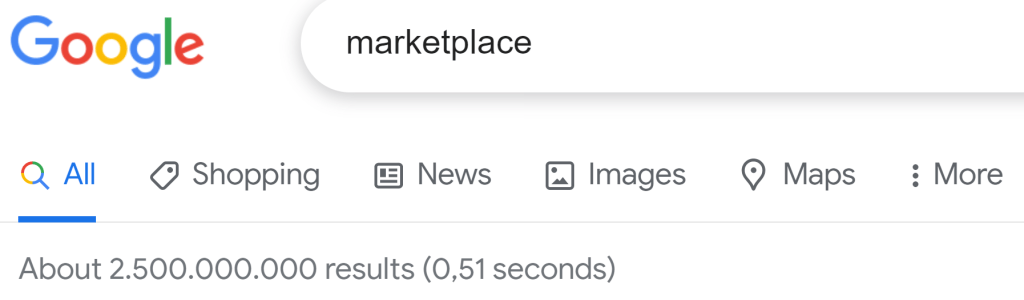
Standard Queries + Utilities analysis: “marketplace“ If you have read all of the over thirty chapters of this book project so far, you may already be able to explain these results much in the same way as I can. Yet since I am by no means perfect, my description of the phenomena is also not perfect — and what is more, I just now realized I have even made a mistake in my analysis presented at SQU data (which I will therefore need to revise). Beyond the difficulty of showing the “full list” of results (actually only the first “SERP” or “search engine results page”), I also made the mistake of not including some local results presented by the “Bing” search engine (since they were obviously faulty) — this also needs to be shown (even if it these results were shown in a small area off to the side of the page). [1]
The choice of the term “marketplace” was in no way haphazard or random. Markets and marketplaces are a central theme throughout the entire “Social Business” story. Beyond that, the term itself is rather generic — in other words: it tells practically nothing about what the user wants to buy or sell. And this directly points to the top result, probably the most significant finding:
Facebook is somewhat surprising, though the company does provide a service referred to as “marketplace”
Our first question ought to be: Why is Facebook shown as the #1 result? Personally, I can think of many results that are far superior to Facebook — especially since Facebook will not show any information unless the user is willing to give the company the company’s required personal data about the user. Another remarkable caveat is that to some degree, Facebook is actually a competitor to Google — since both companies are heavily invested in the online advertising industry. It could also be considered a competitor to Bing, except that Bing belongs to Microsoft, and Microsoft actually also holds stocks in Facebook. What the top results show first and foremost is that all of the companies involved are trading in “PII” (“personally identifiable information”) — personal data about the user.
As an aside, I want to note that I did the SQU analysis using Edge (which is software managed by Microsoft). Normally, I use Firefox, because it allows me to more easily manage how much PII I am willing to share online (via my browsing behavior).
The intriguing question that remains from this first result is why Google would be willing to hand over their own user to this second-rate result — which is actually a competitor? My hunch is that Google is actually happy to be rid of this user, because a user searching for such a generic term as “marketplace” cannot easily be sold to any other advertisers (as, for example, on mainstream media websites displaying Google Ads, or on any other Google sites such as YouTube). I might speculate even further and go so far out on a limb as to say that perhaps Google expects the user’s experience to be so poor with this #1 result that they would return to Google — which of course makes no sense whatesoever, unless the user decides to choose another term … which Google could then (presumably) more easily sell to advertisers.
Which brings us to the title of this post — a lengthier but more exact statement than “the market price is always right”. Is Facebook paying any money to show up as the #1 result? Presumably not, as this #1 result is not displayed as an “ad” (or “sponsored result” or whatever). Is Facebook perhaps paying for this placement with any user data? It cannot be completely ruled out, but I would consider it quite unlikely for competitors to share data with each other. What I think is most probably the case is that Google, recognizing that they cannot make any money from this user, is willing to use the data they collect directly from the top 10 results links on this SERP to further refine the next results Google presents to this user (should they return to Google at some point in the future — whether in one or two seconds or in one or two years … machines don’t care, because machines never forget [2] ).
What about the other results? For most (indeed quite probably for all of them), the payment to the search engine comes in the form of a combination of ads and PII (user data). Ironically, I think many website developers view the data they give to so-called “analytics” companies as a way to “optimize” their standing in search engines. There is virtually no one who will point out the fact that surrendering user data to the analytics company (which is usually the same company that develops the search engine, or is perhaps simply closely linked to that company) is a kind of payment to the search engine (in data units, rather than monetary units). This becomes a reinforcing feedback loop, in which developers hoping to improve their website rankings are motivated to give ever more user data to search engines — and indeed, the search engines are also incentivized to rank websites highly which provide more information about the website users to the search engines.
Now let me cut to the chase. There are many possible takeaways and follow-ups to these insights. The first one I would like to present here and now is what I will refer to as Socio BIZ Rule #2:
There is no general market price — market prices vary according to marketplace (i.e., whether a marketplace is well-suited to the good or service in question) … and (ceteris paribus) online marketplaces are characterized more by topical focus than by geographic location.
[1] I plan to make these revisions before publishing this post
[2] Another interesting aside regarding this comes from an exchange I had with Pierre Omidyar (the founder of eBay) a long time ago about trust — whereas I maintained that I would extend trust based on just a few weeks of historical evidence, Pierre noted that his experience with eBay led him (or rather his company) to a much longer term historical analysis of trustworthiness. Note, however, that my flippant phrasing here somewhat unintentionally draws attention to the (infinitesimally small) cost of data storage.
-
With or Without Advertising
In the previous two installments, we investigated worlds with and without advertising. Now let’s begin trying to discover which world we prefer to (or choose to) engage in.
Essentially, this boils down to choosing whether we want to receive one message at a time, or whether we would prefer to receive two messages at the same time. Much like two people talking at the same time, the result is normally completely confusing or it ends up being a matter of the louder voice drowning out the quieter voice.
Usually, the people running the advertising fun-house (in the vast majority of cases online, this is Google) are very strongly financially motivated to make the advertisers’ voice come through loud and clear — and indeed, a big part of their technique involves spying on their so-called “users” around the clock, so that they already have a pretty good idea of which users are craving for what. As a simple example (for which I have absolutely no data to support my hypothesis), if they know that a user has been traveling for several hours in a car then they might offer the user something that also enables a “bathroom break”. Whether that solution is good for the economy or whether it involves any moral or ethical issues is not important — what’s important is that Google got the user to react to an ad. [1]
Of course the user is not allowed to notice this. If the user noticed this, Google would be a financial failure. FYI: It isn’t. And it really doesn’t matter which of the leading propaganda companies we’re talking about, because they all use the same modus operandi: gently nudge the user towards the hook (which might not even be the propaganda company’s own hook — they are very willing to point you in any direction whatsoever, as long as their “guidance” [2] leads to profit maximization for the propaganda company).
As I tried to point out last week, the cases in which there is no advertising are now few and far between. This is not surprising, because it seems much easier to motivate people to click on some bogus sensational bullshit headline in order to sucker them into signing up for some free deal or similar once-in-a-lifteime opportunity (or at the very least the manipulation engine can collect data on the types of bullshit headlines they click on, what ads make them look twice, what other deals might work better the next time around, maybe in a second or two).
Without such distractions and trickery (and first and foremost meticulous tracking), it beomes much more important to message clearly, and also to be very selective from the beginning. Any negotiation involving a varible X requires agreement regarding X. In the advertising case, the user types X into a search box, and doesn’t really care whether that leads to Y, because Y doesn’t seem too bad, either.
In the non-advertising case, X and Y represent distinct communities. Those who care about X engage in an X community (or in many X communities), and those who care about Y engage in a Y community (or in several Y communities). Since most people have numerous interests, they also engage in numerous different communities. As I noted last time, these communities are also connected via semantic networks — basically, links between communities, community members, and so on. Every member is free to engage or disengage from every community, and the community’s organizaional overhead is maintained via the community’s membership fees. All free content is supported by the community’s “outreach” interests.
[1] Of course, this view comes from taking the manipulation engine’s perspective. Users — if they are literate (and rational) may have different priorities (see also Socio BIZ Rule #1 [ https://socio.business.blog/social-business/social-business-regulation-introduction-socio-biz-rule-1 ] )
[2] For more about such rather questionable “guidance”, see in particular “Herding Millennials” [ https://connect.data.blog/2020/09/16/herding-millennials-a-new-agenda-for-tech ]
-
Publishing Without Walls
Picking up the pieces from our previous installment (“A Deep Dive Behind the Editorial Wall“), let’s consider what publishing looks like without walls.
My hunch is that there are a lot of people who are completely unfamiliar with the idea that it is possible to publish something without some kind of advertising — and here, again, I guess I need to remind some readers of its duplicitous nature (if this is new to you, please go back and check out some of the basics involved).
Without attempting anything like a historical overview, let me go back just a few decades to note that one of the landmark establishments of print publishing were directories — first and foremost the ubiquitously well-known telephone directory. My hunch is that originally these were maintained by and large by the telephone companies, which were sort of responsible for a variety of telephone services. Maintaining a telephone directory — especially the so-called “yellow pages” was discovered to be a quite lucrative business … and note that one could argue that it was based on 100% ads (if it weren’t for the fact that there was indeed absolutely no non-advertising content). In a quite similar vein, websites like ebay and craigslist are viewed exclusively for the paid content (ads) — and there is practically no other content available. I predicted long ago that natural language sites would ultimately become more reliable sources of information than brand name sites — and indeed, even today, the most well-known brand name site (Google) cannot ignore a site like hotels.com when people search for “hotels” (and the number of such examples has been consistenly and constantly increasing).
Yet this isn’t the end game. Increasingly, these topical sites will become more nuanced and differentiate a wide variety of stakeholders participating with a wide variety of aspects related to the central topics of engagement. In the long run, sites will organize into networks of semantically related activity (to stick with the previous example, e.g. “hotels” and “travel”). Again, in the long run, brand name sites like Google will not be able to compete with natural language. Most of the leading brand names online have woken up to this fact, and in a “last ditch” effort many of the brand name companies have even attempted to own language (the two largest registrants of proprietary TLDs [see also “Auctions + Markets for Domains, Domain Names + TLDs“] are none other than Google and Amazon). Apparently, these companies intend to dupe enough “suckers” into believing the TLDs they own are not owned in order to exploit the suckers even more. Natural language cannot be owned — it simply routes around attempts of ownership.
As a result, we now find ourselves at the cusp of new interpretations of many business ethics. Exploitation is no longer the ruling mantra. I believe the future will increasingly belong to organisations which pay attention to the way everyone is a stakeholder, everyone is engaged (more or less), and ultimately, everyone is increasingly focused on sustainable solutions that answer questions such as “how would we like to deal with this situation?” (see also Chapter 21, “Social Business Regulation: Introduction & Socio BIZ Rule #1“)

Social Business (WordPress weblog)
 Socio Business blog