-
Order + Dis-Order
My thinking about the complexity of the world was significantly influenced by a book recommendation I followed up on about a decade ago. It was summer, so one of my friends asked about influential books … and a friend of hers mentioned “The Social Construction of Reality” (by Berger & Luckmann). I decided to read it and was completely “blown away“.
While I often try to state things simply, I am fully aware that the world we live in is neither simple nor straightforward. Let me offer an example I dreamt about a couple days ago.
In my dream, I was attending some kind of event having to do with open source and open organizational structure. One guy there was repeatedly talking about trends and trendy words were bandied about like there was no tomorrow. Different streams of thought were jumbled in quasi-word salads and I noticed that the guy who was attempting to bring order to the mixed-up confusion was up against a rather daunting task — namely the lack of authoritative, valid and reliable texts. All of the mumbo-jumbo was sourced from the shifting sands of the world-wide web. Traditional publishing was nowhere to be seen.

Image from the film “Manufacturing Consent”, a documentary about Noam Chomsky’s work Noam Chomsky’s work in the field of propaganda and manipulation focuses very much on the role of traditional publishing. And publishing industries have themselves been traditionally intertwined with many other industries and also interwoven with most (if not all) of western capitalism.
Let me add in a little bit of historical context here. We now have about five centuries of publishing industry — yet publishing five centuries ago and publishing today are quite different things. For example, when Martin Luther proposed schools and libraries in order to promote literacy, that may have been interpreted as dangerous and controversial. When I talk about literacy, I am no longer concerned with print (paper-based) publishing. I understand why Noam Chomsky points to media like radio and television; increasingly, I point to the languages of algorithms. Yet to bring it back to “mass media“, the basic technology has not changed very much: Five centuries ago, the media were images presented in churches; today the media are images presented on paper, on screens, in trademarked logos … of companies steeped in western capitalism … brought to you by … western civilization.
This is, by the way, the same organization that brought on global warming, corona, the military industrial complex and all that jazz. So when you kick up your heels on the front porch and throw back some refreshments, think a little bit about who is really financing the bombs being dropped on Ukraine.
-
Know “No”
Today I would like to simply share a rather straightforward insight: politicians rarely — if ever — say “No”.
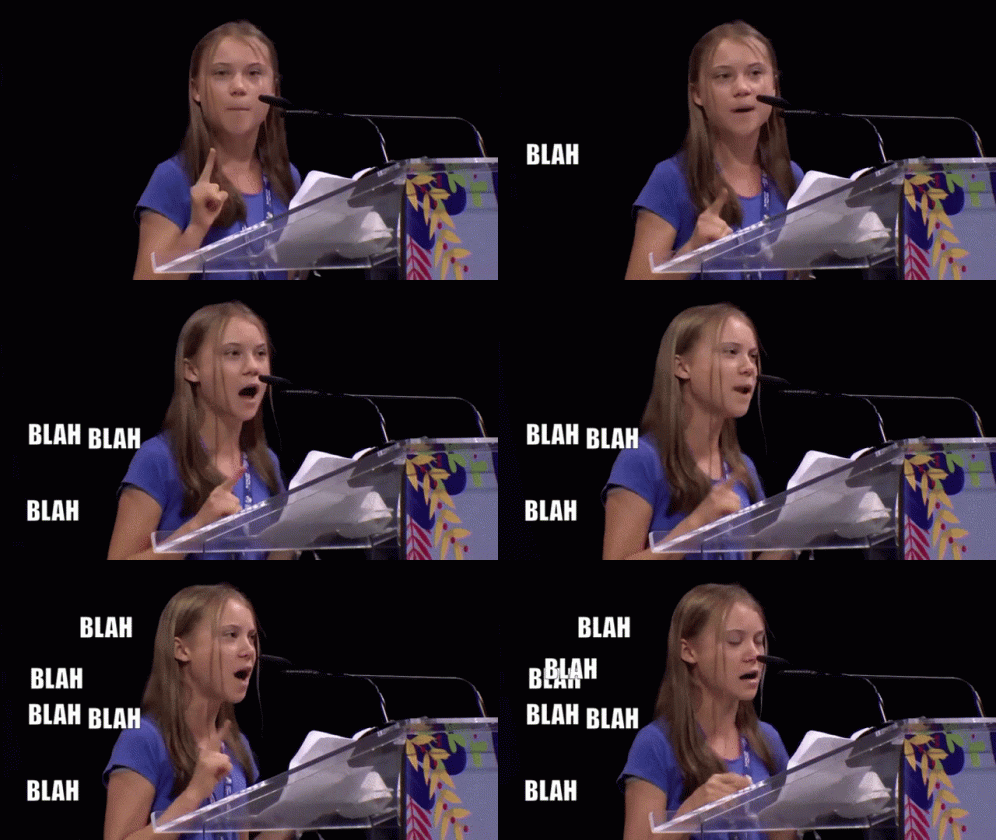
Greta Thunberg image source: https://tenor.com/view/greta-thunberg-gif-23254392 The way normal people can nonetheless identify and recognize a politician’s opposition to an idea is as follows:
The politician will say “Yes” — and commit to this yes in the very far-off, distant future … to some time far past the politician’s own life expectancy (or in any case far beyond the politicians career plans) — this is essentially, for all practical purposes, a “no” (“not in my lifetime”).
In case anyone is in doubt, they can usually quite simply check if any short term goals align with the politician’s purported long-term plans. If the short term goals contradict the long-term plans, then the long-term plans are simply bogus.
-
Chaos vs. Reliability
There is a very widespread prejudice against dependence. Dependence is generally considered to be bad, and independence is generally considered to be good.

Santana 3 [source: https://www.pinterest.com/pin/339669996866725121 ] A little over half a century ago, a musician named Carlos Santana published a song called “I Ain’t Got Nobody (That I can Depend On)” (or simply “No One to Depend On”). The lyrics to the song are pretty much just that text– repeated over and over for several minutes. Of course there are also musical instruments, and also some Spanish words are uttered too. What’s particularly remarkable is that it seems to me that the song offers an iconic and quite different perspective on dependence. Here, dependability is heralded as an ideal.
Likewise, there is quite widespread appreciation of natural sciences, the scientific method and such as being very dependable. Nature as an object of interest is appreciated at least in part for its predictability. It follows natural laws. You can’t change the laws of nature.
On the other hand, it seems like you can indeed manipulate the prejudices of humans. For example: if you make a national holiday and call it “Independence Day”, you can thereby influence patriotic people to admire independence. Never mind the kinds of conditions humans need in order to live healthy lives, if humans do not pledge allegiance to independence, then there must be something wrong with them, right?
-
The further on I go, the less I know
Wittgenstein had a saying about “die Grenzen meiner Sprache”, namely that these correspond to “die Grenzen meiner Welt”. [1]
In my not-so humble opinion, this quote misses something very fundamental about language: that it does not exist in any “particular individual” (see also the previous post, “Self Mythology“). Language is a technology that exists between / among (groups of) individuals. Since “the word” (and language) play(s) such an integral part in the Bible, I also assume there is this element in Jesus’ saying about “whenever two (or more) of you gather in My name”.
Similar to the way I mentioned (in the previous post) that languages seem to force us to segregate ourselves from the rest of the world, when I use the word “technology”, it seems to imply “invented by humans“. Hence, I am really quite “on the fence” about whether I should refer to language as a technology or as a natural phenomenon. Yet I am also open to entertaining ideas such as genetic information being expressed in a language, and even referring to such natural phenomena as technologies — quasi invented by evolution.
Wittgenstein also had another quote about the world being whatever is “the case” (or actually true, or something like that) — sort of indicating that it’s actually not possible to consider something which doesn’t fit into the molds our languages have prepared for us … e.g. it is only possible to think of a “unicorn” if we already have such concepts as “horse” and “horn” at the ready.
In the heyday of Kurt Cobain’s Nirvana, I had a different album playing virtually nonstop on replay: Peter Gabriel’s “Us” — and the title of this post is from a recurring line in the song “Only Us” … . What if there were no “them”? Mr. Gabriel apparently couldn’t avoid referencing the self, or an opposite “you” … and still there lingers this notion of a universal “us”, which is also alluded to in Wittgenstein’s universal world-is-whatever-is-the-case.
Whatever. Never mind. 😀

Screenshot from “Smells Like Nirvana” (by Weird Al Yankovic) [1] “Grenzen” (as pretty much all words) can be translated many ways — here I would offer the alternatives “the limits of my language / world” and / or “the boundaries of my language / world”.
-
Self Mythology
This week a person near and dear to me used a particular term in a rather peculiar way … which I feel is at least odd, which I do not subscribe to, and which also seems confusing and misguided (from my point of view). Yet I cannot call it “wrong“, judging by what I can document from terms in modern usage:

source: https://www.urbandictionary.com/define.php?term=Individual This modern usage of the term is in contrast to the classical usage, which simply means (something like) incapable of being divided. I feel I understand this modern usage, but I find it odd nonetheless. This modern usage is not completely new and perhaps also not completely improved just recently. For example: the term is featured in one of my favorite movies from about two decades ago:

A particular individual (“Not Sure”), from Idiocracy (2005) see e.g. https://archive.org/details/Idiocracy_201507 Ironically, this movie seems to emphasize how strongly outcomes for individuals are actually much more interdependent on one another rather than they are independent of one another. This is also something I came to realize a long time ago — yet which seems to contradict the “self-made” ideal so strongly held by many (especially Americans).
I have a hunch that our own languages predispose us to think of such a “self mythology” — as if we ourselves exist, as if we could rely upon our selves to continue to exist, as if it were impossible to deny our own existence. I do not mean to deny my own existence, but I do find it rather odd to think that maintaining my own existence might be undeniable. In contrast, I consider it difficult to fathom how to deny that I will at some point no longer exist, or that once upon a time I did not exist yet, and so on. I also do not consider myself to be “self-made”, unless perhaps I were to consider my environment to be a part of myself … yet this is where language sort of “gets in the way” and forces me to recognize boundaries between myself and the rest of the world.
See also “Inter-Reliance, Self-Dependence & Responsibility” and also the “about” description on the homepage of http://wants.blog
-
Swarming Around

On the verge of solstice [1], let’s consider time some more.
Amidst the bees buzzing around here and there, ideas have also been swarming around in my mind.
First and foremost: it seems like swarms never die. Individuals die, swarms live on forever (more or less). Sure, extinction will do in a swarm, but isn’t extinction the exception, rather than the rule?
I recently heard a podcast, in which some sort of well-known physicist (whom I had never heard of before, which isn’t saying much), said one of the questions that often occur to physicists (of the astronomical sort, I guess) is “why is there something instead of nothing?” At that moment it occurred to me that this probably became a fascinating question after the Big Bang. Before the Big Bang, the fascinating question would have been: “why is there nothing instead of something?”
Back to swarms.
Apparently, since some people refer to whatever it is that “swarm intelligence” is supposed to refer to, this “swarm intelligence” (whatever it is) must be a thing. Does that make sense? Or is there perhaps a bee buzzing around somewhere in my skull?
I think I should just give up on any notion of knowledge and rather plainly state that my gut feeling is that intelligence (whatever that is) is based on learning from experiences. Generally, such learning is therefore based on a statistical attitude — as in: “4 out of 5 dentists agree that getting punched in the mouth may very well negatively affect your ability to chew meat”. And also in a less professional manner: letting go of stuff generally results in the stuff falling down, so intelligent beings generally don’t haphazardly let go of stuff they would rather keep (also known as: “hold on to”).
This sort of alignment between “scientific” statistics and “popular” opinions reminds me of the smash hit belief in “The Wisdom of the Crowds”, which was sweeping the globe about two decades ago. I responded with my own “Wisdom of the Language” approach [2] — and there is indeed a point of overlap between the two approaches: the popularity of a language does seem to give it some kind of credibility.
[1] Doesn’t it seem odd how one solstice might be considered differently than it’s opposite? Likewise, why is Australia considered to be “down under”? I could perhaps ask more questions, but let’s not get sidetracked, OK?
[2] For more about this, see also http://indigenous.news.blog
-
Lifetime Guarantee for How Natural Languages Scale
In the last episode, we looked at a few different scales — implicitly, from technology and product life cycles, through writing, biology and genetic information all the way across the universe back to the Big Bang itself.
Seen this way, the irony of seeing writing and written langages as something permanent becomes crystal clear. Perhaps the only thing more ironic is pretending to rely on techologies which reach the end of their life cycles in less than a couple years, let alone a couple generations (of homo sapiens).
Speaking of humans, while it should now be obvious that so-called “natural” languages do not scale across time very well, they do scale rather instantaneously across humans and humanity. While it takes just a few years for a human to acquire native language(s), communications and understanding using these languages are hard-wired throughout a human’s lifetime, they are the operating systems that seem very much the fundamental firmware … unquestionable, hard as rock, rock-solid.
Of course, when we look at natural languages meticulously, we can see variations of dialect, across generations and many more nuances. Yet these variations pale in comparison to the power of soundbite truths touted to millions (if not billions) of humans — day in, day out, over and over, drummed into the unconscious minds and repeated not only daily but also every night for hours on end in our dreams.
While billions (if not trillions) is invested in brand names [1], words flow out like endless rain across humanity — completely free of charge. Perhaps not all words, but in any case soundbite words. How many words? Which words? …? It depends — mainly on the nature of the communities within which the natural languages are indigenous (see also https://indigenous.news.blog ).
[1] cf. discussion about GARM (“Global Alliance for Resposible Media”) @ “Brand Safety” [ https://find.news.blog/2019/07/20/brand-safety ]
-
Rates of Evolution
Evolution is often thought of as a single thing. Yet’s it’s not even a thing at all — it’s a phenomenon, a figment of our imaginations, one way that we interpret the world we live in.
It is perhaps one of our most abstract scientific concepts. At the same time, no one even just somewhat versed in evolutionary theory would be surprised in the slightest were to mention how important generations are to in evolutionary development. Some organisms live less than a day, others can live thousands of years, … I myself view all of nature as alive, so perhaps universes regenerate themselves on the scale of billions of years (or more?).
I would be lucky to make it to 100 years (sometimes I joke that I would only be upset if someone misses my “galactic” birthday, by which I do not mean some astrological phenomenon but rather when I become 1 “galactic year” old 😉 ).
Let me now address why I chose this topic today.
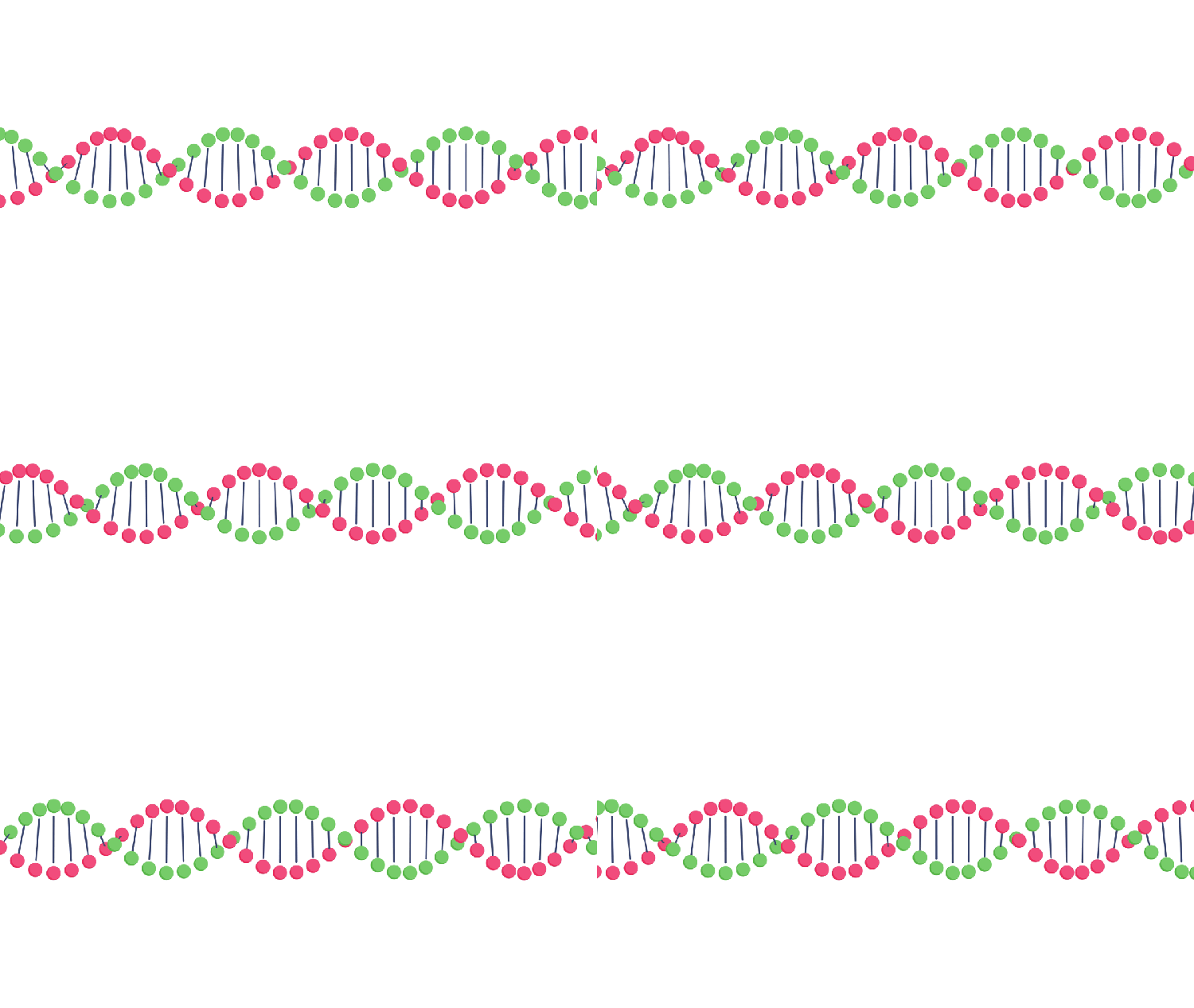
We interpret genetic information as a codified natural language [image source: https://blog.helix.com/what-does-dna-stand-for ] Today, many, most, perhaps even all linguists recognize that natural languages are also living phenomena, and that languages also evolve over time. When I studied linguistics in grad school, I had a disagreement with one of my professors (in “diachronic linguistics”) regarding whether it is possible to practice diachronic linguistics on anything other than a written language. I believe it’s impossible to practice diachronic linguistics without recording data in some kind of codified writing system. He did not understand my argument, and insisted stubbornly that the work of a diachronic linguist is indeed focused on spoken language. Maybe my argument is indeed invalid, but I did not abandon it, I still refuse to abandon it, and it is for this reason that I cannot maintain to have achieved a master’s degree in Linguistics. At the time of the disagreement, I questioned how such a piece of paper might impact my life … and I came to the conclusion that it was not worth losing a lot of sleep over.
Nonetheless, to this day humans have a reverence towards this abstract notion of a language as being something permanent. There are certainly traces of language that seem to evolve at different rates from other traces. At any rate, only a fool would believe to understand Socrates or Plato — we merely interpret what we believe they meant according to our own current language and our own corresponding understanding. Let alone all of the thoughts that were never even written down.
No less foolish are the astronomical sums spent sending space ships into the vacuous ether with audio recordings or similar hare-brained notions of intelligence.
One of my friends joked to me yesterday how he wishes back the bygone days of natural intelligence!
-
Mainstreaming vs. Mass Throttling
This week I am very much under the influence of a few podcasts which address (or “report” on) topics I find fascinating, yet which are not directly in the “wheelhouse” of my interests.
The topics covered, while somewhat similar, seem rather unconnected (apart from both being related to my own interest in such topics as propaganda and manipulation).
The more recent episode covers an issue referred to as the “Censorship Industrial Complex” — which can be succintly summarized as the following phenomenon:
In the absence of these (sort of) media gatekeepers, that they now don’t have anymore … they’re replacing them with these “tech” gatekeepers — to (sort of) go from the supply side to the demand side and throttle on that side instead.
“LEIGHTON WOODHOUSE EXPLAINS THE CENSORSHIP INDUSTRIAL COMPLEX” https://www.podcastone.com/episode/E232-Leighton-Woodhouse-Explains-Censorship-Industrial-complex [ 27:00 – 27:20 ]This is discussed both at length and also in detail in the podcast episode [1], and so I will not even attempt to reiterate the many details of the mechanisms involved here, other than to note that the algorithms employed seem to not only decimate (i.e. reduce by maybe about 10%), but nearly annihilate (i.e., more like a 90% reduction in) free speech. This is, however, merely my “gut reaction”, since it is actually *impossible” to assign such quantitative statistics to these operations. Nonetheless, when I decades ago referred to Google as the “Pope of the Internet” [2], it likewise seemed to me to be a “shock and awe” situation of unfathomable scale. To now hear such reports that such censorship is actually taking place on such a huge scale is definitely shocking but not at all in an “awesome” way.
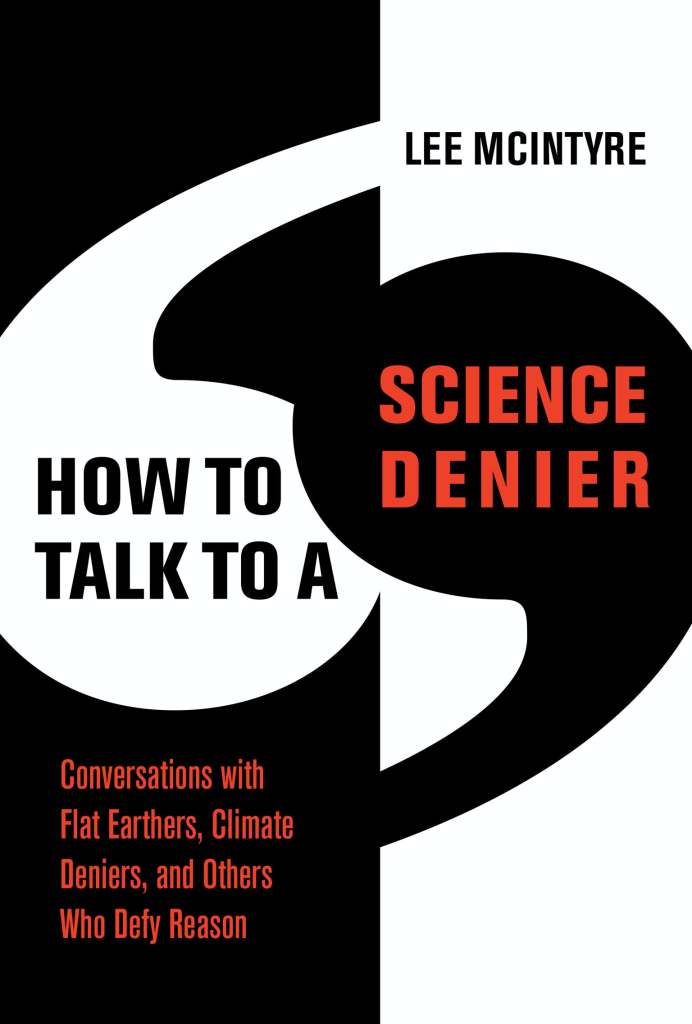
“How to Talk to a Science Denier: Conversations with Flat Earthers, Climate Deniers, and Others Who Defy Reason” By Lee McIntyre [ https://mitpress.mit.edu/9780262545051/how-to-talk-to-a-science-denier ] Another podcast episode I wish to draw attention to in this context is more about mainstreaming than it is about censorship — and this episode is probably at no risk whatsoever of ever being censored. In contrast, it is itself quite obvious a mainstream product. Alan Alda, a mainstream celebrity, interviewed Lee McIntyre about a book he published, named “How to Talk to a Science Denier”. Lee McIntyre himself notes that:
I started my book with a quotation that’s attributed to Mark Twain: “It’s easier to fool someone than to convince them that they’ve been fooled”.
Lee McIntyre: Talking to Science Deniers [ https://archive.org/details/qll4jnxpstuwqn6yggwpvf8fashfjx7pevhyr8ry 13:15 – 13:25 ]What I find most interesting about this episode is that these two “science advocates” both acknowledge that the tactics and techniques the employ are very much the same as the approaches used by so-called “science deniers”. Indeed, the discussion is much more about the science of manipulation (and propaganda methods) than it is about advocacy and /or denial.
You don’t want to close the deal in a conversation. You don’t want to get them to admit they were wrong. You want them to start to doubt and walk away and then their own brain will work on it and then later they will come back and say “I guess you were right”.
Lee McIntyre: Talking to Science Deniers [ https://archive.org/details/qll4jnxpstuwqn6yggwpvf8fashfjx7pevhyr8ry 21:42 – 22:00 ][1] The “Censorship Industrial Complex” is also elaborated even more in another podcast episode, namely: “Mike Benz: From Tanks to Tweets” [ https://public.substack.com/p/mike-benz-from-tanks-to-tweets ]
[2] See e.g. www. quora.com/How-is-trust-in-Google-similar-to-or-different-than-trusting-the-Pope (which I also cited in “Decentralization of Marketplaces“)
-
Motivational Characteristics of Marketplace Participants

I have thought about issues related to “Motivational Characteristics of Marketplace Participants” for quite some time already. Although that title is already quite long, I think I need to narrow down what I intend to write about today even more.
I want to contrast two instances of marketplaces — one from the past, the other from the here and now. They are in fact quite similar — and some might even argue that one has been replaced by the other — namely it almost seems as if “Yellow Pages” have been replaced by “Google”. Both of these institutions seem to resemble natural monopolies. Yet they are also quite different in some respects: whereas “Yellow Pages” (and similar business directory organizations) made money by listing companies in their directories, “Google” (and other brands considered to be so-called “search engines”) usually make money by collecting and selling information about their users (in most cases — but not exclusively — to companies who pay Google to target these users with targeted advertising).
One very significant difference between traditional business directories and so-called “search engines” like Google … which exists on a very fundamental level is that while Google is a “one size fits all” offer, business directories tend to be more focused, specialized and specific. This can be a matter of geographic localization, or it can be a specialization in particular market segments or a wide variety of aspects. Such specializations are often also reflected in the languages of the people who participate in the corresponding communities — whether that is a local dialect, or a professional jargon or some other kind of language variation.
In contrast, machines and machine learning systems like Google attempt to apply simple algorithms to each and every case, regardless of variations that could be meaningful in specific cases. For example, many people can easily and obviously observe such simplistic (or oversimplistic) solutions when they see an algorithmic translation of text regarding a subject in which they have some specialized knowledge.
Ironically, there seems to be a lot of interest in so-called “large language models” in the field of so-called “artificial intelligence”. Over time, I expect the main insight real people might gain from such algorithms is that machines can create a whole lot of text simply by combining sentences like “see spot run” and “there was a run on the market” to create more (and even longer) press releases no human being with a rational brain would ever waste a single second to look at.
Then again human beings are indeed not very interesting for companies like Google. Their main motivation for business is to maximize profit, and as long as they are able to find enough suckers who are willing to give them more money for useless crap, then making more useless crap will continue to be a winning business strategy.

Social Business (WordPress weblog)
 Socio Business blog