-
If Google is the Pope of the Internet, Then Who Are You & I?
I’m sorry that this week’s installment is a little bit later than usual, but I have been experiencing some technical difficulties. As far as I know, these technical difficulties have to do with censorship … insofar as someone or something seems to be trying to censor me. Yet I refuse to relinquish — much like Martin Luther did a half a millennium ago, so too I aim to persist in speaking my own truth … and if more or less powerful institutions try to silence me, well, I consider that to be their choice, not mine.
So here comes another episode of Socio BIZ uncensored (at least I hope so 😉 ).
Today’s metaphorical image goes back at least a decade (I think). Back then, there was another new & improved website online, named “Quora”. For a while, I enjoyed playing around with it, kicking the tires, pressing the buttons, bells and whistles, and checking it out to see what happens whenever I did. I even asked a question back then that went something like “Is ‘quora’ the plural of ‘quorum’?” … but the answers I got were generally too highfalutin for me.
Another question I asked went like this “How is trust in Google similar to or different than trusting the Pope?” (I haven’t visited or used Quora in ages, but I think the URL might be https://www.quora.com/How-is-trust-in-Google-similar-to-or-different-than-trusting-the-Pope ). In my opinion that question was more serious, but perhaps it was interpreted as less serious. My own favorite answer I considered to be simply funny, whether serious or not (I think it was something like “The Pope gives you free bread and wine, but Google doesn’t”).
I guess it should be quite clear that when I asked the question, I already interpreted Google to be “The Pope of The Internet” — and I still believe that to be true to this day.
Recently, I wrote to an acquaintance in an email exchange that I consider myself to be sort of the web 2.0 version of Martin Luther … and then I started wondering if that is the appropriate analogy or not. In this vein, I also considered: “well, then who is Gutenberg 2.0?”
Just this morning, as I was chatting with friends about the latest attempts to censor my ass (does anyone here get the pun / joke, since I consider myself to be similar to Martin Luther?), I came up with the following setup.
If Google is the (metaphorical) Pope of the Internet, then everything / everyone else falls into one of three (metaphorical) categories:
- Martin Luther (protestant, reformer, revolutionary, etc.)
- Johannes Gutenberg (scientist, technologist, entrepreneur, etc.)
- suckers (bandwagon followers, mitläufer, opportunists, etc.)
Which category are you — or is there another category that might suit you better?
Maybe I ought to also consider categories like “capitalist”, “marxist”, “industrialist”, “slave”, etc. — but let’s put such questions off for a bit, or maybe even for a while.
-
Who is Free to Choose?
I distinctly remember my father telling me to watch TV once — or rather: strongly recommending me to sit down and watch it together with him (and whoever else in the family happened to be around).
It was a very special event: PBS was doing a series with Milton Friedman, called “Free to Choose“.
We were not especially patriotic Americans, but being anything else than entirely behind free market capitalism was pretty much out of the question. This series (here at socio.business.blog ) of meditations opened with (and continues to be about) a paradox: how do we balance freedom and regulation? (see “What is the Primary Goal of Social Business?“)
Milton Friedman (whether he realized it or not) stood in a long tradition of freedom-lovers — including not only Adam Smith, but also Immanuel Kant and Martin Luther. Yet Martin Luther also passionately argued for schools and libraries in order to promote literacy. Although Luther didn’t live long enough to witness the fruits of his “promo” work, today few people would say that acquiring literacy is a “natural” result of some kind of libertarian devotion to liberty, liberal ideals or perhaps even something anarchic.
Today, education is usually a compulsory matter. Many years ago, I wrote an article (I think also @ socio.biz ) in which I pointed out that schools are “establishment” institutions (I think this was even long before George Carlin’s popular bit about “obedient workers”). In any case, we are a far cry from free to choose the world we grow up in. In sharp contrast, we are far more fatalistically fixated by our fates.

BIC Browser technology (see “The BIC Browser is Watching You“) In order to be truly free to choose to visit websites not approved by BIC browser technology, people need to have enough literacy skills to realize that exercising their freedom to NOT be watched over by a nanny-state or similar governmental regulation is still a matter of being educated enough to act in such an enlightened manner.
Self-education is as ridiculous a concept as is the idea that language might exist inside an individual. Languages exist between (and among) individuals. Freedom and regulation and literacy and many things more are all social constructs.
Well, at least in my humble opinion (which is fundamentally based in a “more or less” degree of humility 😉 ).
-
Please Don’t Make Me Think
Thinking is hard. It’s much easier to just let someone tell you a story and when you hear the same old story over and over again, then it will probably begin to ring true.

Image source: “The Power of Familiarity” (episode 10 of “Psychology Vidcast with Dr. Ross Avilla” @ psychologyvidcast.com [?] ); some popular video platforms may have a copy of this video (with added promotional advertising?) using the title “The Psychology of Repetition” This is neither a new insight nor is it rocket science — it’s something a scientist from a long time ago documented and to this day we recognize his contribution to the science of psychology (and in particular the so-called cognitive science [and / or engineering] of “conditioning” relationships between stimulus and response) with the term “Pavlovian”.
Such principles about how the natural evolution of brains has given us the brains we have are generally considered to be completely due to the workings of nature, natural selection and stuff like that.
And yet, at the same time science is also evolving. There are now vast areas of science, classified as “social sciences”, which perhaps even just a century ago might have been considered to be ridiculous farces, hoaxes and maybe even conspiracy theories.
And there’s even more: there are now large portions of industry devoted to building Pavlovian machinery. What is particularly weird about this development is the degree to which our focus seems to be less and less on “nature” and more and more on “social” phenomena.
I recently started a new blog called “Compelling News” to consider how humans seem compelled to think a certain way … and to make more or less educated guesses as to what might be compelling them to think that way (see e.g. “Compelled People — What is Compelling Them?” [ https://compelling.news.blog/2023/09/12/compelled-people-what-is-compelling-them ]). The above simple example about “storytelling” is something I am considering, as also far more complex issues regarding stuff like “The Social Construction of Reality” (see also “Human Brain Conditioner“).
You might even say I’m sort of tangled up in it … and this is little more than a quick manner of keeping y’all updated about what I’m up to (to date 😉 ), up in or whatever.
-
How to Explain Ignorance
First thing I want to avoid is mansplaining something:
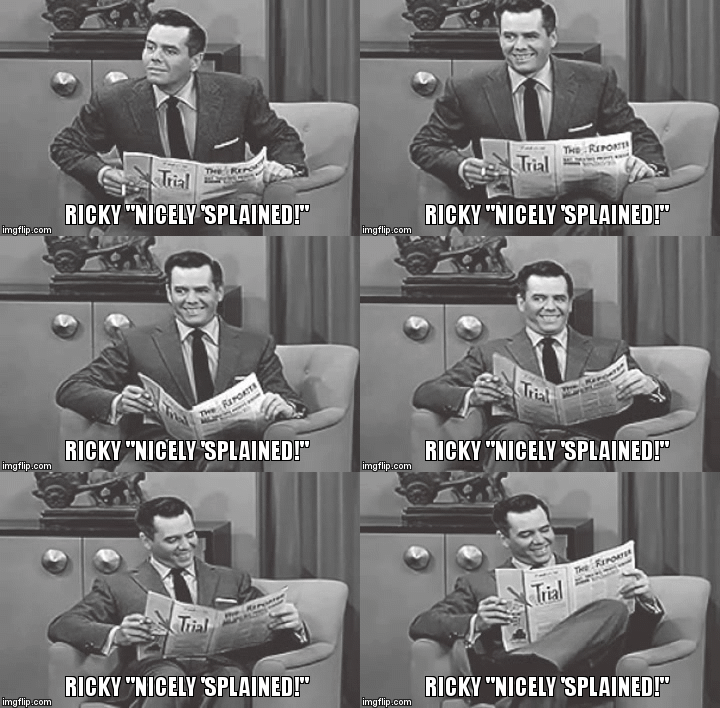
Source: https://imgflip.com/gif/1nkpso Apart from that, addressing the issue of ignorance has many issues, problems and stuff like that. Awareness of ignorance is probably no easier than becoming conscious of what we have managed to repress into an “unconscious” state. Yet I wish to completely sidestep all such matters of psychology.
What I do want to address is the wide spectrum ranging from ignorance through oversight past focus (versus a lack thereof) to neglect and beyond (or whatever) … we seem to be aware of our own ability to tolerate some thoughts and ideas … more or less.
I’ve already addressed this somewhat in my recent posts related to mainstream media (see e.g. “Do Not Read This” , “Sensationalism, Individualism, Mainstream Media Bait & Switch Tricks” , “Self Mythology” , “Mainstreaming vs. Mass Throttling” and perhaps several others, too). Indeed: this ignorance topic is obviously a recurring theme — perhaps in large part due to the widely available information that humans are apparently shortsighted and easy to manipulate.
Take, for example, the notion that entering a few words into a company’s data collection engine might lead to something fruitful and even “authoritative” … especially when it is common knowledge that that company exclusively makes money from advertising. A business model based in advertising should not be considered a reliable, let alone authoritative source for information related to anything at all. It almost seems as if making a deal with the devil might make more sense.
An advertising agency’s client list is paying money in order to be listed among the results? Such results will not be very heavenly. A listing of crooks and criminals would probably lead to more trustworthy potential business partners.
Now think of all the people, businesses, organizations and such who are NOT to be found among the “Most Wanted” list of results.

Source: https://digital.library.unt.edu/ark:/67531/metadc130058 You can’t?
Maybe the main reason you can’t think of these upstanding pillars of society is because you ignore anything not listed among the “Most Wanted” list.
-
Quick update while slowly drifting out into the zone
I’m living and loving heading out into the zone.
That said, I also want to keep y’all updated on my life, vital signs, all that jazz and so on.
One of the updates I need to share with y’all is that Socio.BIZ is now a supporting member of the Social Skills Network (@ social-skills.net 😉 ).

Social Skills Network In case you missed it, social-skills.net is itself part of the PHLAT (Pretty Hyper Local and Topical) Network. To learn more about PHLAT, please visit the PHLAT News & FAQs blog (@ phlat.news.blog 😀 ).
With that, Imma zone out some more now. B-)
-
X did Y, and I don’t care

There’s nothing more mainstream than Metro (source: https://metro.co.uk/2016/09/29/10-glitter-eye-makeup-looks-for-your-next-night-out-6065532 ); I find it amusing that quite a few of the “Insta”-content is gone (but who cares? The ads are what count, right? 😛 ) I am reflecting on my recent posts over the past couple weeks. Two weeks ago, I described how mainstream media uses “bait and switch” tactics to get suckers to look at advertising. [1] This is usually done with a headline that claims something sensationalist along the lines of “X did Y”. Last week, I went a little bit further out on a limb to speculate about how Silicon Valley companies have gradually (over the past decade or two) formed something like a syndicate to force gullible suckers (with limited literacy skills) to consume massive quantities of mainstream propaganda … because these companies “make money” from thereby selling ads to such suckers.
Most suckers do not even realize that the drivel they’re allowed to read is only a small fraction of the information available on the Internet.
This drivel is so watered down with “brand safe” safety measures that reading such tepid broth is pretty much on par with swallowing a sedative. Each article is an additional dose of sedation. This is how well-read suckers become certified zombies. Brainwashed, spun and dried … the only sparkle left in their eyes is the residue of glitter dust sprinkled there by their robot overlords doing contract work for apparantly benevolent advertisers.
[1] Today, this is mostly done by Google (which controls the vast majority of the online advertising market). By and large, the role of “traditional” mainstream publishers (like The New York Times) is bypassed by Google placing ads on individual articles and giving the publisher a small cut of the ad revenue — this way, Google is able to maximize advertisers’ reach by placing ads regardless of which mainstream publication the individual sucker prefers.
-
Sensationalism, Individualism, Mainstream Media Bait & Switch Tricks
I have and hunch that these three things (Sensationalism, Individualism, Mainstream Media Bait & Switch Tricks) are all linked — as if they were all parts of the same “complex”. [1]
The complex situation I am referring to is the “Bait and Switch” game which most mainstream media organzations engage in. You might think that grown adults would not be susceptible to such trickery, but if you do actually think that way, then you would almost certainly be wrong. It is quite the contrary: sensationalist bait-and-switch tactics are the bread and butter of mainstream media.
Is this simply a natural phenomenon — a so-called “fact of life”?
I don’t think so — let me tell you the main reason for thinking the way I do: Sensationalism builds on a steady supply of outlandish stories.
The sensational story begins with some exceptional individual case. For example: Person A is threatening to destroy the world; or Person B is attempting to save the world. Often, such sensational persons claim to do such sensational acts by themselves, individually, as a “leader” or something like that. And because this seems so fantastic, it also seems difficult to ignore.

Just the other day I was involved in a heated discussion about ignorance. [2] I said that ignorance is always bad. But I do admit that I find it difficult to say that ignoring such manipulative games is bad … or good? What am I trying to say? I am trying to say that if we realize that whenever manipulative experts invite us to participate in a manipulative game, we ought to ignore their offers, free deals, and opportunities to act now.
You may say “very well, OK — but how can we realize that manipulative experts are out to trick us this way?” The answer is actually astoundingly simple: follow the money.
Why does mainstream media exist? Do people go to their workplaces in the mainstream media industry simply because they love to spend their days manipulating things? Or do they get paid to do so? Obviously: they get paid. Well, who pays them? Certainly not the people who are getting “free deals“. The way mainstream media gets paid is that advertisers must pay for advertising. The reason why advertisers are willing to pay for advertising is that this is a quick and easy way to reach gullible suckers to whom they can offer free sales pitches for products and services.
Now let’s punch in some numbers. Let’s say there are a billion people online (more or less). If there are only just one percent crazy people and only just one percent gullible suckers, then that means there are 10 million crazy people and 10 million gullible suckers to work with. This means: Mainstream media can easily rely on a steady stream of crazy people for crazy stories, and the publishing industry can reliably offer the advertising industry an ample supply of gullible suckers who can be (more or less) easily tricked into buying their products and services.
It also means I can (more or less) easily refuse to pay any attention to any of it.
[1] Quite often, the things I write about are precipitated by the things I am currently reading about. Of course, I (just like everyone else, I guess) read about things that interest me. Many of my interests go back many years. So if I mention that I recently read (and reviewed) the article I posted about in “When I see a heading that even sounds a little bit interesting I will start to read the article” [ fuckwith.news.blog/2023/08/03/when-i-see-a-heading-that-even-sounds-a-little-bit-interesting-i-will-start-to-read-the-article ], then I am mentioning that mainly to accentuate how current the topic continues to be these days. These topics have also been written about for decades, if not centuries, but I am not going to start putting book-length bibliographies into single little itty-bitty footnotes like this.
[2] In part, this discussion is related to “Self Mythology” [ socio.business.blog/2023/06/24/self-mythology ]
-
Consumer Culture Technology, Cancel Culture Technology & Other Cultural Technologies (?)
It is now approaching two decades since the company now known as Alphabet started its attack against rational media [1], and at the same time started promoting its own brand names (such as Google). Other companies in the irrational media space have likewise fed mainstream consumers with similar myths regarding their own algorithms. All of this propaganda is spread not only via all of the traditional irrational media channels, but also falls on mostly illiterate ears, as most users of information technology have no idea whatsoever how the tech gizmos they simply use blindly as consumers work.
The so-called tech giants can hardly slow down the floods of cash flowing into their coffers — they are completely awash with advertising money in order mesmerize and manipulate hungry consumers with offers, deals and spending opportunities galore. It is a wonder that they still seem able to spend so much cash, it almost seems like they’re looking for new enterprises on a daily basis, new worlds, new ventures and new expeditions to places where no rational human being has ever ventured before.
As a result, potential consumers are nearly drowning in ads. Since they mostly lack the literacy skills to recognize how they are being manipulated, pretty much the entire advertising industry feels the entire world is hunky dory … except that it’s also becoming more competitive. New and improved algorithms are starting to show up on every virtual corner, increasingly consumers can start becoming more and more comparison shoppers. Slowly but surely neither Main Street nor Madison Avenue are the only shop in town any more.
Bells and whistles, ding dongs and bright lights are now virtually everywhere. Content now flows in all directions, from every direction, and the race to bargain basement prices is on — look for many more sweat shops coming soon to a theater near you.
So far, I see this mostly happening behind the closed doors of so-called “proprietary” institutions … but some recent developments in leading open-source communities are also worrisome at least. I hope and also expect that course corrections will happen, but I do not rule out the risk that open and transparent information (which “wants to be free” [to move like water] ) may at some point be stuffed into a pipe and brought to you by some new and improved irrational media company.

Image source: https://wallpapersafari.com/pink-floyd-the-wall-wallpaper In the long run, irrational media will fall to cancel culture — we don’t need no propaganda. Yet before we reach that point, we may very well have a very long trek of whack-a-mole wars ahead of us. Any company willing to bet on illiteracy as a long-range plan would probably do well to consider how the Roman Catholic Church had to revise their game plans after several centuries of death, destruction, wars, bloodshed and overall general turmoil.
I do not for one moment doubt that in the long run, literacy will win against illiteracy. But perhaps another path will open up — perhaps yet another new and improved technology?
[1] More discussion of rational media vs. irrational media can be found here via the tags “rational media” and “irrational media“; for more background about these concepts, see also “Hope & Change: Flipping the F-word & Removing the Old-Fashioned R-word” [ http://remediary.com/2020/11/06/hope-change-flipping-the-f-word-removing-the-old-fashioned-r-word ]

Social Business (WordPress weblog)


 Socio Business blog