-
Science vs. Technology
Believe it or not, this is where I want / need to address in a first step toward working out the “digital divide” concept I introduced in “More about Modes and Levels of Literacy>“.
When I was young, I always thought science and technology were aligned, and that engineering was all about this sort of alignment. I guess this may still be true in the ideal case. Yet I also want to talk about the real world here and now.
Ever since the world has become populated by billions of people, government and regulations have become more significant. Centuries ago, I guess people could easily live quite free of governments and laws to govern them, whether deep in the woods, out on the frontiers or sailing out across the high seas to virtually uninhabited new worlds. Such wide open space is now long gone on Earth.

Today, one technology every living person needs to pay attention to is the legal system. In some countries, the legal system can be quite complicated or even downright complex. One of the legal systems which was put into place thanks to our so-called new world order is generally referred to as “intellectual property” (and intellectual property law). Intellectual property laws enable the ownership of ideas (which is, more or less, what the term “intellectual property” refers to).
What does this have to do with literacy? (Remember, in the previous post I sort of promised to explain how a sort of “digital divide” has been created)
Well, today very few people are aware of the way the so-called “technology” they use actually functions. For example, most people apparently do not understand that this “tech” collects data about them. People generally really mainly focus on their own interests at any given moment, so they might look at pictures or maps or maybe “look up” a so-called fact. They are less aware of any economic motives some company might have in presenting them information … or whether they are being manipulated … or whether the so-called facts they are given could be classified as propaganda.
Lets take a step back and consider this from a wider perspective. A few decades ago, there was a lot of controvery because one company “bundled” technologies. Today, most of the hardware technology used bundles lots of technologies, and quite a few companies even collect enormous amounts of information about their users in order to better manipulate them — and almost none of these users are even aware that this is going on. The reason why boils down to literacy.
Today, an infinitesimally small minority of very literate people are aware of propaganda (any many of these people actually make a lot of money in the propaganda industry) and the vast majority of people are basically illiterate … insofar as they do not understand that the technologies they use on a daily (or perhaps hourly or even “constant”) basis are produced by the propaganda industry in order for the “propaganda company” to “make money”. [1]
Companies working in the propaganda industry are generally protected by IP laws (“intellectual property” law). IP laws enable propaganda companies to offer bundles of proprietary hardware with proprietary software — and usually these technology bundles are quite cheap, because the propaganda companies are willing to subsidize the costs in order to thereby be able to collect information about users, and thus to maximize their earnings potential from manipulating these users. Indeed, many argue that the users of such technologies are not the customers per se. Instead, “consumer companies” are the actual customers, insofar as the “consumer companies” are willing to foot the bill for the enormous revenues paid to the propaganda companies in order to advertise the “consumer company” products and services to such “illiterate” users.
[1] see also “Herding Millennials — a new agenda for tech?” [ https://connect.data.blog/2020/09/16/herding-millennials-a-new-agenda-for-tech ] and / or “Us OR Them — Whose Job is it to GTFO?“
-
More about Modes and Levels of Literacy
I have mentioned before that it is wrong to contrast literacy with illiteracy (see e.g. “Literacy = ! { an on-off switch }“). Instead, I believe there are many modes and levels of literacy.
Take, for example, language written on paper. If someone were to call a person who could read either cuneiform written on tablets or hieroglyphics painted on stones illiterate (simply because they cannot read something written on paper), that would be wrong, wouldn’t it? In my book it would be.
Likewise (in my book), a person who understands the significance of a crosswalk is more literate then who does not understand its significance — and I think this is also another kind of literacy. Literacy is very much intertwined with other kinds of technology, too. For example: a door knob today (usually) functions quite differently than a door knob did several centuries ago. Knowing how to use doors is something people generally learn at an early age, and at some point this knowledge is simply second nature.
In many cases, understanding technology is not simply a matter of the technological knowledge being either present or absent. It is not impossible to ride a street bike in the mountains; it is not impossible to ride a mountain bike in the streets … yet they are simply designed for different purposes (and are thus more appropriate for such different terrains).
I guess the roman alphabet was designed for Latin, but it is also used for English. Knowing the alphabet, however, is a far cry from understanding a language. Languages definitely differ from one another in very significant ways that cannot be captured via a simplistic robotic translation machine. Time and again I am frustrated (for example) that there seems to be no simple translation from English to Germany for the English term “literacy” — “Alphabetisierung” simply fails to capture any of the repercussions and/or implications of what it means to be literate (i.e., in the sense of being “versed“). There seems to be no contrasting terminology corresponding to the polar opposites “literate” vs. “illiterate”. In German, there is however a term “Medienkompetenz” (yet oddly it is almost never used, since it seems to be perceived as a rather academic issue). Ultimately, I guess such differences in languages boil down to distinctions which are either made or not made by different societies: English and German are different languages mostly because English and Germans are different people.
Such differences can also be observed similarly in a sort of seamless narrowing of focus on such sub-languages as dialect, jargon and similar sociolinguistic genres of language. A fine example of this was presented in the movie Idiocracy, such that the main character’s language is often interpreted by others as stilted and thus he is treated like an outcast.
People who are unaware of such nuances differentiating various groups (and sub-groups) can (I guess) be easily mislead to believe that translation is a simple thing. If someone lacks the sensitivity to understand that someone who does not speak the same language will often be rejected and the gobbledygook they talk will likewise be rejected (both in short shrift) … then the supposedly “simple” matter of translation will fail miserably.
I have really only scratched the surface here. Paper literacy is on the verge of obsolescence. Online literacy is virtually non-existent. There is a very deep digital divide, and it has nothing to do with levels of wealth. I think I need to address this next.
-
How to Become Someone or Something
First and foremost: You must change. If you simply stay the way you already are, you will never become someone (or something).
Personally, I don’t want to become someone or something — I am very happy just being me.
If you aren’t, then I guess there is no way around actually changing. So if you are determined to change, then you will need to figure out what you want to change into — what you plan to become.
Since I surf around a lot online, I come across quite a few people who maintain they are something. Innumerable people, for example, maintain they are authors (probably such people think that sounds fabulous, celebrated or whatnot). OK, well TBH: IDGAF. If someone maintains to be X, Y or Z, then that is 100% meaningless to me. It doesn’t matter one iota what someone says about themselves. What matters is what other people say — in other words: what a person is known as, is known for, whether or not they are renowned.
Probably one of the easiest ways to become a renowned someone or something is to simply pay people to talk about you. You don’t need to call it advertising or bullshit or bogus or whatever, just make sure it gets repeated enough to your so-called target audience.
And here’s another piece of advice (from none other than Joe Rogan, just a few days ago):

People resonate towards positivity (JRE #1941) -
Human Brain Conditioner: Super Bowl Edition
Today I would like to consider the Super Bowl — and similar “global” sports events.
In gerneral, I stopped watching TV many decades ago — I had become aware (at a quite early age) how such machinery (and “programming”) is made in order to manipulate people. I have not missed it at all, and I feel my understanding of the world is at least on par with most other people. I am also quite careful with other “sources of information“.
I already know who wins every sporting event well before the event begins. This is rather for one very simple and straightforward reason: the advertisers always win.
A few years ago, I decided to “loosen up” a little bit, and watch a world cup match (on television — I would never visit a stadium in order to behave like a madman, I can do that quite well in the privacy of my own home 😉 ). I even watched the ads during halftime — I was interested which companies wanted to show up in front of this audience … perhaps I might even be able to learn something from it … (?) … and (of course) I continue to derive great joy out of irritating people around me when during a match I cheer for the advertisers showing their advertisements during the live event.
And just now I also remembered how such sports events also prominently feature celebrities, politicians and such — whether on a stage or among the crowds in attendance. I now wonder: could such “platforms” also be used by other members of the crowd? Of course, streakers have discovered this niche in order to show off pieces of their personality, but what if someone were to raise a banner saying where to buy the best vuvuzela in town? Perhaps a code for quick & easy delivery service? Or maybe a bunch of fans could each wear t-shirts which together would display some leading brand name or logo? (see also “Who’s ON / OFF First of All?” )

-
Proud People Have Nothing to Hide (Besides Their Foolish Pride)

There is a certain species of proud person — the one who comes across as somewhat courageous, but who is in fact much more naïve — who will apparently fearlessly declare that they have nothing to hide. What most of these sort of people overlook is their own foolish pride.
Whether they are more or less upstanding than you or I is not the issue. There is no secret police ready to jump out from behind a bush. In the vast majority of cases, crime is not what online privacy is about at all. Instead, when large masses of illiterate buffoons wholeheartedly expose themselves online, they quite simply make it so much easier for the propaganda machines to exploit their ignorance.
For example: Imagine a person could be predicted to click on a certain type of image — wouldn’t it be child’s play to offer that person such images, linking them to content that the advertising agency earns revenue on? Wouldn’t it be a stupendously simple algorithm to get such suckers addicted to such a machine, thereby churning out cash like there’s no tomorrow? And of course the cherry on top would be to present the suckers with the reward they were seeking all along after they were good little lab rats and clicked the appropriate links.
The truth doesn’t matter at all — you can always find someone willing to make any kind of argument online … and the fools are more than willing to rush in time after time. Every time, over and over: kaching, kaching, KACHING! (see also “The Social Construction of Publishing“)
-
Responsible Media Literacy
The World is turning, the times they are a’ changing and “the news” is no longer as relevant as it was decades ago.
There is no longer TEH news — as if there were something that might qualify as newsworthy … the way it was in previous times:
I know it’s true — oh, so true — because I saw it on TV
John Fogarty, “I saw it on TV”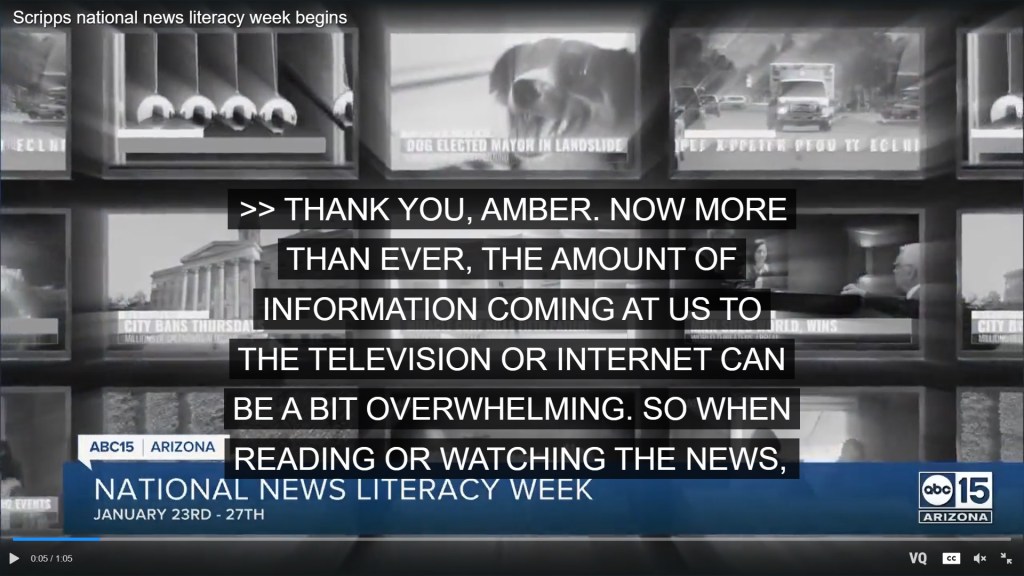
source: https://news.yahoo.com/scripps-national-news-literacy-week-054136834.html via https://www.noagendashow.net/listen/1524/transcript (@ 2:30:33) Today, everyone can decide for themselves what qualifies as worthy of attention (or not). Something is worthy of your attention — not only do you get to decide that, you must decide.
You cannot pay attention to everything, you can only pay attention to some things.
Today, media literacy is no longer about paying attention to the news. Today, media literacy is about choosing which information to pay attention to.
Almost every issue every individual faces today is either personal and subjective or a global phenomenon. [1] There is no longer much of a case to be made for nationalist agendas.
Individuals can no longer hide behind the group-think of regional mass movements. Today, individuals must practice responsible media literacy: to be a literate person today means taking full responsibility for the choices made in the selection of media sources. When someone asks why an individual chooses to pay attention to a particular media source, the individual who cannot justify the choices made should be considered irresponsible — and perhaps even illiterate. [2]
[1] Yet some global phenomena may be particular and distributed. I feel I need to revisit this in more detail — insofar as the regular interpretation of “global” as “present everywhere” needs to be tempered somewhat … perhaps something more like “globally present, albeit in a distributed fashion, at a quite diluted concentration“.
[2] For example: one justification which I would consider to be valid might be “because the media source is “rational media” (see e.g. “Introduction to Rational Media: Content vs. Container” )
-
Supply, Demand, Natural Language & Free Markets — Some Preliminary Thoughts & Ideas
Many if not most — or even all? — (educated) people have probably heard of supply and demand before — and perhaps also that they are the basic building blocks of free markets.
Likewise, many may be familiar with the expression “supply creates its own demand” (which is a sort of shorthand for views expressed by Jean Baptist Say — and known in economist circles as “Say’s Law”). But I would like to step back even a little bit further (than merely a couple centuries ago) … to a point before scarce resources became a thing. A very long time ago, maybe back in the times of the “Garden of Eden”, there was an abundant supply of things. All the things were there, and there was no scarcity of anything (except, perhaps, for unicorns — if such a concept even existed back then).
It was obviously not until much later that scarcity was something which happened, and that humans had to figure out a way to deal with. Fast forward many millennia, and at some point money became one of the solutions which was widely used (and has been used, and will probably continue to be used for the foreseeable future [1] ) to address the issue. It must have been sometime around this time that the notion of supply and demand also became more widespread (presumably, at some time before this happened, some things may have been exchanged for other things — indeed, I believe some of the first coins actually represented livestock of different kinds, and holding such coins was perhaps interpreted as owning the represented livestock).

Since such ancient times, my hunch is that supply and demand were more or less neatly separated: the things were described with language, and their ownership could be accounted for with coins. At some point, coins no longer represented actual things but rather simply amounts … of something. Perhaps the something was at first a “precious” (or particularly scarce) resource (such as gold) … and indeed this was arguably still the case up to just about a century ago. At any rate, today money is mainly simply a unit of exchange — and it is widely accepted as purely numerical measurement instrument.
Likewise, most things which are to be measured in monetary units are expressed in linguistic units (quite often a written contract describes / defines what is being offered “for sale” in exchange for an agreed upon amount in monetary units). Economists are usually quite keen to gloss over that there are obvious differences between apples and oranges, and they often prefer to turn everything into “widgets”, thereby transforming the complexity of the real world into generic units of such abstract and theoretically generic “things“.
So what we have had for a very long time is an exchange system which has two sides: supply uses linguistic communication (qualitative data); demand uses numerical communication (quantitative data). Marketplaces, where these things can be bought or sold, use some kind of (more or less formalized) language to define / describe these things (people are generally reluctant to buy a cat concealed in a sack; they generally want as complete clarity as possible about what they are supposed to exchange their hard-earned money for).
In economics, this is simply assumed to work completely perfectly — one of the main tenets of such a perfect marketplace is perfect information. Of course the real world is rarely (if ever) quite that perfect. Most “real world” cases involve allow for such imperfections. Ask anyone if they have ever been disappointed with something they have paid money for, and the only surprised look you might get would be about how anyone could ask such a foolish question about such a ridiculously obvious “fact of life”.
However, another issue remains severely neglected: Since the expectation concerning perfect information about these innumerable units of abstract widgets is obviously much more illusory rather than somewhat realistic, the so-called market price seems much more holey than being completely holy (as any card-carrying free market economist would certainly argue — see also “Some Market Price is Probably More or Less Accurate at Some Moment in Some Marketplace (& Socio BIZ Rule #2)“). Matching up supply and demand is in fact not at all straightforward. No, it is (especially in so-called “real world” and / or “IRL” cases) much more immensely complex.
Now let me go one step further. Online, this complexity is actually very central and crucial to the business plans of many if not even most (perhaps even all?) so-called “leading” companies that “make money” online. These companies earn enormous profits by matching linguistic expressions (representing supply of certain “things” and also demand for certain “things“) with the price they charge for their “match-making” services. Beyond that, they also make money by monitoring such linguistic expressions and suggesting other “neato” products and services the customer might also be interested in (and “click on” or whatever).
What seems to remain constant throughout (modern) history is that linguistic expressions are the language of supply, and so-called “consumers” are limited in their ability to express demand to expressions in the language of money … and that a sneaky middleman will almost always find a way to make a quick buck (see also “The Social Construction of Publishing“). Doc Searls (of “Cluetrain Manifesto” fame) introduced the notion of “vendor relationship management” many years ago — long before it became clear to many “leading” companies that they would much more prefer monopoly power to such much more distributed approaches. I am inclined to simply add this: The bigger they come, the harder they fall! 😉
[1] see also “In What We Trust” [ http://remediary.com/2021/02/11/in-what-we-trust ]
-
Us OR Them — Whose Job is it to GTFO?

I am more or less clean — I wash my hands regularly, bathe regularly, I stay safe, … whether I do so more or less than the average human, I don’t know.
Yet I do go above and beyond what ordinary folks do on a regular basis. Ordinary folks do not normally take measures to protect their privacy. Ordinary folks do not worry much about manipulation. Ordinary folks can quite easily become suckers.

GTFO A while ago, I watched part one of a five part series called “All Hail the Algorithm” [ interactive.aljazeera.com/aje/2019/hail-algorithms ] — well over a year ago, in fact. Just the other day, I watched it again … and I decided to check out the other four episodes. There are many recurring themes interwoven throughout the series, but each episode nonetheless comparmentalizes a single story. I find it very well done, even if I find the way Ali Rae (the narrator of the quasi-documentary) addresses the camera in a “selfie” manner while walking along (but at least not stumbling or falling down) a little distracting. To me, it’s quite obvious that this is done in order to sympathise with a particular target audience (which is probably important for selling advertising services).
One of the recurring themes is the notion of “data exhaust” — and this is a sort-of jargon term used to describe the way the people I refer to above as “suckers” above are prone to get sucked in to some kind of propaganda scheme.
The myth goes something like this: Humans reek of data. When someone sees a human, all of this data emerges from their appearance, and in order to protect their privacy, they would need to be sealed off from the external world in order for all the data to not leak out into the surrounding environment.
Very few people are able to recognize that this is simply naive — almost ridiculously naive — and in any case, it’s simply wrong. I can get piece of paper and a pen (or pencil or whatever) and simply jot down notes of my own choosing. I can call the day sunny or rainy, I can note that someone seems to be young or old, I can refer to them with some sort of “racist” and / or “sexist” terms. These are my choices, not anyone else’s. We are all free to take down notes.
Whether anyone likes or dislikes someone else’s notes is a completely different matter. I don’t want some big brother company to sell me bullshit based on whatever “pigeon hole” category they have decided to put me in. So I GTFO of being anywhere near companies like that.
End of story.
-
Mainstream vs. Anonymous
Breaking News: There are problems with mainstream media! 😯
I DO listen to the “No Agenda” podcast regularly — and have listened to it for a long time (too long to share without feeling somewhat ashamed). Yet, it does feel good to consume John’s & Adam’s version of “media deconstruction” — and they can also simply be funny (and therefore fun) to listen to.
Nonetheless, over the many many episodes I have “consumed“, I have also reached a point of wondering why it makes sense to consume even more media deconstruction … especially because John and Adam continue to focus exclusively on mainstream media.
This leads me to the question: What media do there even exist besides mainstream media? The media few people know about, the stuff almost no-one pays attention to, and one fine example of that are indeed: rational media — but rational media (see e.g. “Introduction to Rational Media: Content vs. Container” [ https://contextual.news.blog/2020/04/22/introduction-to-rational-media-content-vs-container ] ) are not the only exceptional case. I wonder how I might refer to the vast plethora of sites which are neither mainstream media nor rational media.
Perhaps one way to resolve this issue is to find a name for all non-mainstream media. How about “non-mainstream media”? That would be all good and fine, but it would not really address separating what I might refer to as problematic media from non-problematic media. Most people are probably hardly aware of so-called “long tail” media — because they rarely (indeed: if ever) see such sites. When they do (occasionally?) see such a site (plastered with non-mainstream advertising or maybe a Google “parking page”), their immediate reaction is probably something like “OMG, a spam site!” and they close the window immediately.
These problems do not exist for rational media. Since rational media clearly state what they are “about”, there is no basis for “bait and switch” tactics, as is the case with all of advertising-sponsored media (which is very fundamentally based in such “clickbait” strategies). The main difference between advertising-sponsored media which are mainstream vs. advertising-sponsored media which are non-mainstream … is perhaps simply a prejudice created by the Human Brain Conditioner. Since a wide variety of organizations have been anointed throughout a wide variety of human brain conditioning processes, people find the sponsorship of clickbait advertising by these “establishment” organizations easier to swallow … and thus, every second another sucker gets hooked!
Yet there still remain a very large number of non-mainstream media which are neither rational media nor advertising-sponsored media. Let alone non-English language media ( and please also note that I have for some time also wanted to build online communities for bi- and multi-lingual native speakers — see e.g. “Multilingual Native Speakers Project” [ https://indigenous.news.blog/2023/01/07/multilingual-native-speakers-project ] ). My hunch is that the vast majority of “long tail” media are so-called “personal” sites — in other words: people who simply want to publicize their individual perspective on whatever they feel like sharing their “personal” point of view with the entire world.
The irony is that since these sites are probably unknown to anyone but their authors themselves, they are for the most part insignificant (even if in numerical terms they are quite significant). Indeed, many such authors seem quite surprised if / when I contact them. They often write on their sites that they are addressing “the void“. The feel anonymous. And unless someone happens to visit their site’s URL (see also “Infinity vs. URL“) for whatever haphazard reason, they essentially not only are anonymous — their site (and its contents) can be considered to be completely unknown to anyone except to the companies involved in creating and/or maintaining those sites (perhaps most of all: Google [1] 😉 ).
[1] Note, however, that Google would probably never show any Google search engine user such an “anonymous site” (because Google’s business model is “to make money“, and therefore listing a site without any Google advertising on it is at odds with the company’s own business model)
-
There (but for the Grace of God) Go I
That’s a quote from a woman going by the (stage) name “Bridget Phetasy” — which she repeats time and again, mostly on podcasts she publishes.
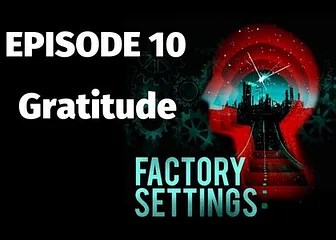
I enjoy listening to her opinion. I especially enjoyed an episode she published (together with her husband) on the podcast named “Factory Settings” earlier this month — episode 10, titled “Gratitude”.
Bridget also mentioned that quote in this episode (@ ca. 19 min.), but that isn’t what intrigues me about the chat she had with her husband. I think the views I want to share here regarding the episode have a lot to do with some of the ideas I am puzzling over these days, but I recognized while listening that it is also very much tied up with issues discussed by Bridget and Jeren.
Personally, the way I think about gratitude right now is that when people feel grateful, they recognize that the world is ordered in a particular way … and they are happy that according to the way the world is ordered, they come out “on top”. Yet I also recognize that I am very aware of my view that the order of the world is actually quite arbitrary. I also can imagine a world which is ordered differently. Thus, “fair” and “unfair” are quite malleable. As Bridget and Jeren were closing their discussion, they touched on the topic of religion, and this seemed to be quite similar to my own thinking (perhaps especially because of my own fascination with Quakerism — insofar as [in many / most cases] Quakers also tend to be very welcoming to other points of view).
The result of my thinking along these lines may seem quite odd to many / most people — namely: that gratitude is not inherently good, but it almost seems simply opportunistic. To be grateful that you are not sick or poor or in any way not well off is actually in a way an ignorance of the notion that the cards could have been shuffled differently, or that the laws of nature could have resulted in a different world plan.
Today, it seems like humans dominate the world, and bugs, rats and snakes seem to have less esteemed reputations. What will happen when humans no longer exist? What will come out “on top” then?

Social Business (WordPress weblog)

 Socio Business blog