-
Exploring Humanity: Clickbait Edition
I’ve been asked to be part of an event to highlight some music I find worthy of highlighting at a weekend soiree in a couple weeks, and I’ve chosen to focus my “feature” on a brief period in musical history (roughly 1980’s, yet also as far back as the 1950’s and also much later — even up to and including our own “era” of music) which has been strongly influenced by cinematography and is most widely known by the rapid surge of a new format commonly referred to as the “music video”.

Clay animation from “Inca Roads” (Frank Zappa) At the same time, I am also currently very inspired by a conversation between Alana Newhouse and Bridget Phetasy (see “Equality of Opportunity Rule” [ https://teaser.news.blog/2025/07/06/equality-of-opportunity-rule ] ) which also deeply explores a variety of aspects involved in the human behaviors related to information processing.
One of my favorite examples of this “thank you, next” principle (succinctly described by Alana Newhouse and quoted in the linked-to article above) is the web site pets.com which once had a website declared “forever dead” (or something like that) during the “dotcom bust” about a quarter of a century ago. Spoiler alert: pets.com remains alive and kicking address, apparently stronger than ever to this day (and most likely far beyond that, too).
-
Supply, Demand and Making or Creating Meaning
If someone knocks on my door and / or rings my doorbell only to tell me they want to offer me new and improved meaning I will probably tell them to go … do something else.
I don’t need or want any interruptions in my life, thank you very much. I want to move forward, I want to progress and I know myself well enough in which directions I need to go in order to get it while I can.

source: https://catlintucker.com/2024/02/meaning-making I consider this matter so important that I have featured it on the homepage of Wants.Blog [ https://wants.blog ] — and yet you can also save yourself that one extra click by going directly to “Inter-Reliance, Self-Dependence & Responsibility“.
Not only do I demand meaning — no, no, no, no, no! I also supply it.
-
Cavities, Spaces, Pigeon Holes and the Tunnel-Vision through the Channels in Between Work and Life
This week, I’m living (and working) according to a little bit different time schedule than most weeks.
Just a few days ago, I had a marathon movie viewing bout — I think I watched 4 movies in an 8-hour time frame. They were all very different, and one of them I chose mainly based on the title of the movie alone: “Turtles All the Way Down” (which is a famous quote I myself also alluded to a couple weeks ago — see “Relational Data-Based Logic & Meta-Physical Constraints” [ https://socio.business.blog/2025/06/01/relational-data-based-logic-meta-physical-constraints ], specifically my point about “it’s fiction all the way down (or up, or sideways or whatever)”).

Source: “‘Turtles All the Way Down’ Review: Isabela Merced Is Spectacular in Heartfelt YA Drama” [ https://collider.com/turtles-all-the-way-down-review ] While this movie seems to be about a person who is very much “in their own head“, it also involves media in between people (as shown above) … and therefore also seems to harken back to another popular movie named “The Social Dilemma” (2020), about which I also wrote a post on another blog at that time — see “Herding Millennials — a new agenda for tech?” [ https://connect.data.blog/2020/09/16/herding-millennials-a-new-agenda-for-tech ]
I feel all of this is closely related to something I have also sort of discovered this week: increasingly, people seem to be commuting back and forth inside highly insulated channels in sort of tunnel-vision experiences in between their work life and home life experiences. And for many people across the globe (at least in the industrialized world) their home life experiences are strongly “mediated” by immense media conglomerates (and therefore for many people, much of their home life experience is likewise insulated from other people they might occasionally come into contact with).
As a result, there is a growing threat of an almost complete communication breakdown between people.
-
How Censorship Can Be Particularly Damaging to Open Source Projects
Upon returning from a WordPress Congress last week (namely WordCamp Europe 2025 in Basel, Switzerland), I had some reservations concerning in the WordPress community’s evolving cultural norms.
This week, these reservations became even more rampant as I became aware of signs that some of my own views may be being censored. Censorship is always a problem, but I feel that open source projects may be particularly severely damaged if and when an aspiring censor steps into the arena. Since open source projects rely heavily on the contributions of people who share ideas freely, any attempts to stifle that sharing of information can quickly and easily bring contributions to a standstill.

“Appearing in search Q & A” [ https://search.tech.blog/2025/06/10/google-cant-answer-question-about-using-google-or-not ] During the congress, I raised a question during a Q&A period. The speaker asked me to ask the question at another time, in another setting. I was open to the request and agreed to avoid postponing the discussion any further, as the speaker had already gone overtime with his talk. Yet when I had later written up my ideas (see “Google can’t answer question about using Google (or NOT)“), I noticed that I was unable to share these on the post dedicated to the talk. Even if I left the corresponding link absent from my comment, the comment was simply not published. I began to wonder if perhaps I was being censored.
It has already been an entire week since the original post was published. My comment is nowhere to be seen. The repercussions of such an action (of censorship) would indeed be dire. I am shocked to be even considering this possibility. I find my trust has been gravely impacted, and it is causing me to worry about the associated questionable future of the entire project.
-
Losing the plot
I was at an event over the last few days which I will probably write a lot more about over the coming weeks, but there were a few interactions I had with others which have prompted me to write about this topic — and in particular the way I see it.
In my humble opinion, it is possible for someone to “lose the plot”. It is also possible for entire communities to “lose the plot”. Maybe even all of civilization, humanity, and all the members of homo sapiens (whether on the planet earth, or even if they’re floating somewhere in space).

This is some more or less random image from slang.net. I am including it here because of this text (sourced from https://slang.net/meaning/lost_the_plot ): “This page explains what the slang term “Lost the plot” means. The definition, example, and related terms listed above have been manually compiled and written by the Slang.net team.” Note that the text appears to be referencing itself — as if I were to say of myself “I am a successful person” ( LOL ). -
Relational Data-Based Logic & Meta-Physical Constraints
When I as author of a text choose a title for that text, then I become an author on a different level. The descriptors I choose describe other descriptions. On a gut level, we feel this by being aware that the choice of a title feels more significant than the choices of commas or similar punctuation throughout the subordinate text. When we get into the “flow” of writing, we are able to turn off that “meta-” mind more easily.
One thing that is truly mind-boggling is that there seems to be something like an unwritten rule that titles and subordinate texts need to be composed using the same language, the one we presumably share with our more-or-less fictional audience, which we assume also belongs to our own linguistic community.
To cut to the chase: What is all too easy to lose sight of is that it’s fiction all the way down (or up, or sideways or whatever). Every meta is just as fictional as the one above it, below it, next to it, in front, behind or whatever as we walk to wherever we are going. There is no there — neither here nor there nor everywhere nor anywhere for that matter. There is no truth, there is only opinions or at best educated guesses, which may very well be better or worse depending on whose opinion it is we happen to be relying on at the moment.
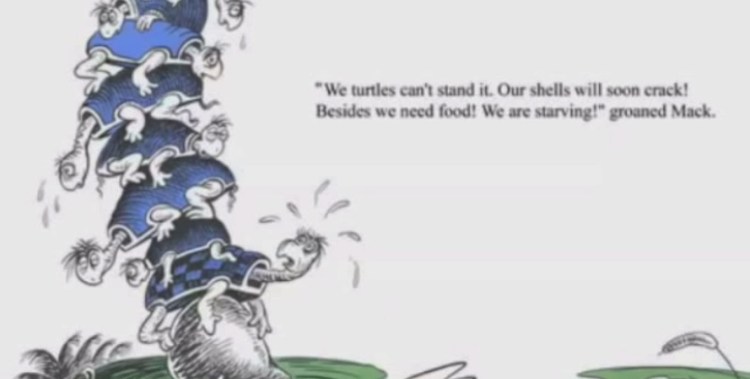
source: https://quotesgram.com/yertle-the-turtle-quotes It can be very liberating to approach the more or less artistic work as merely up to the “whim” of the author, such as how George Orwell must have felt when he came up with “1984” (which, ironically, seems to be written in a way that transcends language).
When we thrust our attention towards such meta-physical aspirations of logic and truth into the realms of tagging systems such as “tags” and “categories” (and other such menus of “lions, tigers and bears”), we force ourselves to acknowledge that we all simply appear to be in the same boat, speaking the same language, when in fact we truly know nothing at all.
Perhaps the greatest irony of all is that we don’t tend to become dizzy or uneasy on our feet until we look down and realize that we are indeed afraid of heights.
-
Spoken vs. Written Language
Writing this week’s blog post has been difficult, because I have experienced significant trauma related to the topic of this post. In graduate school, I wrote an essay on the differences between written and spoken languages in a course called “diachronic linguistics”, in which I came to the conclusion that it is impossible to study the development of spoken languages over time. The professor who oversaw my work failed to understand my point, and I refused to budge. I got such a poor grade in that one course that for that reason I was not able to earn a master’s degree in linguistics. I decided that didn’t matter, because no one would ever hire me for a linguistics degree, and I still earned my master’s degree in information science anyways (though few people seem to be very impressed with that degree, too).
I do not wish to go into great detail about the differences between written and spoken languages here. Instead, I want to point out something that has changed in the intervening decades. Back when I wrote my essay, I already pointed out that sound recordings are actually a form of written language. Yet in the intervening years, the fidelity and data storage capacities of recording systems have increased vastly. Gone are the days of grainy recordings! Today, humans are probably unable to distinguish between sound recordings and actual spoken languages.
And there’s even more! Today it either is feasible or it is rapidly becoming feasible for data processing companies (such as Google, Microsoft, Amazon or probably a dozen more so-called “tech giants”) to track what their users like … and so they can not only make any voice sound real, they can make it sound very much like a beloved voice. Perhaps this need not even simply be the voice of a beloved person. They can probably monitor which voices, which intonations and similar speech patterns users find the most agreeable. They can thereby create entire new personas which are better than the mere flesh and blood persons we experience “in real life”.

source: https://archive.org/details/tobacco_meo23e00 Written language has come a long way, baby — and it also shows no sign of slowing down any time soon.
-
Are You Experienced?
I’m a huge fan of Jimi Hendrix — I guess he must have been rather funny. This title of his (“Are You Experienced?” was the so-called “title track” song from his debut album) was obviously meant to be provocative, at least to people who are open to actually hearing and listening to the words … and most of all to think about what they say (or ask). It doesn’t require much thought to reach the conclusion that it’s impossible to be both alive and to be completely lacking in experience — every living being experiences something.

source: adapted from https://www.authentichendrix.com/products/jimi-by-janie-hendrix-by-john-mcdermott [via https://www.jimihendrix.com ] This weekend, I had a few experiences I don’t regularly have and so I experienced what I don’t regularly experience. None of these experiences was particularly exceptional, on the contrary they were probably all quite ordinary for many or even most people. I realize that my own life is rather exceptional — in the sense of being not ordinary.
I did not really experience any propaganda or manipulation until after I left school and academia. Perhaps I only became aware of it because it affects my “bread and butter” work in such a significant way. For most people living “ordinary” lives, it is also quite ordinary to not become aware of the degree of propaganda and manipulation bombarding their lives on a daily — no, a constant — basis every day of their lives. This is not because they are insensitive or unresponsive to it. It’s simply so ordinary that it’s phased out — perhaps like fish might be unaware that they’re swimming in water.
I think our everyday experiences shape our extraordinary experiences in a significant way. We perceive something as extraordinary or atypical because it contrasts what is typical or ordinary. Many people seem very willing to accept pavlovian conditioning sessions simply because they have been introduced as ordinary. They are as neat, right and salutary as communion. Such rituals cement people’s notion of “ordinary“, regular and “common sense”. The more people get on the bandwagon, the thicker the cement, the stronger the wall against any potential opposition. What a fine example of this the so-called corona virus (“CoViD”) pandemic was.
When it ended, I thought surely people must have now woken up to the propaganda and manipulation they are swimming in constantly. But I guess the way the pandemic was declared as “exceptional” and the world afterwards somehow smoothly went “back to normal” … the repetition of manipulative messaging after the pandemic was over is now comparatively somehow miraculously less manipulative, and so it’s also “back to normal”. Thus, conditioning through repetitive massaging of false narratives and propaganda is now again accepted as completely ordinary.
-
We Have All Been Here Before
If you’re familiar with the “hippie” generation in the United States, you may also remember this refrain (quoted in the title of this post) from a song by a musical group of hippies named “Crosby, Stills, Nash & Young” — “Deja Vu”. Many years later I heard a song by Frank Zappa (which was probably recorded around the same time) mentioning Crosby, Stills, Nash and Young “fighting at the Fillmore East”. Hippies don’t follow leaders — I think Bob Dylan once said something like that.
OK, so here we are — over half a century later … and this post is actually supposed to be about something completely different (although it might also be somewhat inspired by Jimi Hendrix’s quote about “the power of love” vs. “the love of power”). Picking up from last week’s post about “progress” (see “The Progression from Progress through Progressive towards Progressivism”) and also the previous one about Taylorism, etc. (see “Scaling Time”), I want to delve a little deeper into this notion of leadership and power. Apparently there is nearly never any shortage of potential leaders, hierarchical power structures, etc.
Let me provide just one example — a contrast between two such “powerful” leadership icons.
First, we have the quintessential dictator himself, referred to as “Führer” (“leader”) by many millions of followers. This was a case of Influencer 0.1 (or maybe even 0.0.1? … ??)

source: https://blog.todamax.net/2014/perfect-loop-charlie-chaplin-edition/chaplin-hitler-mussolini-charlie-gruss 
source: https://makeagif.com/gif/steve-ballmer-developers-11j2vN Second we have the quintessential caricature of leadership from just a few decades ago: Steve
BallerBallmer.Whereas a full century ago, a leader had to build stuff, make things and maybe also start wars, kill millions of people and many things more, more recent leaders can get by simply by creating enough hot air to increase global warming — either on their own or through oddly “pleasant” [1] humming sound coming from their machines.

source: adapted from https://commons.wikimedia.org/wiki/File:20130527-hummer-h2-3-abri.jpg Lucky for us, leaders have apparently moved on from obvious large-scale death and destruction. Unlucky for us is that apparently the narcissistic hunger for power has transformed natural environments from military battlegrounds to environmental battlegrounds … and the unfortunate transformation has replaced obvious battlegrounds with stealth battlegrounds.
[1] Note that I feel this “oddity” is based on something like a narcissistic personality disorder in which the narcissist is motivated by their experience of complete power over machines.
-
The Progression from Progress through Progressive towards Progressivism

Source: adapted from https://de.wikipedia.org/wiki/Vorw%C3%A4rts_(Deutschland) For a couple of centuries, progress has been an industrial undertaking. During this time, smokestacks and iron buildings were built to embellish many skylines. Today, many of these rusty ruins remain as relics of what once happened. And similar “progressive” plans are still being built to make similar results happen somewhere else (in the spirit of “out of sight, out of mind”).
Finding an opponent to progress is probably much harder than finding a needle in a haystack. It is truly difficult to fathom how persistent the belief in mainstream propaganda is — despite the global wakeup-call the CoViD pandemic was. there does not seem to be any dearth of suckers willing to fall for any “progress”-based plan for tomorrow.
I wonder if the progress metaphor is especially well-suited to railroads. Trains usually go forwards, and only rarely in reverse. Ironically, they are a far more rational (and economical) use of energy than electric cars.
It almost seems odd that the metaphor needs to be hammered home through decades of indoctrination in so-called “modern” education systems … and then after “twenty years of schoolin’” they put you on the day shift (or perhaps you go directly to the unemployment line and “do not pass GO”).

Social Business (WordPress weblog)
 Socio Business blog