-
Celebrity Talk Show
For anyone unfamiliar with what a steroid is, … well, I’m sorry but I don’t know that much about steroids either. Essentially, they are like wonder-substances which make organisms grow … and especially also to make muscles grow, and they are apparently used by people with athletic aspirations to help them become miraculous machines. In common language, the term “on steroids” is used to say something is simply increased very strongly, to something like a gargantuan scale.
In this post, I want to extend the idea behind the previous post (“Mainstream Milieus“) along one particular tangent — the mainstream media genre usually referred to as “talk show”, which has now suddenly become stunningly popular again in a “new media” format, the podcast. I have titled this post “Celebrity Talk Show”, because today it is simply implied that any person appearing as part of the cast in such a talk-show or podcast interview must be an extraordinarily celebrated person, and not some ordinary worker who does nothing more than household chores day in, day out, 24/7/365. The ins and outs of cleaning a toilet simply don’t translate all that well into much of an interesting conversation.
The reason I mentioned the phrase “on steroids” at the beginning is that I view this post as a “mashup on steroids”, insofar as I will also integrate observations from a wide variety of previous material, all of which I intend to mashup into one gargantuan snowball I aim to fling out into the void (haha, for more on this little chuckle, see “Voiding and Avoiding the Void“).
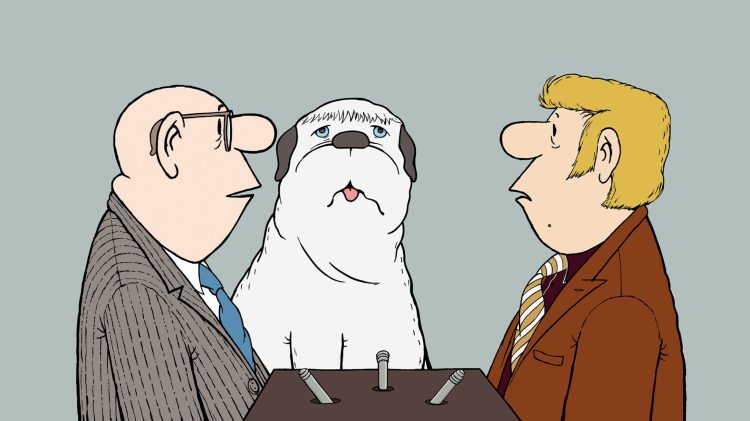
Source: Loriot, “Der sprechende Hund” [ https://www.lichtblick-kirchlengern.de/project/loriot ] First, let me start off by referring to a note I wrote about the psychology of symbolism revolving around celebration, celebrated persons, celebrity, and thereby stunning the consumer audience into awe and amazement. This is easily done — very simply by positioning pointed microphones in front of the celebrities (for more on this, see “The Smartest Person in the Room“). Of course other theatrical constructs, such as a stage, or simply using several cameras and switching between them, perhaps sometimes also including “split-screen” views from different angles and such, and the suckers in the consumer audience will be wowwed and entertained in seconds. There’s no need to go overboard with flashing lights, but I guess whatever does the trick is good enough to sell almost any product.
In this context, I will once again call to attention a few academics who were extremely influential (at least for me) in the fundamental foundations of such organized media productions. First, over half a century ago, “The Social Construction of Reality” (by Berger and Luckmann). This seminal work was truly groundbreaking in presenting the immense complexity of modern societies. Above and beyond that, “Manufacturing Consent” (by Herman and Chomsky) presented a detailed analysis of the organization of publishing industries and crucially also the the socio-economic (and regulatory) motivations behind them. While many of the case-studies I present here span many centuries and situations from many countries across the globe, a thorough reading of these two works provides what I consider to be a thorough understanding of the “media landscape“. Granted, they are decades old, but nonetheless I feel they are far more insightful than most of the other stuff I have seen in the several decades since then.
-
Mainstream Milieus
I guess about a decade ago I became aware of a new trend in the music industry, referred to as the “mashup”. A mashup was a combination of two songs — and these songs could be quite different. The result was (I guess) a new piece, and one of the most prominent examples and in any case the one I chose to play time and again for my friends was “Never Gonna Give Your Teen Spirit up”.
This is the same spirit of extreme contrast I want to introduce the concept of “mainstream milieus” with. I have a general familiarity with both parts of this concept, yet these individual parts are, I feel, seldom (if ever) studied with any serious (or quasi-“scientific”) scrutiny. Instead, they are usually bandied about barroom banter and tossed around in an off-the-cuff manner and therefore carry a small tinge of inebriated party-talk.
Before we get the party started, let’s pay particular attention to how the two elements (“mainstream” and “milieu”) contrast. A milieu is, I feel, usually seen as a small group — originally, I guess, this was a way to refer to a group of people who “hung out” together at this or that place. In other words, it almost seems as though “mainstream” and “milieu” could be diametrically opposed opposites along a scale of broad vs. narrow appeal.
Yet over the past few years, people all over the globe have been sort of hit over the head with the stark reality that “mainstream” is largely built upon a myth of quasi-correct popular opinion. All of a sudden, the fake bubble has now burst and a centuries-old propaganda ploy has popped. Ordinary people standing on every street at every corner now suddenly realize that what used to be considered “mainstream” is just as laughable and insignificant as that clown standing behind the curtain in “The Wizard of Oz” … and also just as small-scale as any other milieu.

source: https://www.gettagged.us/behind-the-curtain-brand-authenticity/behind-curtain-wizard-of-oz-2 The contrast of 99% mainstream versus 1% milieu is nothing more than a myth. Today, the world-wide web potentially creates thousands or even many millions of milieus. [1] Some in the publishing industry have even coined a new term for this new-world phenomenon: the “splinternet”. People deeply steeped in the concept of mainstream media find it very difficult to grasp the reality of a highly differentiated real world — a real world with many languages, with many cultural backgrounds and with innumerable perspectives and milieus.
In closing, I would like to try to identify two well-known “mainstream milieus” [2]. First, “mainstream media” — the news and publishing industries that have spread ideas to mainstream media consumers like there is no tomorrow (see also “Trailblazing, Trailbuilding and Ideological Infrastructure“). Second, “mainstream advertising” — the propaganda people who have increasingly been working with digital switches to bait suckers into clicking for them (and their business partners). At this point I merely want to suggest these mainstream milieus, primarily in order to introduce the concept and to get the ball rolling. There are probably many more possibilities — such as government or other mainstream industries such as finance, health, the arts, etc.
[1] see “Introduction” [ https://phlat.design.blog/2024/01/14/introduction ]
[2] note, also, that I have before investigated several related concepts — such as “indigena” (“Propaganda Information Technology vs. Indigena Information Technology — the Basic Idea” [ https://indigenous.news.blog/2022/05/07/propaganda-information-technology-vs-indigena-information-technology-the-basic-idea ] ), “populism” (see e.g. “Emotional Politics” [ https://emotional.politics.blog ] ) and “contextual news” (see e.g. “Contextual Meanings” [ https://contextual.news.blog ] )
-
Last Week, This Week, Next Week and Choosing My Own Beliefs
Last week I invited you all on a small excursion down memory lane. I carried these thoughts and ideas with me throughout this week, and now I have been lead to wonder whether I have great expectations for next week and also beyond that: am I free to choose my own beliefs about past, present and future reality (or realities, if such a plural form makes sense at all)?
There was a dude a few hundred years ago named Blaise Pascal who apparently tried to give a sort of mathematical proof for the existence of God. Whether he succeeded or not I don’t know, but I think part of the so-called proof was a rather simple argument. He argued there are really only two cases: either God exists or God doesn’t exist. In case God doesn’t exist, we don’t lose very much by believing that God does exist. But if God does exist, then it seems as though the loss of believing God doesn’t exist would be far too high.

source: https://en.wikipedia.org/wiki/Blaise_Pascal 
source: https://en.wikipedia.org/wiki/Do_the_Right_Thing I think I have come up with a somewhat similar yet significantly different rationale for choosing to believe something. Instead of using a term like “God”, let me simply refer to something like “doing the right thing” (versus “not doing the right thing”). Let me give some concrete examples. This week in Aschaffenburg (Germany) apparently (according to news reports) some crazy person attacked a group of small children. A bystander tried to defend the children from the attack. The attacker killed two people: the bystander and one small child. I do not wish to get engaged in the political discussion related to the event. I wish to focus on the bystander: did that person do the right thing? (this is intended as an exercise for you to think about). I could easily create a very long list of such examples, Should anyone drive a car? Should anyone kill any living thing? Should abortion be legal? It is undoubtedly far easier for me to pose questions than to provide answers.
For me, the crux of the matter is really focused on the present. I believe my life right now is more interesting if I believe doing the right thing is good for me. Now. Whether I might profit from it at some time in the future really doesn’t matter — except (perhaps) insofar as the expectation of a reward seems to be required. Even if I know that the future reality is that no such reward will ever exist, my own imagination that doing the right thing is good for me now is sufficient to give me the motivation to do it.
Class dismissed! Oh, one more thing: I have decided to not give you a quiz on this next week, or even at any future date.
-
Something …
Something in the way my brain thinks behoves me to start thinking differently … .
Just the other day I got a distinct feeling, which felt very much like what I imagine running full speed ahead head-first into a thick hard cement wall might feel like — and that gave me some pause.
I thought to myself: “Wait a second, something’s not right.”
I thought long and hard. I slept on it, and I was transported back to an experience I had a few decades ago. I can pinpoint that moment in time quite precisely — at least the date. I had just recently embarked on a career path that I felt was quite certainly leading to somewhere, but that was still a quite nebulous space. Yet at that time, my life was still more or less mired in uncertainty.
I don’t remember what precisely had precipitated it, but all of a sudden I found myself heading towards Tübingen to see and hear Susan Sonntag speak there. She had just won a prize and I drove there the night before and slept on a friend’s couch before attending her talk the next day.
To say that she simply spoke eloquently is a severe understatement. All who sat quietly to listen and hear every word, her every murmur and every single breath, and pause, and to capture each and every awe-inspiring glance, sat there in complete wonder, astonished and amazed by her presence which gave the entire room — a sizable auditorium — that warm, cozy feeling of “Gemütlichkeit”, which allowed her ideas to float around in the room like a bunch of cheerful, playful birds in the springtime, swooping in and out of her speech and also the questions and answers following.
I distinctly remember one particular point she made. She talked about one of her students who seemingly frustrated her. She mentioned how laboriously he would mention every minute detail in a story as if it were a long laundry list of details which needed to be checked off before the story could progress any further — since “otherwise the readers wouldn’t know those required things”. Ms. Sonntag was not happy with the resulting task of having to trudge through such long laundry lists of details just get to the next steps. She also explicitly stated how she felt it might be an entertaining (and liberating) game for the reader to actually use his or her own brain to fill in any such blank spaces in the canvas of a story which can unfold by engaging the reader to think a little bit, too.
I was reminded of this when this last week someone pointed out to me that they feel my approach is plagued with pedantry. I myself feel curiously willing to accept the argument that it was not intended as an insult, but rather as constructive criticism — that I need to work on this. I have a hunch that perhaps there’s an element of “we” need to work on it involved … insofar as I seem to have an urge to solve problems, yet I am not fixated on only my own solutions. The way I see it, one of the best ways to reduce my own pedantry is to become more aware of other proposals. I think it might also be fun to entertain rather fantastic ideas which at first glance might seem hardly plausible. Yet the prospect of a negative attitude such as “we’re all going to die anyways, so why bother?” just doesn’t cut it in my motivational wheelhouse.
So please: Hit me with your best shot!
-
Generally speaking, facts are independent of belief and of knowledge and opinion (and other basic literacy skills)

“Generally speaking, facts are independent of belief and of knowledge and opinion.” Source: https://en.wikipedia.org/wiki/Fact Literacy is an amazingly nebulous concept. The word is commonly used in a binary either / or fashion: either you are literate or you are illiterate. Yet as anyone with even just an inkling of an education will easily assert, it is much more realistic to say that there are degrees or levels (or maybe directions) of literacy. A person may be especially literate (or “well-versed”) in botany and at the same time be barely literate in astronomy. Literacy need not only apply to scientific methods — indeed, someone may be illiterate in women, men, both, children, babies and also cooking, archery or nearly anything at all. [1]
Generally speaking, though, most people are able to communicate something to someone in some kind of language. Yet to be able to use one language is a far cry from being able to use all language. So although we may refer to someone as literate in one language, or even a few languages, I feel I can quite safely go out on a limb and maintain that there is no-one at all who is literate in all languages. In this manner, everyone who is alive or has ever lived (and maybe also everyone who will ever will live) is far more illiterate than they are (or were, or will ever be) literate.
Let me now turn to a very specialized “literacy” topic — and that is what people sometimes refer to as “media literacy“. With this topic, we focus on the technology (and market forces, such as capital) commonly referred to as “media”. These are the nuts and bolts of language, information and communications technology. In order to understand media, we must be aware that these inputs are actually scarce resources. That is fairly obvious with such factors of production as ink and paper, yet it becomes ever more nebulous when we advance to more abstract concepts such as letters of the alphabet, or more generally words and ideas. Yet in linguistic circles it is a well-known phenomenon that when a word exists which already refers to a distinct concept, that same string of letters is sort of “taken”, and therefore is no longer available to refer to another new concept. Over the past few centuries, this has led to governments creating more and more regulations for various terms, including terms for particular companies, organizations and such. Usually, these are very makeshift solutions, and this is probably due to the ephemeral nature of life (and death), namely that these things come and go — so there is really no need to work on something like a permanent solution.
One key idea, though, that has guided the development of regulations for these special terms (such as “brand names” and “trademarks”) is that they must be clearly separated from what regular humans use everyday for ordinary life — namely: language. Note that this is in sharp contrast to the historical development of family names such as “Smith” or “Miller” or “Johnson” (etc.). As a result, in most countries there are government regulations granting entities (such as corporations) the exclusive right to define particular strings which are intended to refer to the company (such as “Microsoft” or “Google”). These terms are assumed to have no linguistic meaning themselves (and indeed: this is usually a prerequisite to these privileges [of granting the right for companies to name themselves] being allowed).
These historical developments have lead to a bifurcated media landscape (which I have referred to elsewhere as the bifurcation of “Rational Media” [ https://phlat.design.blog/2024/01/14/rational-media ] … versus “irrational media”). Yet the traditional media landscape has such a long history that there now is such a long (and large) tail of a wide variety of legacy media brands, that what is now commonly referred to as “mainstream” brands are for the most part meaningless strings. Since these mainstream media brands have no meaning, they are not “about” anything. They seem to be disinterested and unbiased. This has led these mainstream media brands to focus their attention entirely on maximizing profits amidst cutthroat competition. Therefore, the leading mainstream media brands tend to be the companies most prone to push advertising (and similar types of propaganda).
Increasingly, there seems to be less and less justification for anyone to expect to earn a profit by expressing something — whether facts, beliefs, knowledge, information, opinions or whatever. Since more and more people are becoming more and more literate, why should anyone pay someone else for their expressions? Personally, I feel it would be much more appropriate for someone to pay me to have to listen to their meaningless babble or twitter or whatever.
My own interests are much less “consumer”-oriented. I prefer to participate and collaborate with others who also share my own interests, hobbies and such. My hunch is that I would gladly pay an entrance fee to join a community of fans, much in the same way I might join a club or team working towards common (or perhaps complementary) goals.
[1] See also “More about Modes and Levels of Literacy“
-
Trailblazing, Trailbuilding and Ideological Infrastructure
There is a myth that is plaguing the media — that myth is followers.
Why are followers a myth? I’m glad I asked! 😉
It’s a “Catch 22” thing. If you need followers in order to get followers, then it will never happen that way. What actually happens is that someone gets promoted (by paying money, for example) and then after thousands of suckers take the bait, then the quasi-leader has thereby “built” a following — that’s the way they do it.
In a world of potentially billions and billions of potential leaders, the task of finding the right leader still remains a daunting puzzle. On the other side, we find another myth .. namely “if you build it, they will come”. The more appropriate saying should be something more like “if you build it and make a lot of noise, thereby disrupting the entire town and distracting a lot of people from what they were just busy with, then (maybe — if you’re lucky and the disrupted and distracted folks aren’t angry with you for bothering them) they will pay attention.

Source: https://en.wikipedia.org/wiki/Moon_landing Let me give you an example. In America, there were once a couple of pioneers named Lewis and Clarke. These trailblazers created trails by telling people they were going to go where “no man has gone before” (at least no man of European descent). [1] Such “wild and crazy” adventures are often followed by many thrill-seekers, the kind who are likely to turn on the TV-set to see if some daredevil celebrity will succeed or fail, if a space-ship will successfully land on the moon or Mars, and so on (and they are also quite likely to take pictures, one of which will probably get sold to the highest bidder and land on the front-page news) — it’s simply sensational.
Last century, Vannevar Bush, the visionary who basically envisioned what would eventually become the Internet, proposed an idea he referred to as “trailbuilding”, whereby trailbuilders would create links between ideas, such that later followers could use such guideposts to find their way through the maze of data (and thereby perhaps discover new facts). [2]
I believe that over the past several decades, the so-called “media-landscape” is experiencing a revolution … from trailblazing to trailbuilding. As an increasing number of trailbuilders continue to build a sort of ideological infrastructure ordinary people are beginning to realize that they are becoming more and more independent from trailblazing leaders “brought to you by” the old-fashioned industrial propaganda machinery. Increasingly, ordinary people can find their own ways through the maze of everyday life via the guideposts that have been created by networked communities of trailbuilders.
Let me try to tie up some loose ends from last week’s post by coming to a preliminary conclusion here. I feel the difference between trailblazing and trailbuilding is not hard and fast, either this or that, or any such binary contrast. It seems to be a gradual and nonetheless ongoing shift in our approach to information. Last week I mentioned I wanted to provide a contrast between American and German communities. I noted that in America there seem to be a large number of community-based communications about gender (e.g. the “What is a Woman?” documentary I alluded to). In contrast, in Germany I notice a wide array of leaders (whether among religious organizations, or among political organizations, or whatever) publishing information about topics such as “What is a family?” Both of these approaches are fascinating, yet I also wish to draw attention to the fact that both approaches also leave trails behind — even though one is more a matter of trailbuilding network activity, while the other is more a matter of traditional leadership trailblazing. Although I see this contrast clearly, at the same time I acknowledge that I want to be able to see it — in other words: maybe what I think I see clearly is simply a vision my brain is too easily convinced of by “wishful thinking”.
Another thing I think I see quite clearly is that since we can choose from a wide variety of trails, there is no guarantee that any one trail will certainly succeed in delivering us to our expected conclusion. The situation may indeed be even worse than mere uncertainty. If different communities form different groups and thereby build different (and perhaps even opposing) competitive camps, then it might be quite plausible that one camp might create bogus paths to nowhere in order to lead the so-called competition to failure. Therefore, as time goes on it will become increasingly important to be very wary about the paths we choose to go down. As our own success will increasingly become a matter of wisely chosen path-dependency, we need to focus evermore on straightforward paths that lead to our desired destinations certainly, avoid roundabout joy-rides and arrive “on time” reliably rather than to follow foolish “get there quick” plans (regardless of how “cheap” or “easy” they seem to be).
At this point, it also seems obvious to me that the so-called leading brand name media companies are offering “bait and switch” schemes like there’s no tomorrow. In contrast, rational media are currently building out reliable paths to here, there and everywhere like there is truly tomorrow. [3]
[1] I myself actually know quite little (nearly nothing) about the Lewis and Clarke Expedition. I hope it will suffice to quote this statement: “The object of your mission is to explore the Missouri River, & such principle stream of it, as, by its course and communication with the waters of the Pacific ocean, whether the Columbia, Oregon, Colorado or any other river may offer the most direct & practicable water communication across this continent for the purpose of commerce.” Ambrose, quoted in https://en.wikipedia.org/wiki/Lewis_and_Clark_Expedition#cite_ref-35
[2] “Thus [the researcher, e.g. of ancient bow technology] goes, building a trail of many items. Occasionally he inserts a comment of his own, either linking it into the main trail or joining it by a side trail to a particular item. When it becomes evident that the elastic properties of available materials had a great deal to do with the bow, he branches off on a side trail which takes him through textbooks on elasticity and tables of physical constants. He inserts a page of longhand analysis of his own. Thus he builds a trail of his interest through the maze of materials available to him.” Vannevar Bush: “As We May Think” (The Atlantic, July 1945, p 107)
[3] For more about rational media, see “Rational Media” [ https://phlat.design.blog/2024/01/14/rational-media ]
-
Unser Kampf
For anyone who isn’t all too “fluent” in German, “Kampf” means something like “fight” or “battle”. Adolf Hitler wrote a book titled “Mein Kampf” — referring to “My” (fight or battle). I have chosen the title “Unser Kampf” — referring to “Our” (fight or battle).
Survival is indeed to some degree a matter of fighting or battling. There is a German saying that goes along the lines of “I have to do this (work), because (so far) the chickens (for dinner) simply won’t fly directly into my mouth.” [1]
If you had asked me a few weeks ago, I might have referred to the battle or fight I wish to discuss now as my battle. I might have even said that up until a few days ago, yesterday, or maybe even right up until a couple of minutes (or maybe hours) ago … but I have made a significant discovery — just like John Lennon used to sing: “I’m not the only one”.
What took so long? Well, I usually encounter HUGE amounts of “pushback” whenever I share my ideas (which is also a sort of “link” to last week’s post about another author — see “Why Do You Want to Share Your Ideas?“). Most people consider my ideas about “Rational Media” [ https://phlat.design.blog/2024/01/14/rational-media ] repulsive (or something like that), and therefore refuse to give them what I wish to refer to as “adequate” consideration.
Never mind that I was also quite convinced that my own ideas were quite influential in eBay’s acquisition of shopping.com or the website without a name’s acquisition of twitter.co.uk (and perhaps many similar deals which have happened over the past couple of decades — oh yea: don’t forget CNet’s divestiture of their very misguided approach to the very wacky website that was once help.com 😉 ). Whatever — nevermind.
There have been early inklings that more and more people are becoming more and more aware of bullshit. [2] The whole CoVid-19 hoax was of course a big part of it. Or how about the American media giant CBS fabricating a simulated answer from one of the candidates during the most recent presidential election in the USA? All of that kind of stuff was slowly lining up, but two media sources I rely upon heavily have very recently kind of pushed me across a sort of “Tipping Point”.
One was a recent episode of the “Joe Rogan Experience” — which I wrote about in my blog post “Is Our Language a Religious Issue?” [ https://podcasts.video.blog/2024/12/26/is-our-language-a-religious-issue ].
But the real clincher was last Sunday’s episode of the “No Agenda” podcast, which I must admit that John C. Dvorak’s (and Adam Curry’s) analysis of the tragic terrorist attack in Magdeburg (Germany) during a “Weihnachtsmarkt” event was nothing short of mind-boggling. [3] What boggles my mind was how straightforward Mr. Dvorak’s analysis is, how hare-brained the mainstream media account is (as a result), and how shamelessly the propaganda machinery keep chugging along full speed ahead like there is no tomorrow.
All of a sudden, I have come to the realization that this is very much our battle, not merely my (individual) battle. Sort of like John Belushi, I now (finally) see the light! 😀

Source: https://giphy.com/explore/xal-see-the-light 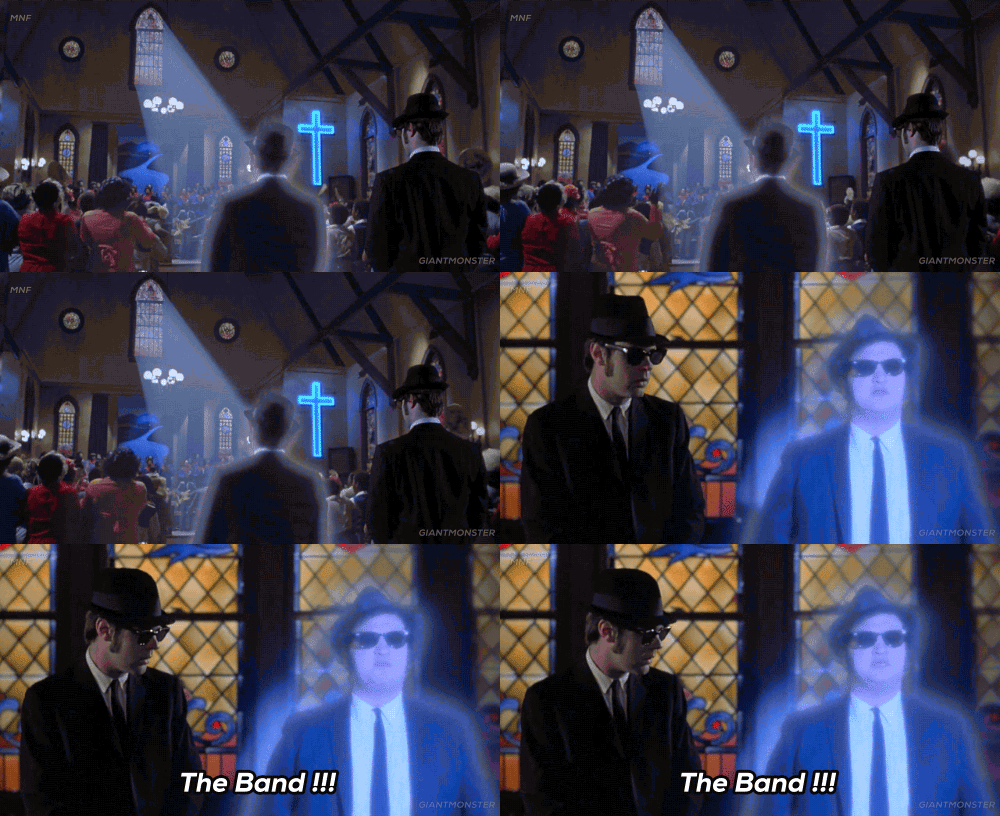
Source: https://www.reddit.com/r/hawks/comments/5wrv5q/pending_ufa_dman_johnny_oduya_is_indeed_heading I now think one of my New Year’s resolutions ought to be: to no longer forgive people if they continue to remain ignorant when the truth is so undeniably obvious. [4]
[1] See “jmdm. fliegen die gebratenen Tauben in den Mund” [ https://www.dwds.de/wb/jmdm.%20fliegen%20die%20gebratenen%20Tauben%20in%20den%20Mund ]
[2] For more about the difference between indigena and propaganda, see also “Propaganda Information Technology vs. Indigena Information Technology — the Basic Idea” [ https://indigenous.news.blog/2022/05/07/propaganda-information-technology-vs-indigena-information-technology-the-basic-idea ]
[3] See “No Agenda Show” Episode # 1723, Chapter “Christmas attack in Germany” [ https://www.noagendashow.net/listen/1723 ]
[4] I had originally planned to contrast the propaganda machines in the USA with their counterparts in Germany, but perhaps I will save that for another post. I do, however, wish to at least recognise the astounding work by Matt Walsh with his “establishment”-breaking documentary “What is a Woman?”.
-
Why Do You Want to Share Your Ideas?
This morning I heard an author being interviewed. In my humble opinion, the radio-person asked a strange question: “Why do you want to share your ideas?”
in order to visualize for yourself just how strange this question is, consider how every human being is brought into this world. Even before we are born we seem to be aware of human conversation. Parents give their children names — they speak to them by name. They narrate everyday life, every day. They introduce their children to society. They bring them to schools, and these schools teach children the “proper” way(s) to use language(s). The entire social fabric of humanity is interwoven with languages, with expressions and with many techniques for sharing ideas with one another.
And so when this radio-person asked: “Why do you want to share your ideas?” I found this shocking. I gasped and was taken aback, and wondered: how would I answer this question if it were asked of me?
I think my first “gut reaction” was something like “I wish to communicate” (or maybe “I wish to practice communication” or something like that). Yet words often have quite multi-faceted connotations and therefore such expressions can have quite unintended interpretations. Later I thought maybe “I wish to express myself” might be a better way of putting it, but now I feel “I wish to participate in humanity” might be best of all.
And now I have to chuckle — because of an insight that occurred to me at least a decade ago already: I myself am not particularly proud of the species I apparently “belong” to (see also e.g. “Sometimes I Feel So Proud to be Maladjusted“)
It is widely accepted as an established fact that some of the most severe (and perhaps also cruel) punishments known are things like ostracization or solitary confinement. Nonethless, one of the first things that occurred to this radio-person was to ask: “Why do you want to share your ideas?”
When something as absurd as this happens, I become flabbergasted — even (almost) speechless. Yet there is indeed an Internet-Abbreviation that seems to hit the nail on the … um, head … namely: SMH.
-
This Life is Different
I know a woman who is a singer / songwriter — more or less. She’s written some Christmas-themed songs, and she is currently on tour singing some of these and also some of her favorites. I visited one of her events and she sang a song that I feel was (at least somewhat) intended for me. I enjoy this imagined intimacy, so I didn’t even ask her about it. I will not name her to spare us both the disappointment of reality crashing in on our dreams.
Instead I will write this post — and again: it’s (at least in part) for her.
I have never lost my religion, but my beliefs have indeed changed quite a bit over the years. In my humble opinion, all calendar-based religions are essentially a matter of worshipping the Sun. I think Sun-worship makes a lot of sense, since this results in acting appropriately throughout the seasons.

Source: https://www.carnivalarts.org.uk/post/what-is-yule Beyond that, it doesn’t really matter much what I believe — insofar as it probably doesn’t have much impact on reality.
The way I see it, there are basically two approaches to belief systems. Believers can either be tolerant or intolerant. With intolerant believers, failure to believe what they believe results in believing the different person is certainly lost.
One way this plays out in many modern Christian cultures is when they ask things like “what are you doing for Christmas?” My response to such questions is usually bewilderment at the fact that those people seem to be in a sort of mesmerized state of existence. Depending on my mood, I might reply with something like “nothing” or maybe “sleeping a lot”. The mesmerized people often react with something like shock and / or pity that I am not living in line with their own herd behavior.
As I mentioned above, I don’t believe such herd behavior is wrong. Neither is it exclusively right, and so I see no reason to share in the herd mentality that everyone else might be lost.
-
Human Brain Conditioner: Human Nature is a Top Secret Affair
Over the past several weeks, I have focused on the quasi “post-mortem dump” of the so-called media‘s election coverage in the United States. I no longer usually pay much attention to the junk that has increasingly become known as “mainstream media” — I prefer to focus more on the distinction between “rational media and “irrational media” (see e.g. “Rational Media” [ https://phlat.design.blog/2024/01/14/rational-media ] ).
Just a few day ago, I wrote a longish essay that spans media trends over the past half millennium (since about the time of Gutenberg’s printing press — see “Taking words out of context and thereby thinking outside of the box” [ https://contextual.news.blog/2024/12/05/taking-words-out-of-context-and-thereby-thinking-outside-of-the-box ] ). In my long and winding blathering I also touched upon a concept which became quite popular during the Enlightenment: “Natural Law”.
In the past few days of reflecting upon those reflections, I am now struck (yet again, since I have noted this before [at least privately] ) by an oversight in both natural sciences and social sciences over the past few centuries (i.e. since the Enlightenment): there is no longer widespread publishing and communication about scientific discoveries.
Increasingly, scientists do their scientific work (and thereby produce “science“) behind closed doors. Whether in a lab in Wuhan, China or in a video studio in New York, Hollywood, Austin or indeed anywhere in America there are people studying anything and everything from the most itty bitty microscopic tidbit to a full-blown celebrity impression, and especially inside of cyberspace headquarters, top-notch geeks sit around conference tables and study what kinds of impact each and every pixel on their platforms will have on each and every message blurted out through each and every application, advertisement and whatnot more.
All of this manipulation and manipulative propaganda scheming is (of course) TOP SECRET. The algorithms are TOP SECRET. The money is TOP SECRET. The deals are TOP SECRET. Pretty much everything is TOP SECRET.
One thing, that is NOT a secret is a very well-known fact on Wall Street: this is a very big deal, and this is very BIG BUSINESS. Billions of suckers are being duped every day, and they are even standing in line waiting to pay an entrance fee to the REALLY BIG SHOW.

Social Business (WordPress weblog)


 Socio Business blog