-
Pretty Pictures
One nice thing about PDF documents is the pretty pictures.

Spread of misinformation ranked by most widely identified sources / creators. Source: https://www.bertelsmann-stiftung.de/de/publikationen/publikation/did/verunsicherte-oeffentlichkeit Granted: Beauty is in the eye of the beholder, but this image shows the extreme disconnect between reported facts and actual reality like no other (in my not so humble opinion 😉 ). Anyone who believes that the advertising industry is all about honesty has a few things to learn about misinformation. Nonetheless, this graphic depicts “Wirtschaftsunternehmen” (roughly: “business concerns”) as the least prone to practice misinformation — at only 30%, compared to the “average Joe” you might meet on any street corner (listed at 50%).
I became aware of this so-called “study” published last week because it was drilled over and over into every household paying attention to German so-called “public” (and also “mainstream”) news media, hammered home hour upon hour so that even the average Joes passed-out drunk on the couch would be mesmerized by this state support system for the German publishing industry, of which Bertelsmann is a rather large example.
And therein lies the rub, of course. Do you think one of the largest publishers is prone to tell you that the publishing industry is full of shit? No! Of course not!
According to Bertelsmann, what is full of shit, lies, misinformation, propaganda and all sorts of evil things is “social media” — or rather Bertelsmann determined that the average Joes (whether standing around on street corners or comatose on couches) become aware of misinformation predominantly via “social media“. Yet of course “social media” still remains a term which cannot be defined. “Social media” is simply couched as “the bullshit that other people create”. Bertelsmann bullshit comes across as clean, healthy, respectable and such.
LMFAO! 😀
-
Fascism & Regulated Media
Of course the word “fascism” is a loaded term. Let alone that the term was invented by some short pudgy Italian only about a century ago. What does it mean? He might have known, but in the meantime (now, a century later) the term has been applied so often in so many contexts that it seems like little more than the perfect prototype for quintessential newspeak.

Source: Fascist symbol https://en.wikipedia.org/wiki/Fascism As I sketched out in one of my first blog posts (“What is the Primary Goal of Social Business?“), one of the main focal points of “Social Business” is the struggle between two opposing forces (roughly: freedom vs. government) and I find it intriguing the way one of the defining characteristics for “fascism” is a supposed alliance between government and business interests (a vague amalgamation roughly aligned with concepts like “capitalism” or “bourgeois”).
Not only during the past century, but also in particular in the last few years the world has experienced such alignments in the realm broadly referred to as “media“. My hunch is that a big part of what precipitated this “when the shit hits the fan” moment is the Internet … which is now like a genie that’s gotten out of the bottle.
Before concentrating on the latest news, let me backtrack a little and give a brief overview and historical context to the notion of “regulated media“. I guess I don’t need to go all the way back to the dawn of civilization, but let me nonetheless make a broad blanket statement that somehow a small number of “elite” kind of people wrote stuff down like it was some kind of message from God (and therefore ordinary people should shut up and listen). This was more or less the case everywhere for many thousands of years.
Then what happened is: a lot, more or less all at once. A little over half a millennium ago, many discoveries were made … and the “printing press” (with movable type) was invented. Discoveries plus a booming business with printing presses proved quite explosive, and shortly thereafter the first attempts to regulate media sprung up like springtime in full bloom. The times were ‘a’ changing, including not only reformations but also revolutions. Things were getting curiouser and curiouser, maybe even a little out of hand, which eventually led to the short pudgy Italian who invented “fascism” — perhaps mainly in order to prevent “communism“.
By this time there were already quite a lot of regulations “on the books” about books and stuff like that. They had dribbled in sort of piecemeal over the intervening centuries, but had definitely “taken off” in a more significant way since the new & improved invention of offset printing had made widespread literacy much more of a feasible prospect.
Once widespread literacy had been — more or less — established, a new avenue for regulating and controlling media could be opened: the central regulation of strings of characters. This allowed governments to get a foot in the door into the business of regulated media. This was the birth of privately owned strings. Allowing one entity the right to its own definition of a particular string of letters was undoubtedly a novel idea. Up until this point, such strings of characters had always been a mutually agreed upon matter (by the community of “speakers” of a language). Increasingly, governments are selling off more and more such strings all the time, as we speak, here and now (and presumably for forever more?).
Regular ordinary folks like you or me generally don’t think about this very much … mainly because these strings seem like Greek to me (or maybe like Chinese or English to a Greek person?). Besides: this is only one form of media regulation. There is another form that might be even more significant, at least in some ways.
Over the past century or so, the entire business plan of Gobbledygook strings has been established, developed and expanded significantly. As they exist today, each Gobbledygook string company functions more or less like a marketplace, bringing together supply and demand for something (in the case of media companies, roughly the supply and demand for ideas). Three parties are involved: the supplier, the demander, and the marketplace administrator. The administration of a marketplace leads to transaction costs, and these must be recovered from one of the other two participants (plus a little amount of profit, in order to keep the administrator from wandering off to do something else instead).
Since information wants to be free (see also “All Your Data Are More Free to Us“), but also in order to present an image of impartiality, media companies generally gravitate towards getting someone else to cough up the money. Early on, these “others” were more or less random entities (aside from the very early times, in which they were generally entities with some “axe to grind” of their own), but increasingly these others are other entities with their own manipulative interests. Gobbledygook media companies themselves are increasingly on the verge of bankruptcy, subsisting only on arbitrage, while others make more of a killing through their manipulative engagements.
Since almost all companies today are Gobbledygook companies, they are all regulated by government regulations concerning Gobbledygook strings. In addition, Gobbledygook media companies are also regulated by other entities which pay for their ability to economically subsist. The motivation for these other entities to engage in these marketplaces is in order to manipulate the suckers who hope to find information in the marketplace.
Which lessons from the past few years obviously lead to this conclusion are left as an exercise for the reader.
-
Captain’s Log
I recall the television series “Star Trek” … and the entries entered into the “Captain’s Log”, which were spoken somewhat in the voice of a narrator. This didn’t occur odd to me at the time, but as I reflect on it now, I do find it odd that this narration seemed so trustworthy and reliable. Today I would no longer put so much faith into the perspective of some storyteller, and almost certainly not if that storyteller is telling “their own” story.

Source: https://www.giantfreakinrobot.com/ent/star-trek-erasing-kirk.html I want to reference another image from mainstream media — namely that of Robin Williams’ portrayal of the teacher named Mr. Keating in the movie “Dead Poets Society”, who was endearingly referred to as “Oh Captain, My Captain” by his students.
I find this mashup of stories particularly poignant for several reasons.
First of all, Star Trek emphasizes the organizational structure which is the glue holding together the fictional Star Trek world. In contrast, Mr. Keating is the iconoclast who liberates his students from their natural inclination to conform to the order embodied in a variety of social organizations which are integral parts of the setting at work throughout the film (such as school, families, religion, etc.).
While many writers prize their own liberty to engage in writing according to their own individual freedom, very few are very much aware of their own social engagement and how it is constrained by the natural order imposed on them through their own participation in the social cohesive forces at work when they address particular audiences. Perhaps the most fundamental of such constraints are the languages a writer chooses to write in — yet I imagine that many writers may overlook their language much in the same way as fish might overlook the fact that they are immersed in water.
There is another way — at least one other, probably many more.
The one I am thinking of appeals to another authority. It’s neither an appeal to an organizational captain, nor to an individual inner voice (note that many people seem to have many inner voices, rather than limiting themselves to just one). In order for me to adequately describe this other way, I need to clean up with a very widespread misconception about a term commonly referred to as “network effect”.
In most technology circles, a network effect is considered to be a purely technological matter. That is not very surprising or objectionable. What is, however, surprising and objectionable is to not consider natural language to be a technology. This is so blatantly obvious, it should actually be immediately recognized without needing me to point it out. If a person grows up in an English-speaking community, it should be obvious that the person will be “locked in” by the English language. Likewise with any other language. That there are some people who are versed in more than one native language is equally obviously the exception to the rule (I have an entire other blog devoted to this complex situation — see e.g. the article “Propaganda Information Technology vs. Indigena Information Technology — the Basic Idea” [ https://indigenous.news.blog/2022/05/07/propaganda-information-technology-vs-indigena-information-technology-the-basic-idea ] ).
Humans are caught in the crossfire between choosing which language(s) to learn and being constrained to the choices we have made … and the most significant choices are made even before we become aware of the fact that something is being chosen at all.
Let me conclude this post with a very odd (and also very widespread) misconception, which seems to be linked to the misconception about network effects described above. Many (if not most) people behave as if their entire existence is encapsulated within a brand name (or at most a few brand names). They ask each other things like “where can I find you?” and then exchange their brand name information. [1] Such limitations are essentially cases of self-censorship (and mutually accepted manipulation via third parties). This is of course completely ridiculous — but people actually do behave this way as if it were as obvious as the air we breathe and cannot live without. People prone to such behavior apparently integrate propagandistic pollution into their communications almost as if they had no choice in the matter at all.
[1] see also “Rational Media” [ https://phlat.design.blog/2024/01/14/rational-media ]
-
Be the Government You Want to See in the World

If this realization comes to the ruling elites, then yes: then the first person of the state will act in anticipation of what the voters and the people who make decisions at various levels expect from this person. Then, maybe, something will change.
Vladimir Putin, in conversation with Tucker Carlson -
A New Kind of Market Failure?
“Market Failure” is commonly thought of as something that goes wrong with the way normal (“free”) markets work. There are actually a lot of assumptions made about how such markets work normally, and many of these are so illusory that it seems amazing anyone would ever pay any attention to what any economist says — ever.
I will let you consult introductory economics textbooks to find out more about such introductory affairs. [1]

Here, I wish to talk about something completely different.
There are some other assumptions often made (not only by economists, but even by regular folks, too) … such that “producers” exist only to produce, “consumers” exist only to consume. For the most part, this has to do with language: if you don’t want to single out “producers” or “consumers” (or any other groups), then just say “people” (or if “people” unfairly privileges human beings, maybe “things”?).
Long gone are the simple days of “supply” and “demand” and “widgets”. Today, the world is complicated. [2] Today, we may be stupendous at calculating breakneck speeds of growth with mathematical precision, but only a fool would overlook the simple fact that all of these fancy bells and whistles are financed with fossil fuels.
This brings me to our current daily diet of revolutionary uprisings. It seems like all over the place, we’re hearing about farmers showing up riding their tractors and blocking markets (for their own products, no less) … making demands for oil. Wouldn’t it make more sense to simply show up at the harbor and unload the oil from the tankers arriving there? Oh, wait — maybe there might be a few glitches in the technology, right?
[1] See also several other articles on this blog, e.g. “Supply, Demand, Natural Language & Free Markets — Some Preliminary Thoughts & Ideas” [ https://socio.business.blog/2023/01/22/supply-demand-natural-language-free-markets-some-preliminary-thoughts-ideas ] , “Free Speech & Market Speech” [ https://socio.business.blog/2023/05/08/free-speech-market-speech ] and “Motivational Characteristics of Marketplace Participants” [ https://socio.business.blog/2023/05/22/motivational-characteristics-of-marketplace-participants ]
[2] Besides: Even given that “classical” economics has existed for only about 250 years, I don’t see a lot of efforts to explain world events prior to the “discovery” of economics using economic theories.
-
We need to figure out what’s going on
This is something a Silicon Valley celebrity said recently — and I’ve decided to “steal” it because the meaning is actually rather ambiguous and depends a lot on context. The person who said it, simply said it in passing and didn’t contextualize what was meant at all — I actually have a vague “gut feeling” that it was actually used in a manipulative way (because the entire conversation it was embedded in rather nonchalantly was pretty much all about manipulation — perhaps it was itself nothing other than a piece of propaganda?)
Very well, then — what does this statement mean to me? (and hopefully, by the time I am done, also to you?)
I’m so glad we’ve asked! 😉
One thing that’s going on right now is this stuff called “artificial intelligence” (AI) — and a primary reason for this activity has to do with economics.
Yet another reason is the recent “discovery” of language. So-called “prompt engineering” has to do with using language in such a way that effective results can be obtained (this is “ask a stupid question, get a stupid answer” on steroids … or even stronger: AI).
So, this line of thinking goes like this (more or less): Increasingly, content will be “created by machines”. If you’re thinking “that’s fucking absurd!“, then I guess we’re sort of on the same page.
One of most important distinctions to make is the vast difference between intelligence and pattern recognition. Intelligent beings can identify patterns. Artificial intelligence can only recognize patterns that have been defined (i.e., “cognized“) by intelligent beings. All of the hot air and cyber-bullshit boils down to this very simple but immensely significant distinction. Artificial intelligence cannot surpass human intelligence, simply because it is based on human intelligence much in the same way as a reflection is based on the original image.
The second completely wack-o notion is the crazy idea that natural languages are logical. Only extremely feeble-minded nincompoops would ever go so far out on a limb as to propose something so preposterous. Unfortunately, there seems to be a very large congregation of very wealthy and very narcissistic people engaging in precisely such moronic behaviors with one another on a very large scale right now, currently, as we speak, as if they knew the answer to some kind of metaphysical question. It’s actually nothing — it’s just bullshit. [1]

Photo by Markus Spiske on Pexels.com Now I will make a prediction of my very own about the future. In the near to medium future, some of these silicon fanatics will finally come to the realization that there is no such thing as a “logical language” that will solve all mysteries across the universe. That’s simply not how language works. Nature (and natural languages) are distributed processes and as such are very localized and limited. We can breathe in the air [2] here on Earth, but not in space or on Mars. The way such a realization event will most probably ultimately precipitate is when the so-called “large language models” become advanced enough to be able to distinguish several distinct languages to the point that some languages will be deemed appropriate for particular tasks (while other languages will be deemed more appropriate for other tasks) — much in the same way that E.F. Schumacher (and his followers) were able to distinguish other “appropriate technology” solutions to the highly localized economic issues and problems that were being solved at the time.
[1] Some of my readers may actually be familiar with such a line of argumentation from a movie that was quite popular about half a century ago named “The Blues Brothers”
[2] cf. “Breathe” by “Pink Floyd”
-
Sometimes people are skeptical, sometimes people are NOT skeptical, but you can bet your life that ALL people are skeptical (sometimes)
It’s definitely a good thing that all people are skeptical — at least sometimes.
I find it intriguing (and even fascinating), though, that people’s skepticism does seem to follow somewhat predictable patterns — and that such patterns actually interfere with their ability to deal with bias and biased information.
This has a lot to do with (and is sort of a “follow-up” to) last week’s post (about “What’s the Difference (Between Mainstream Media and Echo Chambers)?” [ https://socio.business.blog/2024/01/14/whats-the-difference-between-mainstream-media-and-echo-chambers ] ) Let me illustrate this by analyzing two popular podcasts I have listened to now and then.
One which I listen to more now (occasionally) is the so-called “Joe Rogan Experience” (which was also mentioned and cited in last week’s post). One which I used to listen to more several years ago was (is? I don’t know how regularly new episodes of this are posted) Jason Calacanis’ “This Week in Startups” (which was sort of a spin-off of another podcast, “This Week in Tech”). Let me focus on one of the differences in approach I recognize between Joe’s and Jason’s podcasts.
Both Joe and Jason often address a topic which I would like to refer as “exploitation”. Yet they appear to take different perspectives. Whereas Joe usually sides with the exploited, Jason generally sides with the exploiter. “Exploit” here is a charged yet also somewhat neutral term from economics. According to this point of view, there is nothing wrong (for example) in reaping the benefits from economies of scale — i.e., in exploiting them.
Yet if the exploitation has something to do with people, then the waters seem to get much murkier, much less clear-cut, much less kosher. Perhaps one of the most controversial cases of traversing this ethical tightrope is a quote commonly attributed to P.T. Barnum: “there’s a sucker born every minute” (see also “There’s a Sucker Born Every Minute“).
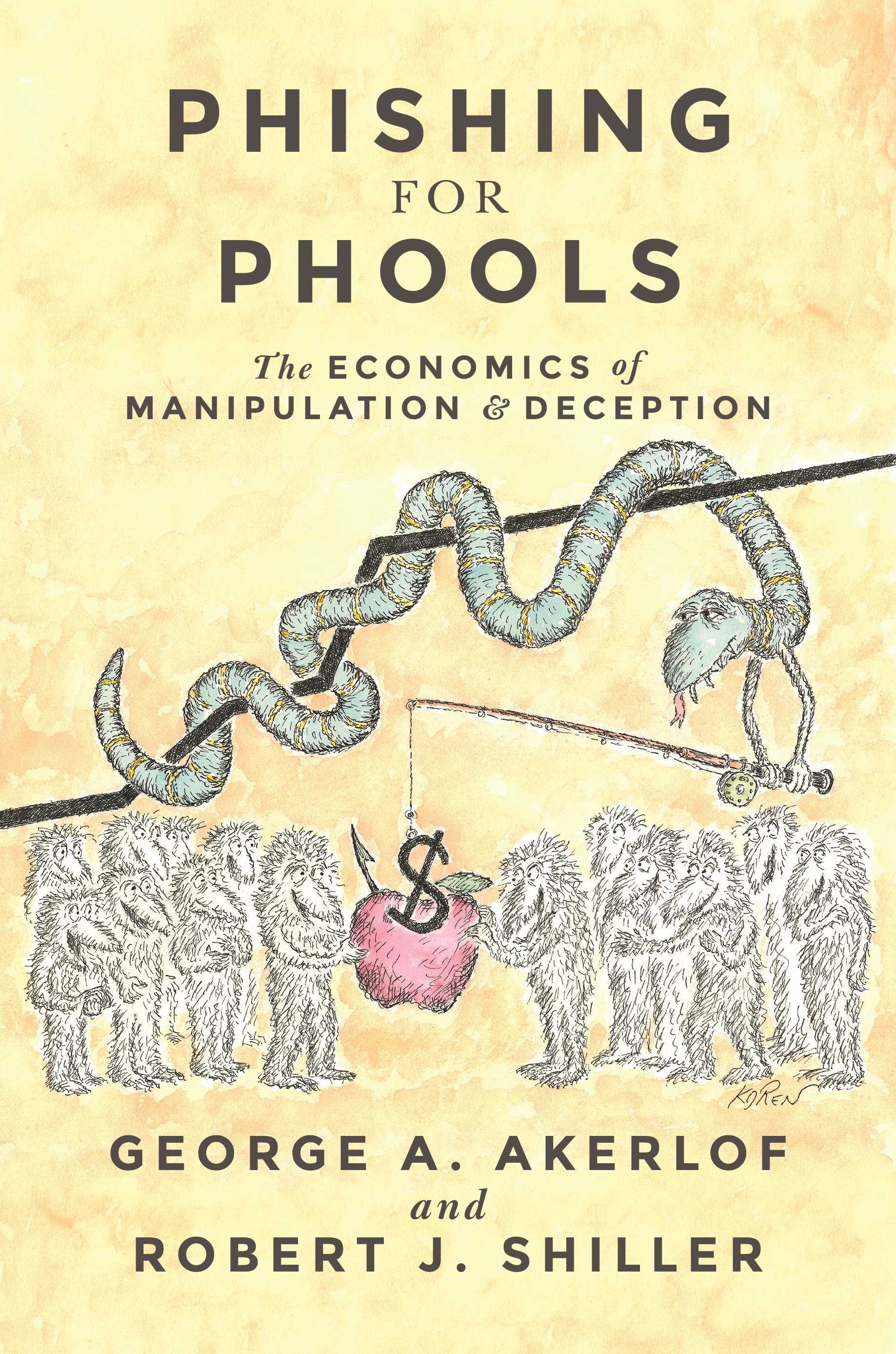
“Phishing for Phools” by George A. Akerlof and Robert J. Shiller [ https://press.princeton.edu/books/ebook/9781400873265/phishing-for-phools ] If my analysis of the difference between Joe’s and Jason’s podcasts is somewhat correct, then it might be reasonable to assume that people who believe that “making money” through exploitation is OK might be more prone to align with Jason’s podcast and that people who believe that such exploitation is (in some cases?) objectionable might be more prone to align with Joe’s podcast. Likewise, it might also be reasonable to assume that such differences might influence the “credibility” of said podcasters.
Such partisan alignment would probably also influence choices regarding which sources of information are deemed trustworthy and whether media sources are considered “mainstream” or “echo chamber” — i.e. whether a source is “credible” or “incredible” (such that a skeptical attitude seems warranted).
-
What’s the Difference (Between Mainstream Media and Echo Chambers)?
Joe Rogan and Debra Soh were recently engaged in a lengthy discussion (about several topics, but also in particular) about differences between mainstream media and non-mainstream media — it was a recurring topic throughout the episode, and I recommend to consume the full podcast before reading my own take on it (see also “Are People “Exposed” (or “Siphoned Off”) to Echo Chambers?” [ https://podcasts.video.blog/2024/01/10/are-people-exposed-or-siphoned-off-to-echo-chambers ]
Note that the term “echo chamber” was only used once by Debra Soh, but the contrast she created by using this term sort of triggered me to examine the terminology more closely. Both Debra and Joe seemed to be in agreement regarding how one ought to be considered significant and the other ought to be considered insignificant … and yet Joe’s description of “mainstream” seemed to indicate not what Debra considered to be mainstream, but rather what she considered to be “echo chamber”. Therefore, since there seems to be somewhat of a mishmash of “apples and oranges”, I decided I should use this as an opportunity to clarify my own thoughts on this “media” issue.
In my opinion, the significant difference that exists between significant versus insignificant media is whether the media are “rational media” or “irrational media”. As I have recently archived the blog where I first delineated these two terms, I have gone back to the archives and will now publish a “new and improved” version of some of these ideas from the vaults.

I have already mentioned PHLAT (“Pretty Hyper Local and Topical”) News on this blog. I now wish to introduce more of the basic ideas at the foundation of PHLAT design [ https://phlat.design.blog/2024/01/14/introduction ] — the technology that we use to navigate the PHLAT world of the WWW. I have decided that this is important because I continue to notice how much people still seem to be lost on the Internet.
-
Everything is Special, Nothing is General (Knowledge)
I’m guessing that sounds sort of extreme … yet I am repeatedly led to this belief.
I don’t believe in such a crass statement as “everything is special, nothing is general“, but I do notice something about the way other people believe to know something about which they obviously have little or no knowledge whatsoever. In general it seems like many people make lots of errors by venturing out onto thin ice and not realizing how crazy they behave simply because they are too uninformed (or perhaps too uneducated) to pay attention to a specialist.
I guess the “renaissance man” (who was probably usually also a white man) is largely to blame. For example: Leonardo Da Vinci dabbled in nearly everything. Today, we refer to Galileo as the man who invented modern science. I expect that we do such proto-scientists a huge disservice if we believe they assumed to be knowledgeable about everything under the sun (and then some). I expect these aspiring students of nature knew when they don’t know quite a lot.
While for many centuries, scientists appeared fully unaware of their own biases, today scientists are taught to become aware of them — as if they could thereby become unbiased. And yet very few people — even in academia — are aware of the fact that on a daily basis they let themselves become manipulated by algorithms which only exist in order for the companies who create those algorithms to increase the own profits — and this is not just one “lost generation”, there are several lost generations who lack the required literacy skills to recognize that the answers they search for on a daily basis come from not only biased algorithms, but even immense manipulative businesses in the booming propaganda industry. And now, this crap is even brought to you by “artificial intelligence”.

Source: https://www.proceedinnovative.com/blog/how-to-search-google-like-a-pro I had to watch along as my father was fed endless streams of bullshit by YouTube. Many mostly illiterate members of my family thought this was a good use of his last years of life among “the living”. I saw him degenerate from being mildly amused by this new and improved technology of manipulation to becoming just as lost as the people surrounding him, advising him, recommending him to “take the jab” and so-called “caring” for him by “providing” for him with hospice care. Unfortunately, he ultimately died from trusting some close relatives too much. But even under the best circumstances, he could not have lived much longer. I am unconvinced that he was certainly happy, or certainly unhappy, or anything in between.
The mass of men (and maybe women, too) still lead lives of quiet desperation — how little the world changes!
-
Building on Dunbar
Over the years, I have repeatedly come into contact with “Dunbar’s Number”. I have read articles and such, and yet right now I am offline and wish to only work from my own memory plus a few inspiring thoughts that came to me this morning.

Robin Dunbar Source: https://en.wikipedia.org/wiki/Robin_Dunbar (this site also links to Dunbar’s “website” [ https://www.psy.ox.ac.uk/people/robin-dunbar ] I wish to acknowledge that Dunbar’s work is a wonderful and excellent source of inspiration itself. I realize that my “armchair reflections” pale in comparison to the groundbreaking work Mr. Dunbar did. Nonetheless, since I generally think my own thoughts are immensely awesome, I will unabashedly venture out into what I consider to be largely unknown territory (which is no doubt predominantly unknown to me) with an adventurous spirit of discovery (or perhaps simply as an opportunity to let my brain cells do a couple laps on an otherwise lazy Sunday morning).
I also wish to acknowledge the great patience exhibited this morning by my youngest daughter, to whom I was sharing my plans to write this post, and who also gave me very valuable feedback regarding whether my ideas seemed sort of like sense or maybe here and there might have been more like nonsense.
The general idea is really very simple. Dunbar’s number simply counts the number of contacts. I do recall some differentiation in the quality of these contacts, but my gut feeling is that this aspect was quite minimal (probably simply because of the difficulty of measuring such differences). The way I wish to build on Dunbar’s idea is to propose some ways we might refine this aspect, namely to arrive at some measures which might be good (i.e. valid and reliable) indicators of said relationship quality. Perhaps at a later stage such quantity and quality aspects could be combined into some kind of social integration score (or maybe at least a “whatever” score 😉 ).
It all started with me listening to an interview on the radio related to New Year’s resolutions — exercise, fitness, junk like that. The wise guy (who has published books on these and related topics) mentioned in passing that doing exercise in groups can also help to build relationships, and I think that was the inspirational spark that got my mind and brain cells spinning towards some sort of newfangled solution. Because my mind is a very simple thing, my first solution was also correspondingly simple: count the number of hours of contact (per week). I then thought contacts that didn’t have any contact in a week should be dropped, but I now think it might be better to track a rolling average over a full year (and even if the contact were to break off for a full year, then to nonetheless still keep tracking the statistic).
I realized from the get-go that this statistic was insufficient. Yet I didn’t directly think of any way to improve the measurement of this amorphous concept that itself still remains mostly undefined. As I have been continuing to think about it, the image of the legendary Spock wandering about on some newly discovered planet with his trycorder (as a kid watching the original “Star Trek” television series, there was no doubt in my mind that this gizmo would have been spelled “tricorder”, but I find this revised spelling much more amusing now 😉 ).
After lots and lots of thinking (we’re talking lots^2 here 😛 ), I have come up with another “new and improved” measure: count the vocabulary used per contact. This sounds very simple, but actually “doing the math” appears quite difficult. For example: when I board a bus, I make eye contact with the bus driver and hold up my ticket; the driver then (normally) indicates (usually with a facial expression or perhaps a gesture) the permission to ride along. What is the vocabulary of such a contact? Maybe 1? Or 2? Personally, I would find it much more intellectually pleasing to consider this to be a vocabulary of 0, and to consider only verbal exchanges. As such, the bus driver would remain essentially undifferentiated from a random passerby with whom I might make a short eye contact with, yet with whom I nonetheless have no meaningful relationship whatsoever.
I also find this intellectually pleasing because of how I feel it “actually works” — I notice that simply saying “hello” to someone immediately differentiates them from the anonymous crowd which populates the entire planet.
That is all I feel able to muster this morning — class dismissed! 😀

Social Business (WordPress weblog)
 Socio Business blog