-
The Communities Involved in Common Knowledge
I have long since been fascinated by the concept of “common knowledge“. People often appeal to this concept, but that doesn’t make it any more clear what is actually meant by the term.
This week, two examples of how such “common knowledge” interferes with publicacy appeared on my radar.
First, on another blog, I wrote about how a teenager expressed quite clearly that she seemed to be confused about the terminology related to publicacy (see “I think ‘publish’ is not the accurate term to use because I only want some close friends to read it, lol” [ https://wants.blog/2024/05/09/i-think-publish-is-not-the-accurate-term-to-use-because-i-only-want-some-close-friends-to-read-it-lol ] ). Ironically, although this expression showed a great deal of sensitivity with respect to this sensitive issue, the teenager more or less blurted out the expression “only want” when what was actually meant may have been something more like “want only”. This seems reminiscent of last week’s post [1] insofar as language sometimes seems to be used without thinking what the expressed words actually mean. The way I interpret “only want” is something like wanting, but not needing or demanding; yet “want only [X]” I would interpret as wanting exactly X, no more, no less, not Y nor Z. Either way, in any case the teenager in question quite obviously lacks publicacy skills, since she seems to be unaware that Silicon Valley companies like Google or Facebook or whatever spyware used are constantly scouring the entire WWW and pore over every minute detail in order to collect information which might be helpful towards reaching their business goals of manipulating ever more people ever more effectively.

Likewise, one of my German friends (who could also be described as an “educated adult” or also as an “old white man” or indeed in innumerable other ways) expressed confusion about the slogan “The Whole World is Watching” (which I referenced in last week’s post [1] ). I thought I had been explicit enough, but I now have learned that (yet again) I was wrong to assume that something might be so-called “common knowledge” (see e.g. ““The Whole World is Watching”” [ https://squ.data.blog/2024/05/11/the-whole-world-is-watching ] ). What kills me, though, is the fact that my friend considered a Google search to be adequate to prove his case. In contrast, all the Google search proves is his own lack of publicacy skills! (LOL) 😀
[1] See “The Whole World is Sleeping“
-
The Whole World is Sleeping
If you (like I) grew up in the United States, or if you have lived a somewhat “mediated” life, then you are probably familiar with the chant “The Whole World is Watching”. You may not know that this chant is older than the popularized Internet, which only really took off once Tim Berners-Lee more or less invented the World-Wide Web (which is also commonly referred to as the “www”).
The germ of many of my posts here are simple ideas like this one, but then I do something a friend of mine once referred to as “pushing the envelope” — in other words, I play with these simple ideas and see how they interact with other ideas. That is what the title of this post is about. It is very easy to disprove that “the whole world is watching”. Rocks and dirt are parts of the world, and as far as I know they aren’t watching. And while they also might not be sleeping, they seem to be more asleep than they might be considered to be awake, let alone woke.
Many if not most life forms seem to practice sleeping regularly. Some philosophers consider sleep to be an almost ideal state of happiness and contentment. Being asleep seems to be quite unproblematical — yet at the same time, it sometimes seems to be somewhat of an insult to be asleep (for example in the face of the so-called “Protestant Work Ethic”).
Awareness and watching are closely related to concepts like being awake. Anti-capitalist movements like the Luddite movement were strongly opposed to machines which seem to not require regular sleep (yet which do indeed require some maintenance — and a WHOLE LOT of energy [1]).
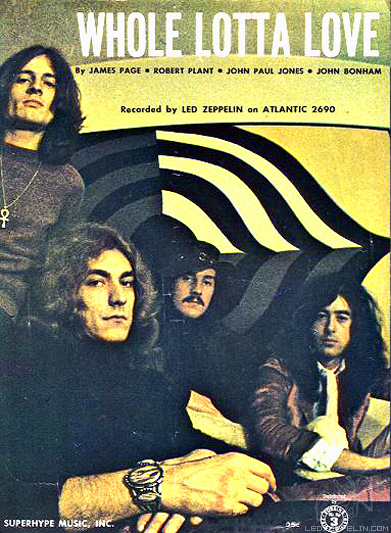
Source: https://www.ledzeppelin.com/photos/memorabilia/general/whole-lotta-love-sheet-music-1969 Sleep is of course not simply an inactive activity. In recent decades, it has been discovered that sleep is a crucial activity which allows a lot of reflection to take place, providing a space for a wide variety of observations and ideas to be “sorted out”.
Let me also add that last week’s emphasis on publicity, public knowledge, etc. definitely also plays a role in my thinking about the aforementioned well-known chant (see “What is Publicacy + Why does it Matter?“). For example, I considered whether people lacking publicacy and / or literacy skills might be considered something more like comatose or perhaps suffering from something like “brain fog” or dementia. Images of zombies with eyes in fact open yet awareness (or perhaps “sentience”?) not obviously present went through my mind.
I have but one conclusion: People chanting “the whole world is watching” are definitely not telling something true, truthful, let alone the truth. This chant is much more dishonest than it is honest — if honesty can even considered to be a factor worth considering at all.
[1] cf. discussion @ “What a Fink – Making AI a reality?” [ https://www.noagendashow.net/listen/1656?t=9:11 ]; whether Robert Plant and / or Jimmy Page surmised that machines could also need a “whole lotta love” is beyond the scope of the present analysis.
-
What is Publicacy + Why does it Matter?
Considering how many people are affected by media world-wide, it seems a little odd how few are aware of how much media control their lives. That’s quite a mouthful, so let me take a step back and describe the so-called global media landscape of today.
Ever since the stone age, humans have been refining concepts like “media” and “publicity”.

Source: https://www.dreamstime.com/people-talking-soundwave-ear-anatomy-medical-d-illustration-d-illustration-shows-talking-people-soundwave-ear-image159040892 Media originally referred to stuff like the air that carried sound waves or the water that carried boats and such. Publicity is a concept derived from the ancient notion of “public”, which today is interpreted quite differently by different groups.
The standard interpretation of a global public roughly sees in this term more or less all of humanity. In contrast, in the field of public relations, the term “public” is commonly used in its plural form … and a wide variety of different “publics” are differentiated.
Yet most ordinary folks gravitate more towards the standard (global) interpretation — and thereby they are most probably hugely mistaken. I myself do not believe that this post is in any shape or form easy to access world-wide. I am not so foolish to think, for example, that simply because it is written in English, that it therefore must be available everywhere across the globe. No, I am well aware that simply because I do not cough up money to Google or Facebook or a bunch of other companies, that they will do everything possible to prevent it from being shown instead of advertisements these companies can reap profits from this very moment. Likewise, I am also not so foolish to think any company would ever inform me of something I care about instead of making profits for their shareholders at every opportunity possible. After all: That is their entire business model.
Publicacy refers to the understanding of “how to” make information public. Previously, I have referred to “literacy” with regard to such understanding about publishing, publications, etc. But even more specialized terms such as “media literacy” are insufficient to the task, in large part because the media industry and related publishing industries are now so strongly influenced by market forces, that they no longer have any public interest as their focus. Instead, their dependency on the advertising industry leads these industries to also become ever more complicit in propaganda and manipulation of the publics which were once their chief customers.
The very low rate of publicacy is increasingly leading to ever more uninformed and misinformed publics. Large masses of men and women alike are leading ever more miserable lives of quiet (and ever more tricked out) manipulation.
-
Trusting the Sales Person
I have a hunch that gullible people are one of the biggest problems humanity faces today.
It seems like used car sales persons have had a bad reputation since time immemorial, and what’s perhaps even more surprising is that time immemorial seems to go back no further than the invention of the automobile. Which people had the bad reputation before anyone could sell used cars? Horse traders? Snake oil sales persons? While one prominent idiom that remains from earlier eras is “don’t look a gift horse in the mouth”, there is a clear implication that you should indeed look a horse in the mouth if you are paying money for it.
Yet although several centuries ago Benjamin Franklin observed (and wrote) that “time is money”, and even though there have already been decades of lip service about the so-called “attention economy”, it is astonishing how few people actually are aware that their own attention is a significant economic factor. People generally believe they are immune to any attempts made to manipulate their minds — even after the CoVid history (let alone the multitude of military invasions based on shoddy so-called “facts“) clearly shows the opposite is actually true.
Probably the clearest tell-tale sign that manipulation is booming is the value of the companies most engaged in it — the so-called FAANG group (Facebook, Amazon, Apple, Netflix, Google) are soaring like there is no tomorrow. These companies are so full of hot air, that their prices ought to be referred to as balloons, not mere bubbles. Yet when I talk with the teenagers (who are the primary target audience for such manipulative marketing schemes), they almost always mention that they do indeed recognize that such manipulation is taking place. The problem is that these young people are apparently too naive to recognize that such observations are simply the few isolated cases of manipulation gone wrong, and that the mainstream cases (of manipulation gone quasi-“right”) are what the skyrocketing stock prices based on bullshit are evidence of.
The blind faith in progress remains astoundingly widespread — it is now (yet again) another well-known fact that “it’s getting better all the time”. All of the FAANGs are incessantly fiddling around with their so-called algos (i.e., algorithms) to provide NEW and IMPROVED services day after day. Most people simply assume that this means the NEW and IMPROVED news must be more trustworthy than ever … they apparently still can’t fathom that the true reality is that the investors are actually investing ever more resources into making the news more manipulative than ever.
-
“Leider” — Information Asymmetry in Leading Media
Up until now, I have regularly participated in a radio program in Germany (in German language) where participants are invited to ask questions about an author’s new book. The show is quite popular, and I find the programmers are being increasingly selective regarding the questions — not only is the censorship quite obviously becoming more and more idiosyncratic, but the setup is inherently asymmetric … such that authors and interviewers are given ample time to expound and advertise their own ideas, yet thirsty consumers are only allowed to submit short soundbites as merely shallow food for thought.
I believe I have pledged to quit submitting to this authoritarian scheme before, and yet yesterday I did it again. The case was so egregiously steeped in woke leitmotifs that to say it ruffled my feathers is an equally extreme understatement. Looking back, I now realize I should have known better.
Instead of wasting my time in such submissive exercises, I should simply express my own thoughts without paying attention to such “leading” censorship platforms.
This is of course one of the main reasons why I am so adamant about literacy skills — and in particular why I am so upset about the insufficient literacy skills of the vast majority of “online” participants.
The vast majority of online “users” feels that being able to find the ON / OFF switch is a license for “understanding” information. These masses have little or no idea whatsoever why they use irrational [1] censors like Google to “search” for propaganda and advertisements. They lack the literacy skills to realize that the reason they are shown advertising is not because such ads are adequate answers to their questions, but rather that there exist enough companies with enough money to pay Google a pretty penny to show these ads to Google’s so-called “users” [2] — who are actually better referred to simply as potential consumers of the advertisers’ products and services. [3]
This is not new information. [4]
[1] See also “Rational Media” [ https://phlat.design.blog/2024/01/14/rational-media ]
[2] People who “use” Google search are actually the suckers who are being sold to advertisers
[3] In many cases, Google advertisers are actually other companies owned by the same parent company as Google
[4] See also “The Social Construction of Publishing“
-
Truth or Dare
I find it funny the way sometimes playing around with words can lead to new insights about the world we live in.
This morning I was playing around with binary concepts — like “Yes” or “No”, “True” or “False”, and then I was reminded of a game we used to play as kids called “Truth or Dare”. The enticing element of this game is that each player is somewhat free to choose between alternatives — they can either tell the truth or perform whatever the other player(s) dare them to do. Surprisingly, as a child it never occurred to me that I was indeed also free to choose to follow these rules or not.
It is also at least a little bit remarkable that as little children we would have never dared each other to do something that might have been life-threatening. I guess this is because the turn-taking involved in the game only allowed us to dare each other to do things that could be done in a few seconds or at most a minute.
I cannot remember any individual instance, but now I am somewhat amazed that it would have never occurred to me to make up a story as an answer to a request for truth with a complete fabrication. Of course if anyone had ever dared me to jump off a cliff, then I would have walked away without thinking twice. Did this game implicitly also teach us that to not tell the truth would have been just as defensible as a response?
Most cases of lying today are not such simple “true” or “false” questions. Instead, we are told stories that are clearly marked as “dreams” … and the lines between fact and fiction are blurred only gradually, such that when finally someone is depicted as flying through the sky, it almost seems like a true natural phenomenon. Such fictions have become so widespread in everyday life, that no one seems to question their validity at all anymore.
No one ever points out that these fictions are in fact fictional, because that would simply spoil all of the fun.
“Fun and games” is, after all, the whole reason we are here — isn’t it?
Instead of answering that, let me suggest an alternative approach. Maybe today we ought to learn from the insights of both Kant and Socrates — and dare to not know.
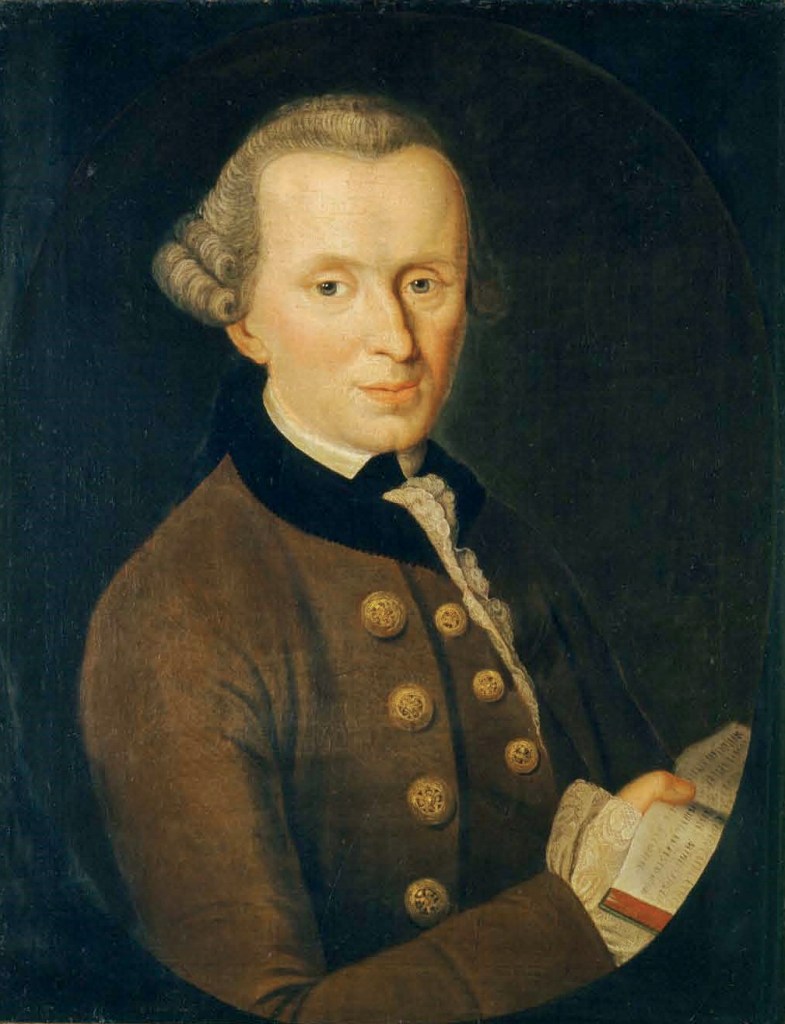

Images source: wikipedia.org -
Nightmare on Time
Over the past several weeks, I have been churning out nightmarish post after nightmarish post, and this week I was beginning to wonder about what’s going on — as in: I seem to be having a lot of nightmares on my mind.

source: https://en.wikipedia.org/wiki/Nightmare I have time and again made comparisons between our own period of information revolution to another period of information revolution — namely Gutenberg’s printing press with movable type. Before Gutenberg’s revolution, similar advances in information technology seem to have been much more gradual. For example, we cannot identify individual years or even something as broad as lifetimes in which natural language or writing systems were invented — at least not as far as I know.
While Gutenberg is attributed with his invention, I bet it did not exactly happen overnight either. Besides, the revolution which followed took not only years or decades, but rather centuries. Note that literacy was still not widespread during the French Revolution. Note also that during the intervening centuries there was actually a lot of war and bloodshed. The establishment powers were actually quite unwilling to relinquish their strangleholds on the people they ruled and governed and lorded over. Large numbers were killed, many in acts of cruel and unusual torture.
Today, we like to think that those days are long gone, as if our so-called “modern” era is no longer plagued with such barbarism and the bygone beliefs which are now virtually impossible.
But that is of course quite certainly not true. If humans were able to learn from history (rather than to repeat it), then we ought to expect that similar hellish times are coming soon … insofar as the establishment powers of today have even more formidable might to annihilate new uprisings in the bud, before they are even able to take hold and begin to grow. What is more: although all establishment powers build on strong foundations, today’s establishment powers have repeatedly evidenced a willingness to liberally cement these powers, and anything or anyone who might get in their way are simply paved over as small specks of collateral damage.
Time and again I find myself vacillating between a hopeful optimism that humanity might have progressed somewhat and a nightmarish pessimistic hunch that the whole world could devolve into widespread death and destruction at the drop of a hat.
The weird and eerie thing about nightmares is that there seems to be no guarding against them. We can neither recognize that they are merely figments of the imagination, nor can we gauge the horrors they lead to before we arrive back in the real world — awoken with a realization that it was all false and fake news, just a bad dream, and we can simply and easily shake it off, completely unscathed.
-
Would You Rather Choose a Book or Pick a Card?
One may be somewhat difficult (intellectually), the other uses little or no brain power whatsoever. Yet for those who might be prone to economize on cognitive load, a few words of warning: do not be so foolish as to leave your nutrition decisions entirely up to chance. There is a big difference between biting into an apple and biting into a rock!

Choose a Book 
Pick a Card Yet many if not most “readers” often or usually choose (and even rely on) a daily diet of “random” information resources. Accordingly, many if not most so-called “advanced” societies have been configured to let a few leaders lead the vast majority of poor huddled masses … and today, one of the most advanced technologies employed for this purpose is so-called “mass media“. These corporations are faceless and undifferentiated — much like a pack of cards. Turning on the boob tube or flipping through a magazine has become the preferred method for propagandists to reach their target audiences for at least a century. [1] Whether exhausted at the end of a long day or impatiently waiting in a doctors office, these mass media technologies have been optimized to sucker consumers into almost anything and everything whatsoever. They have the aura of “plain vanilla”, go down like melted butter and are interpreted as quintessentially popular. There is no better way to invite a mass mob into your living room or other highly confidential quasi-safe space.
Of course if any individual member of those poor huddled masses feels unable to have any influence on any aspect of the future — whether their own or anyone else’s — then they ought to be expected to give up. Choosing when the choice has no impact on any outcome whatsoever is simply wasted energy. And this is another primary attack vector of mainstream propaganda interests: individuals are considered to be utterly insignificant. Each individual will never have any impact when contrasted with multinational conglomerate corporations, governments, armies, unbridled brutal military forces and the opinions of sanctioned celebrities. If any individual celebrity ever happens to make a misstep, they can be annihilated in short shrift and immediately eradicated from the face of the Earth. The mainstream remains a clean slate of monumental media power and will crush any crumb that comes even close to stretching their necks above a neighboring speck of dust.
This is the context in which Gobbledygook [2] brand names rise up to overpower any and all rational thought with widespread artificial intelligence. As long as the vast majority among the poor huddled masses remain conformist card-carrying subscribers, subservient to following the rule of their algorithmic overlords, the mainstream power machinery will remain greased with the blood, sweat and tears pressed out of the last remaining bits of individual energy which remains resigned from the inability to muster a single individual thought.
Since under such circumstances self-determination becomes impossible, the poor huddled masses can only open their eyes to consume the never-ending flow of propaganda streaming into their minds, flooding their brains with Gobbledygook [2] brand names which are completely meaningless. Their intellectual abilities gradually deteriorate and decompose until they are eventually reduced to the level of mud. These can then be written off as collateral damage.
The rising portfolios of Gobbledygook [2] increasingly tower above the crumbs and dust and ashes of previous generations, bubbling up artificial intelligence like there is no tomorrow. The only resource needed is energy, and the forecasts predict that after all fossil fuels have been extinguished, breeder reactors will probably be able to provide a plentiful supply for many millennia to come. Thus, the future of Gobbledygook [2] looks not only rosy but virtually certainly so.
[1] I would maintain that the “motion picture” industry could count as an early form of the “television” industry; and in any case radio broadcast technology is now over a century old (and of course the publishing industry is already several centuries old).
[2] See also “More about Modes and Levels of Literacy“, “Fascism & Regulated Media” and “Rational Media” [ https://phlat.design.blog/2024/01/14/rational-media ]
-
Pick an Existence
Up until Friday afternoon, I was planning to write a follow-up to last week’s post. I knew it would be about “thinking” generally, but I was still pondering on which image I wanted to act as a simple signpost for the basic idea — which I think may actually be difficult to capture in a snapshot image. I was gravitating towards an image from a film I have cited before (see “Do Not Read This“), yet the film actually uses a multitude of recurring images to transport the meaning I was trying to convey. When I finally selected one image, I was not completely satisfied.
But then something unexpected happened. It was almost as if the image I had selected gave me a new insight into a phenomenon I find much more important — and this is now what I wish to talk about today. I have strong intuition that these ideas are all intricately intertwined, and I am somewhat taken aback by the obvious fact that the image comes from the world of magic. 😯
Pick an Existence (see also “Do Not Read This“) Let me take a moment to state my gut feeling — that I really don’t know exactly where the idea that somehow just precipitated in my mind came from. The idea itself has a lot to do with existentialism … and I have read quite a few texts from existentialist philosophy, from Kierkegaard to Camus. It also has something to do with identity … and here I am not sure if the stuff that I know from linguistics is related or not (though I have a strong hunch it might be). Perhaps if I simply point out the perhaps most poignant sign that all of a sudden simply sort of imposed itself on my mind, it may become clearer what I am talking about in the first place.
So here it goes. I have always considered my father (RIP) to have been a very accomplished person. His life was a little bit of a “rags to riches” story, and there were both many chapters of very hard work involved, but also a few cases of being at the right place at the right time (plus the know-how in order to take advantage of those opportunities). While I am still very proud of my father to this day, my reflections on his life over the past few days have been strongly influenced by the insights I had about existence, existentialism and identity.
My father’s existence was very much based in an extremely strong work ethic. His ability to provide for his family was likewise strongly based on the fruits of his labor. My father very strongly identified with his roles as a “worker” (which I put in quotes simply because his success allowed him to climb to the top rungs of many corporate ladders he came into contact with) and as father. What has all of a sudden become very clear to me is the degree to which a large portion of his identity was lost when he retired from work and then ultimately also when he lost his wife (our mother). After these two monumental blows to his existence, my father slowly but surely became lost, having been robbed of the two pillars which a large part of his existence was built upon.
There are some things all humans share existentially — the air we breathe, the sun in the sky, a limited lifetime and so on. There are other things we choose — our career paths, the things we believe, the relationships we maintain and so on. Our own sense of identity is intricately intertwined with these constructs we link to our own existence. When a pet owner loses his or her pet, they also lose their own existential role as owner (and care-taker and similar relationship roles).
Perhaps one of the most fundamental aspects of our own identity is our sense that each of us — each of our selves — is a self that is important to someone or something. Weird — just as I wrote that I was reminded of an old song by the rock-band Kansas called “Dust in the Wind” … and without such self-worth attributed to us by others we are perhaps indeed little more than dust in the wind.
Yet the world we live in is a very complex space, and there are a vast number of constructs surrounding us in our environments, our habitats, with which we can construct a multitude of meanings in life, a wide ranging and incredibly tangled web of relationships are possible … just waiting to be built up … in the hope of never ever being torn down.
Every now and then it seems essential for me to get carried away following such wide ranging tangents across the universe. But now let me bring it back to the image for this post. As a “homework assignment”, I invite you all to speculate what I had initially intended to write for this week’s post, and maybe you will be rewarded with a matching solution in next week’s post! 😀
-
Learning to Understand Irrational Information Retrieval
wikipedia.org (an irrational media site [1] ) states:
Linus Van Pelt is a fictional character in Charles M. Schulz’s comic strip Peanuts. He is the best friend of Charlie Brown, the younger brother of Lucy Van Pelt, and the older brother of Rerun Van Pelt. His first appearance was on September 19, 1952, but he was not mentioned by name until three days later. He was first referred two months earlier, on July 14. Linus spoke his first words in 1954, the same year he was first shown with his security blanket.
https://en.wikipedia.org/wiki/Linus_Van_Pelt
Linus with his “Security Blanket” The same article quotes Charles M. Schulz from pretty much exactly 44 years ago (1980 was also a leap year, by the way 😉 ): “Linus, my serious side, is the house intellectual; bright, well-informed which, I suppose may contribute to his feelings of insecurity.”
Today, whether intellectual or not, people are usually misinformed.
The irony is in the contrast between Linus and the average person today. Today, people’s sense of security is largely based on the sources of information they rely on, rather than on something like a security blanket and / or a thumb in their mouth. The irony is particularly poignant because the propaganda industry (which relies heavily on irrational media) is exploiting their blind faith in irrational media like there is no tomorrow.
[1] See “Rational Media” [ https://phlat.design.blog/2024/01/14/rational-media ]

Social Business (WordPress weblog)


 Socio Business blog