-
Stages in the Transformation of Information from Writing Communities to Written Words
I acknowledge that the title I have chosen is rather broad. So I think I’d like to start off by sketching out the landscape, sort of painting a picture using very broad brush strokes … and then perhaps to suggest one case study in order to begin to flesh out more details.
The entire Internet (well, at least the Internet I am aware of) is governed by rules and regulations. Some parts moreso than others, but for every “user” the very first decision they must make is which set of rules and regulations to choose. For many decades, perhaps even ever since someone actually remembers making such a decision, this choice was rather simple and straightforward:
Always choose .COM
Advice repeated so often it ought make people sick to hear it yet againI will now jump to the chase and simply point out that many people similarly choose Google or Facebook or Youtube or Spotify or Microsoft or Linux or Grok or Anthropic or whatever other sort of “solution” to a rather complex set of issues to select an environment in which to engage … with a community of people who have made the same (or at least similar enough) choices to whatever they have chosen themselves … essentially “choosing a playing field”.
The playing field is essentially the environment for all interaction with information. Indeed, most people who are active at all will probably be active among many playing fields, and many if not outright most people will not even realize that each of these playing fields has quite restrictive limitations, and / or that none of these playing fields are equivalent to TEH INTERNET.
Now (as an example, and maybe also as the beginning of a sort of “case study”) I will focus on one such playing field: WordPress.
WordPress is probably the largest online community devoted to the written word. I am actually not sure whether the community is first and foremost about “open source” or whether the “open source” aspects or WordPress are the result of its community’s very strong enthusiasm for creativity and creative expression in any and all forms. At this point, the project seems so humungous, that saying almost anything about it reminds me of that image of a blindfolded scientist who is unable to tell whether they are touching an elephant’s trunk or tail.
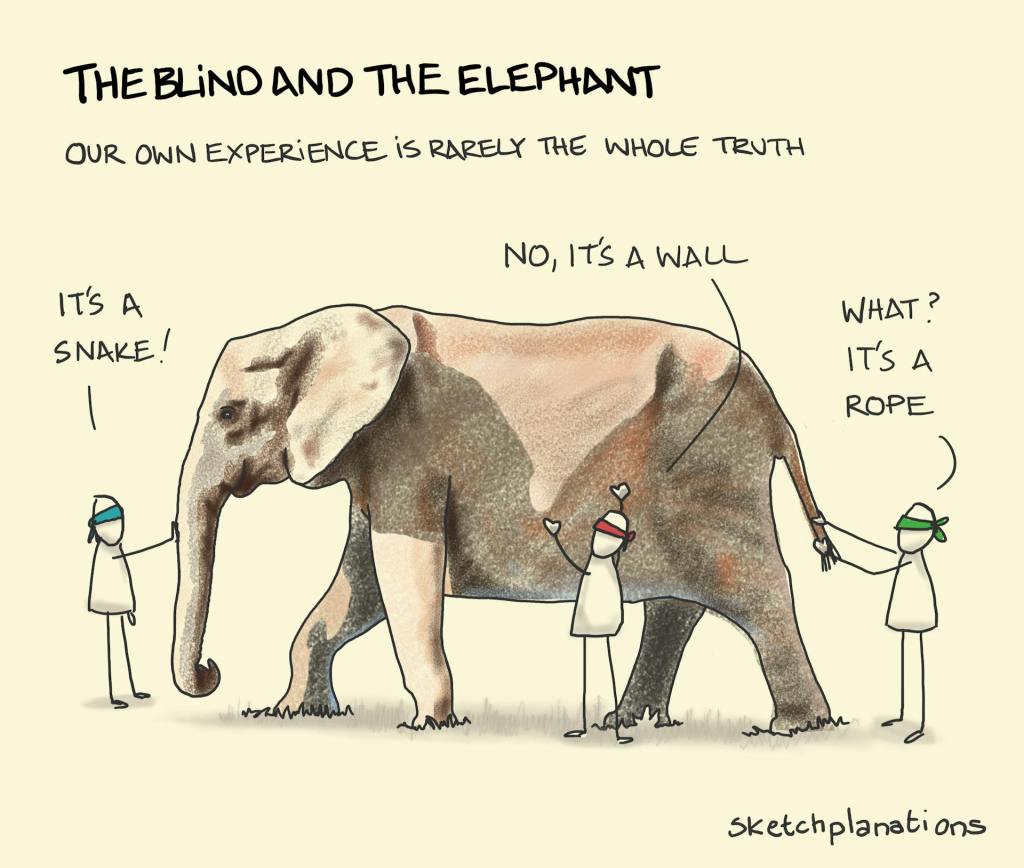
Source: The blind and the elephant – Sketchplanations [ http://sketchplanations.com/the-blind-and-the-elephant ] My gut feeling is that whereas at least 99% of the users of WordPress use it to publish, at most 1% users of WordPress use it to read. I say that even though I know that WordPress content is actually dynamically “created” ever time someone enter the address to view content hosted using WordPress. In my humble opinion, that is roughly equivalent to pointing out that users of printed paper documents use a light source to read them. This distinction between literacy skills and publicacy skills is usually incomprehensible to most of my audiences. [1]
Even though I notice that some in the WordPress community are enthusiastic about their engagement and participation in the community, I also notice that the technological support for such communicative engagement and participation is luckluster at best and usually rather suboptimal and sometimes even quite shoddy. One good example of this is the way RSS feeds are propagated throughout WordPress’s own systems. Some RSS feeds seem to be updated more frequently than others, resulting in non-level playing fields among community members seeking to engage and participate level playing fields. Nonetheless, I am still optimistic enough to feel that when I am able to bring this (“bug”?) to the attention of people responsible for the regulation of WordPress technology, they will address the issue and maybe even fix it. 🙂
[1] In case you feel you may be a “special case”, please consider reading “What is Publicacy + Why does it Matter?” (and / or other posts tagged “publicacy“)
-
Imaginary Relationships
I guess you could think of Bob Dylan’s “Every Grain of Sand” (which he played as an encore when I attended a concert of his just a few months ago) …

Photo by Kindel Media on Pexels.com As it is (IRL — more or less), I currently have Andy Summers’ album “The Golden Wire” (1989) playing in my headphones. 🙂
Whether sound files or image files or simply plain text or whatever else, all of the content you are currently consuming via this channel is more or less imaginary. It is “appearing” on your screen (or through the speakers, or headphones, etc.). In contrast, if we were at a real beach, we could watch every grain of sand slip through our fingers and fall to the ground, as we have once before. Or maybe twice. Three times? Thousands? Millions? … ?
Probably many times before. Iteration upon iteration. Repetition. More reps. Many many more reps. Each and every grain of sand left an impression. Grains of sand slip through the cracks, they all fall down to the ground. And we watch as they do so.
That was the world before the Internet. That’s still the world the way it is today. But something has also changed. Today, there is also this text, these images, these sound files, these updates, these algorithms, apps, … and lots and lots and lots and many more lots of ASS (artificially sentient slop). It’s like the slime oozing out of your TV set (as Frank Zappa used to say or sing or whatever).
Hundreds of years ago, Henry David Thoreau lamented that people lead lives of quiet desperation. I believe that’s no longer the case. I think we have moved on beyond such despair. Today (in so-called “advanced” economies), people increasingly lead lives of imaginary relationships. Many people can no longer identify when some content they are “consuming” is completely imaginary. The words and images and whatnot more they consume on a daily basis are often entirely fabricated and have no relationship at all to what we might have formerly referred to as “reality“.
An entire generation of largely illiterate youngsters bark into their so-called “smartphones” … and actually believe that what the device responds has something to do with “facts”, “the real world”, “logic”, “truth” or anything like that … besides making a buck off of these poor little suckers.
-
The Struggle of Being Happy and Fulfilled by a Mediocre Life
I recall a few years ago as I was signing up to participate in a WordCamp event that while filling out the form I responded to a question about speakers I would appreciate at such events, I answered “Amanda Knox”.
Amanda, together with her life partner (and also “business” partner) Christopher Robinson, started a podcast about a half a year ago. I’ve checked out the first few episodes and have also contacted her (i.e., her “team”) about the way I perceive her situation in the “media landscape” (with respect to dependence / independence).
Without a doubt, her life experience so far has been much more “thrust” upon her rather than voluntarily chosen. Nonetheless, I feel she has very admirably chosen to cope with her very public stances by apparently facing them openly and without even just the slightest hint of resignation. I think I would place her intellectually as quintessentially existentialist.
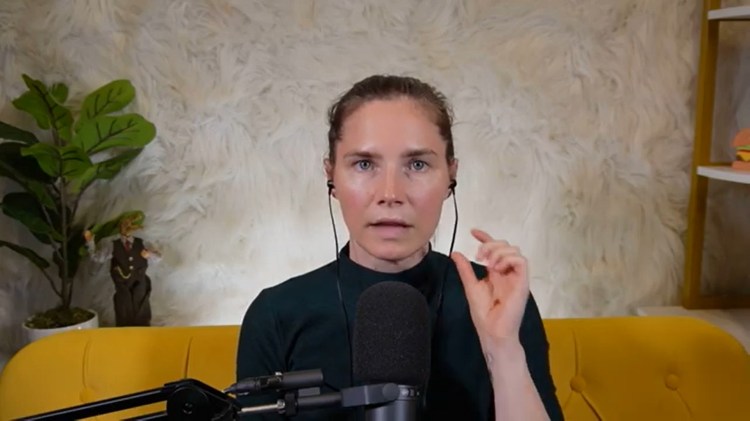
Source: https://podcasts.video.blog/2026/03/01/i-have-deep-sympathy-for-people I also appreciate her apparently very healthy sense of humor with her conclusion (mentioned at the end of the quoted podcast episode) that in the end, “I’ll be dead (so I won’t care).”
-
Decompartmentalization (From Individual Life Experiences Toward Cross-Cultural and Perhaps Even Universal Understanding)
This is without a doubt too much for one single post — so I will start off with a broad overview simply as an introduction to the topic.
For background, please consider what I have already written related to milieus (see e.g. articles tagged “milieu“). Let’s consider our lives as intertwined narratives created while moving through diverse milieus (or “compartments”). In each of these we tangentially touch and interact with a variety of groups also sharing the same milieu (or compartment) at the same time. The complete stories we create are nonetheless individual amalgamations forged according to our own individual life journeys.
Each of the groups we come into contact and interact with may only see one (or a few) of these chapters our entire story contains. Yet if we were to agree to a type of social contract to both reciprocally express (and likewise to follow) our links among the diverse chapters of our own (and each other’s) lives, we could perhaps expand our own horizons past only just our own life experiences towards the wider communities affected and involved with not just the direct experiences themselves but also the wider repercussions throughout society. We might even notice how an experience we have in one chapter (or compartment or milieu) might create repercussions which channel back in through another milieu (or chapter or compartment) in feedback loops we might otherwise not even be aware of if we had limited ourselves towards focusing only on our own direct life experiences.
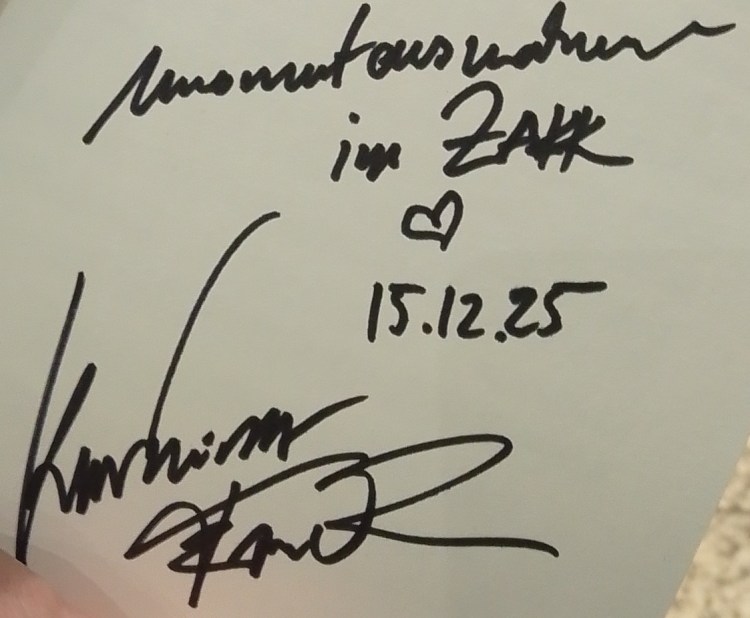
While writing this I was reminded of a song by The Rainbirds titled “7 Compartments”. As you may recall (if you have followed some of the links in my writing), I attended a reunion concert the band gave in Düsseldorf a few months ago … where they also played this song — I wrote about it in “These will be the best Rainbirds there have ever been (Live @ ZAKK in Düsseldorf 2025-12-15)” [ https://events.music.blog/2025/12/19/these-will-be-the-best-rainbirds-there-have-ever-been-live-zakk-in-dusseldorf-2025-12-15 ]. Having picked up Katharina Franck’s book (“Momentausnahmen”, see also “Momentausnahmen — Katharina Franck (Rainbirds)” [ https://branding.photo.blog/2025/12/18/momentausnahmen-katharina-franck-rainbirds# ]), I now see the amazing breadth and depth of her (and her band’s) work. Having thought about the song in the context of writing this post, I feel my own horizons have been significantly expanded.
Source: https://events.music.blog/2025/12/19/these-will-be-the-best-rainbirds-there-have-ever-been-live-zakk-in-dusseldorf-2025-12-15 -
That’s Entertainment — But It’s Not Amusing!
I have a friend who keeps informing me about minute details from blockbuster movies — and I guess perhaps I also sometimes note some noteworthy piece of history in music. We are always attempting to trump each other’s facts about which morsel of information is more essential towards a well-balanced liberal arts education.
Which brings me to another fine piece of ASS [1] crap:

WordPress AI prompt: “Donald Trump as Gladiator Maximus from the movie Gladiator (2000) screaming “are you not entertained?”” I may be entertained, but I don’t find it particularly amusing.
Today, ASS is little more than a tell-tale sign of laziness, lack of thought, dearth of reflection, decimation of intellect and all-around dullness.
Introducing ASS into intellectual conversation is nothing less than simply an insult.
[1] See “ASS: Artificially Sentient Slop” also other posts tagged with “ASS” and/or “Artificially Sentient Slop“
-
Self-Expression vs. Consumerism
The World is My Medium
analogous to expression “The World is My Oyster”Whereas “the world is my oyster” acknowledges the world as a set of conditions which creates a result, “the world is my medium” conceptualizes the world as a canvass upon which the self expresses itself.
From this point of view, one way the self could express itself would also be to consume the world (much in the manner that an embryo normally consumes the amniotic fluid within which it is nurtured towards [much later] life after birth) — yet whereas of course in the natural world evolutionary development (also) optimizes for conditions after birth, in modern societies across the globe the world-as-medium is commonly viewed as disposable, if not even completely ignored altogether. [1] From this point of view, perhaps the only way the world is recognized at all is as a population of (potential) consumers of the self’s own expressions.
Indeed: In contrast to the relatively decentralized natural evolution, since economic evolution and global competitive markets have lead to ever decreasing marginal profits, relatively centralized and extremely large (“global player”) corporations increasingly develop technologies optimized towards economies of scale. Also, improvements in Human Brain Conditioner technology in the modern era also increasingly optimize towards increasing consumerism and thereby maximizing profits by optimally maximizing consumption.
Let me give a concrete example of how this plays out “In Real Life” (“IRL”). This week, I discovered an apparently widely popular article published about a decade ago, yet which proposed a business plan which was shown to be faulty only just a few months ago (see “Ask them to convince you and mean it” [ https://fuckwith.news.blog/2026/02/03/ask-them-to-convince-you-and-mean-it ] ).
In this case, Human Brain Conditioner technology presented one person (“the speaker”) with a stage in front of a large audience of adolescents, many of whom had most probably consumed vast amounts of media which promote consumption via various forms of advertising (including presumably a significant amount of propaganda promoting the use of weapons as a means to engage in acts of heroism such as “vigilante justice”). Likewise, Human Brain Conditioner technology also provided easy access to potentially lethal weapons with such high levels of accuracy that it was possible for one member of this large audience of adolescents to use the event as a stage of his own to practice vigilante justice as an act of heroism by brutally killing the speaker.
Many modern institutions are involved in such events and business activities — indeed, they’re widely interwoven throughout the fabric of many modern societies. Yet despite the diversity of instantiations, I nonetheless (believe to) clearly see one monolithic result — namely the transition from living in the world the way an oyster lives in its habitat to living in a world in which our self-realization, our self-actualization and similar further extensions of our “self”-concept are increasingly becoming viewed as disposable products and services which are increasingly being consumed according to some more or less shady algorithms fewer and fewer people have chosen themselves.

Source: https://wants.blog/2026/02/05/i-want-the-privilege-to-be-reckless-i-want-the-privilege-of-spontaneity [1] yet: contrast this point of view with the conclusion in “Inter-Reliance, Self-Dependence & Responsibility” [ https://socio.business.blog/2022/12/03/inter-reliance-self-dependence-responsibility ]
-
Mob Rules (Blog of the Grotesque)
One of my favorite reading assignments in high school was a short book of extremely short chapters written by Sherwood Anderson, named “Winesburg, Ohio”. The first chapter, as I recall, was about an old man who scribbled down notes about the people in his hometown and then he crumpled up the scraps of paper he had written them on and stuck them in his pocket. I think this chapter was called “The Book of the Grotesque”, I guess referring to the archive of little balls of paper he had stashed away in his pockets.
Today, I too want to write down some such notes about the world I live in, mainly my own views about the situation I share with the people who coinhabit this planet with me. Of course I am well aware that I know very little about the vast majority of people on Earth — my hunch is that less than one billion (out of the over eight billion) people living are native speakers of English, far less are native speakers of German, and far, far, far (that’s very far) less are anywhere near as focused on languages and literacy as I am … and so quite probably the less than 1% of people who are simply as “academically” oriented as I am number more like at most ten million people world-wide. Distilling that number down again by a factor of the commonly quoted one percent who are actually active participants in online communications and my “peeps” dwindle down to maybe a mere 100,000 (worldwide). I could go on like this until I reach the conclusion that there are probably only a handful of people who seem to understand me at least half as much as I believe to understand myself.
Oops — did I just go off on a tangent? Sorry about that. 🙂
Where was I? Oh, not much of anywhere yet. Let me get back there.
In the USA, where currently many mobs are running rampant and talking on tiktok all day and all of the night, things are getting sorta cray-cray real fast. The USA is undoubtedly the global #1 in both military technology and also in propaganda technology (despite the popularity of the recent Chinese upstart). This is not some overnight sensation — just listen to Ike’s “warning” speech given almost 70 years ago:

Source: https://emotional.politics.blog/2021/01/07/a-better-way-to-leave-office I feel that in the intervening time, the USA has been too much focused on the expansion of liberty (or “freedom”) and too little focused on the responsibility required to impart and train to the appropriate levels of literacy (and similar capabilities — such as “publicacy” [1]) with respect to the use of such powerful technologies as have been developed by the undisputed world leaders in both military technology and also propaganda technology.
Today in the United States of America people of all ages have virtually free access to these technologies without even so much as one iota of literacy in how to use them appropriately. Indeed, I fear that the situation globally might even be far worse than that (though perhaps in some countries the access to these technologies may be somewhat less liberal than in the USA).
Worldwide, in the past seven decades we have witnessed a vast expansion of liberty and freedom to use powerful technologies with only an insignificantly small amount of responsibility towards the expansion of literacy needed to know how to use such technologies appropriately.
The risks and dangers that someone may accidentally press a wrong button or trigger or whatever seem to be increasing rapidly.
[1] See “What is Publicacy + Why does it Matter?“
-
The End of Objectivity
I only apologize a little bit for using this ambiguous title. I think there are indeed (at least) two different interpretations that both seem valid, but oddly both interpretations also seem relevant. One interpretation is that there is a point where objectivity will stop — and that is the interpretation that actually motivated me to use this title. But after I had chosen the title, it occurred to me that another interpretation which refers to the goal of objectivity (i.e., the “end” for which the “means” of utilizing objectivity) is also possible. I didn’t actually intend this meaning, but perhaps this is also worth investigating at some point … (but not today).
Today, I will try to make a case that something I discovered just recently (and wrote about yesterday) makes me believe that objectivity may indeed stop (and might even stop soon). Let me cut to the chase here.
Yesterday, I wrote “Irrational Media Promotion Makes “Dr. Noc” Newsworthy“, in which I give a brief overview of something Morgan McSweeney said on Alan Alda’s “Clear + Vivid” podcast recently. Now let me reiterate the gist in my own words here. Basically, he said that what his audience considers to be compelling information is information which is contextualized according to their point of view — essentially, by describing how he himself is a normal person (just like the members of his audience) and that is why the shared information is relevant and valid for them, too (I guess if he were very different — e.g. if he spoke a different language than they do — they might not even pay attention to him). He also mentioned that using a “just the facts” approach of simply presenting raw, dry data was simply not as compelling (and therefore relatively ineffective).
Here I also want to go deeper on a tangent Alan Alda uses in each episode when interviewing his guests. He uses “seven quick questions”, one of which is “How do you tell someone they have their facts wrong?” I think my own answer to this question would be “In order to answer that question, I would need you to explain to me what you mean by ‘facts’”. I have noticed over the years many of his guests find this aspect of the question difficult to manage, and I sense an increasing amount of pushback, and some have indeed even stated that the word ‘facts’ is problematical.
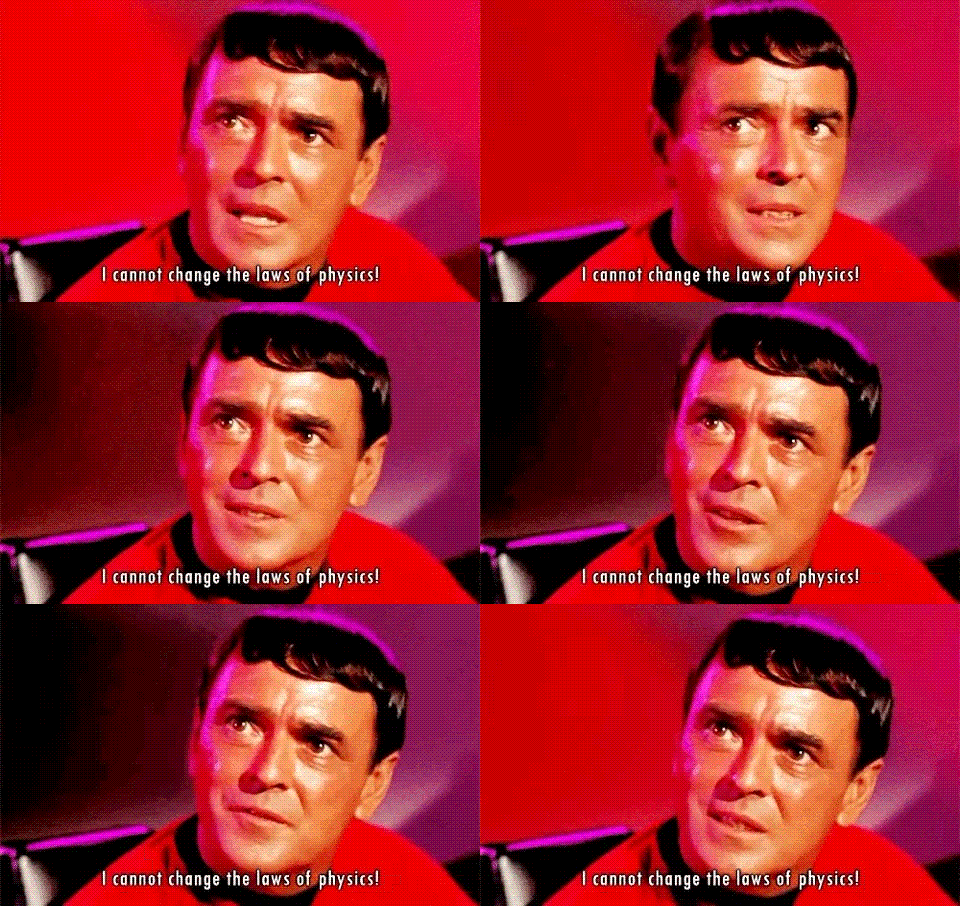
I could probably write an entire book about this one issue alone. But my point is not a matter of philosophical attitude. Instead, I am actually simply observing “just the facts” of what Morgan McSweeney and also other guests of Alan Alda are saying increasingly. I believe this increasing objection to the notion of ‘facts’ tells us something about human cognition. It tells us that we are skeptical of the “just the facts” philosophy. We doubt that humans are unbiased (indeed, maybe we might even say that anything capable of cognition is biased in some way). Maybe we might ultimately be led to the conclusion that the notion of “objectivity” is a hoax.
I have a very strong hunch that such disillusionment might be a very good thing.
Source: https://giphy.com/gifs/startrek-scotty-cannot-QBq8kOtfBd7DG -
From Unprofessors versus Unprofessionals to Science versus Religion
I think in my life I’ve experienced more than my fair share of quacks. I even consider at least one such person (i.e., a “quack”) within the circle of my own close family members. Throughout the many years and decades, quacks are littered more or less all the way along my own path. Some I have been quite easily able to shake off before they were able to do me much harm, others have unfortunately left deep scars behind which haunt me and rob me from well-deserved and sorely needed sleep on long, dark, cold and stormy winter nights.
I guess for the most part a large degree of the damage done occurred during periods on insufficient skepticism. Know-nothings will happily and merrily breed on the naiveté of pupils, scholars, students and assorted teenies, juveniles, adolescents and aspiring adults alike. Thirst for knowledge, experience, wisdom and whatnot more far outweighs the dearth of an ample supply of such resources.
The widespread social systems devised to impart reliability are still no match for the swarms of charlatans thriving in the free markets heating up all over the globe. Just the other day on one of the podcasts I follow, Ms. Phetasy was ranting about the newfangled systems that are being developed in order to provide “solutions” to old-fashioned problems (which are well-known and have also been solved almost a century ago by John Maynard Keynes) related to the way suckers are easily misled in the whirlwind of information being traded in markets worldwide. [1]

“What?!?” I find it more and more difficult to become outraged by widespread stupidity, illiteracy, bad decisions and whatnot. I think my own youth was perhaps filled with too much of “Great Expectations” for humanity. In the meantime, I think I have become much more accustomed to the lack of interest most humans show for pretty much anything and everything.
[1] see “That’s So Gross and Disturbing!” [ https://podcasts.video.blog/2026/01/16/thats-so-gross-and-disturbing ]
-
One is Better than None
This week I met a woman from Ukraine (Tanya) who totally blew me away with how she reacted when I tried to explain to her why I prefer rational media to irrational media. I didn’t actually refer to them with these terms, because that might have been more confusing (since most “mainstream” portrayals are almost the opposite, insofar as they usually portray irrational media as reliable rather than what they actually are — which is: overflowing with propaganda). At any rate, I myself consider the distinction to be rather simple and straightforward, and I think I presented it quite clearly in “Rational Media” [ https://phlat.design.blog/2024/01/14/rational-media ] (nonetheless: if you beg to differ, please feel free to voice your opinion 🙂 ).
In contrast, Tanya seemed completely baffled and explained that she couldn’t understand what I was saying at all. I think to her it seemed incomprehensible how anyone might consider (just) one source of information reliable — merely on the basis of being based on natural language. I think she mentioned that relying on just one source seemed … well, I already said it: incomprehensible (she was actually expressing herself in the very basic German she has been able to learn in the 2 years she has been in Germany since seeking refuge here from her own war-torn country).
I agree — in school, I was also taught to seek information from a wide variety of sources. Yet no one seeks information from an absurdly wide variety of sources. Let me give you an example. If you want to learn about what weather is predicted for the next day or two, then you would not consult a cookbook (even though cookbooks may very well contain certain atmospheric information, such as a note that the boiling point of water depends on the amount of atmospheric pressure in the environment). Searching for a weather report in a cookbook seems absurd — and yet so called “search engines” are supposed to cast such wide nets across the entire internet (yet note also the “world turned upside down” story I covered last week — see “I Want to Say Goo-Goo-Ga-Joob” 😉 ).
As I mentioned last week, only extremely naive people still do not realize that a search engine (like Google) presents information from a very particular perspective — namely the perspective that is most profitable for the search engine company … now (Google [and other search engine companies] executives seem to have learned something from John Maynard Keynes’ famous quote that “In the long run, we’re all dead”).

Source: see “The Social Construction of Publishing“ The mainstream narrative is that Google (like the Pope, cf. “If Google is the Pope of the Internet, Then Who Are You & I?“) simply tells the truth … and suckers (like “the mass of men, who lead lives of quiet desperation”) simply soak it all up. Suckers are so naive that that they simply believe this mainstream narrative — and therefore, they are ready, willing and more or less able to search for something … and erroneously believe that the results are not Google’s perspective … they seem to be so mesmerized that they actually believe such results to be “facts” (remember, remember: my post from last weekend 😉 )
The illiterate masses are indeed completely lost. Since even most literate people won’t remember, I will remind my readers that most of Europe was also completely lost and in turmoil for centuries after the Reformation brought about by the printing press.
Economists like to refer to such “world-changing” events as shifts. Let me (try to) remind those of my readers who are old enough to remember what situation the world was in when Google took the world by storm at the turn of the millennium. The world (and in particular: the Internet and even more specifically the WWW) was quite different than it is today. Back then, the vast majority of “content” was academic — written by professors with impeccable precision. Today, the vast majority of content is quite different — filled with bells and whistles produced by quacks and charlatans and influencers and journalists and advertisers and even machines and apps and bots that get “turned on” by the cheek of some teenager’s butt. Those two worlds have very little in common. Yet due to a large staff of expert lawyers and marketers (and many other specialists, too) a very large tech company (which might actually be deemed as “too big to fail“) can mesmerize large populations of people with rather limited literacy skills to believe that some hack which may have worked back then still works today. IT doesn’t — it (the hack referred to as “Page rank” — which was actually essentially copied from an algorithm developed by Eugene Garfield) was abandoned many years ago. It has been replaced by quite sophisticated engines (see the image above) which produce nearly nothing … other than huge profits for shareholders who are obviously quite far beyond “drunk on the koolaid”.
Any person, company, robot or whatever that purports to have no subjectivity — no “point of view”, perspective, opinion, etc. of its own — should be considered laughable. Instead, shady characters are much more busy laughing all the way to the bank. Duping a global population of suckers is big business (see also “There’s a sucker born every minute“). The only thing that these tech wizards seem to have left out of the equation is a quip Frank Zappa once pronounced (and which is now preserved forever … — or at least until the cows come home):
There’s more of us ugly mother-fuckers than you
https://en.wikiquote.org/wiki/Frank_Zappa#Tinseltown_Rebellion_(1981)Then again: I have been warning that this giant sucking sound is just around the corner for years (if not decades) — so I guess I should add: “your milage may vary”.

Social Business (WordPress weblog)
 Socio Business blog