-
Publicacy 101: Edward Bernays + Propaganda = Industrialization of Institutional Knowledge Acquisition in the Twentieth Century

During the Italian Renaissance, expert knowledge was still by and large handcrafted. The machines Leonardo Da Vinci created were, to him (I guess), just additional examples of more and more “artworks” created as piece works, contract work done as “paid gigs”.
Yet even with contemporaries such as Gutenberg, a newfangled approach was appearing: the first kindling of what Edward Bernays would later reflect upon as elements of market forces. In the span of those five centuries that separated the beginning Renaissance from the modern invention of so-called “Public Relations” (PR), numerous revolutions of scientific thought and institutions would slowly transform a world of individual faces into a faceless industrial society. But maybe Bernays did not wish to upset his audience, so instead he sold them a more human and down-to-Earth story.
Yet by the Twentieth Century, the Albert Einsteins of the world could participate in institutions such as Princeton University. Likewise, so could also what would later become popularised as “Fortune 500” companies — indeed, more and more such corporate institutions are even encouraged to do so. In those intervening five centuries, the world had fashioned innumerable marketplaces for uncountable kinds of information, and this process of institutionalisation is (I believe) what the first chapter of Edward Bernays’ “Propaganda” is all about.
Over the course of the Twentieth Century, I feel the role of personal brands (such as Albert Einstein or some prominent leader of a publishing corporation) diminished, and instead the role of corporate brands increased … such that the knowledge, expertise and talent that had in previous centuries been concentrated in individuals such as Da Vinci and Gutenberg was gradually transferred to institutional organizations, as these organizations increasingly acquired the increasingly loyal (to the company or corporation) support of expert workers, talented designers and so on. Ultimately, we no longer needed to be able to assess the quality of machines by evaluating the workmanship contributed to every individual part. Neither would we (reasonably) be so foolish as to trust the endorsement of any product from any celebrity (as Bernays argued). Increasingly, reasonable people would trust corporate brands if and when the corresponding corporations appropriately managed all the factors involved in the production of goods and services they produced.
By the turn of the millennium, there were so many corporations (and corporate brands) that in almost any market segment several corporations would stand in direct competition with one another. Increasingly, the distinguishing characteristic (or “Unique Selling Proposition”) of any successful brand will become more a matter of appropriately suiting the consumer (rather than some more general “warm and fuzzy” feeling such as happiness or some simple albeit abstract concept of excellence).
The comparatively simplistic approaches used in the Twentieth Century are simply no longer well-suited to addressing the complexities facing both consumers and producers today. Never before has the world been so immensely globally interconnected. We are no longer simply “afflicted” by global pandemics — we now obviously produce them, too.
“Shopping” is one of the most widely used commercial concepts [source: en.wikipedia.org/wiki/Shopping.com ] -
Let’s Kill “Social Media”
In the early 2010s, teens traded in their flip phones for smartphones and the phone-based childhood began: their social lives moved on to social media.
Jonathan Haidt, “How screens stole childhood — and how to get it back” (“TED Talk”, April 2026)Jonathan Haidt and his colleagues have been on a long-standing concerted campaign to criminalise some murky concept of “Social Media” for many years — perhaps already close to a decade. Contrast this with some critical statements made in a review of his most recent book:
First, this book is going to sell a lot of copies, because Jonathan Haidt is telling a scary story about children’s development that many parents are primed to believe. Second, the book’s repeated suggestion that digital technologies are rewiring our children’s brains and causing an epidemic of mental illness is not supported by science.
Candice L. Odgers, “Is social media really behind an epidemic of teenage mental illness?” in “Nature”, Vol. 628, p. 29 (4 April 2024 [ https://www.nature.com/articles/d41586-024-00902-2 ] )
“Social-media platforms aren’t always social” Further, Candice L. Odgers concludes:
Haidt, a social psychologist at New York University, is a gifted storyteller, but his tale is currently one searching for evidence.
ibid.The way I see it, Mr. Haidt can hardly be referred to as a scientist at all, as he cannot seem to define the thing (“social media”) he apparently hopes to aim at in using the crosshairs of his misguided finder. Indeed: I have yet to meet anyone who can provide an adequate, useful, so-called “operational” definition of this illusory term. I believe so much hot air and hogwash have been spread so far and wide since it was first used (I believe by Mark Zuckerberg) that it should be entirely banished from any lexicon intending to be somewhat scientific in nature.
Today, the term is nothing more unusable nonsense.
Anyone who continues to use this term ought to be referred to as a popular (i.e. “populist”) quack, charlatan, and perhaps worst of all: propagandist.
What I really want to know is: Who are these quacks, charlatans and propagandists working for? Obviously, someone must be paying these quasi-scientific thinkers to dream up these stories, get on stages to present them, and act like they are doing anything meaningful … besides misleading the public at large down rabbit holes to nowhere.
Let me offer my own very speculative and so far still completely undocumented hunch.
I think it is funded by no other than the invisible college of Silicon Valley global leading companies … those with abnormally high concentrations of billionaires and trillionaires who seek to blame some scapegoat phenomenon for innumerable social problems — they all want to blame someone else. They all find “social media” to be a very useful concept because nobody can define what it is (and therefore, their own “unicorn” many-times-over company cannot be blamed). So they pay these bigwig quacks and charlatans exorbitant expense accounts to go on never-ending whirlwind tours of storytelling scary ghost-stories over and over again … thereby feeding a frenzied public with ever more outrageous scapegoat bullshit to hack around on.
Personally, I myself feel strongly vindicated by the fact that Ogden’s critical review appeared in a leading “rational media” [1] scientific journal.
[1] See “Rational Media“[ https://phlat.design.blog/2024/01/14/rational-media ]
-
Economics of Information 2.0: Censorship
Just to remind you, last week I started off with:
Traditionally, the field known as the “Economics of Information” has mainly been focused on how market prices happen (in the “supply and demand” scheme of things).
“Economics of Information 2.0: Advertising“And then I talked a bunch about how (predominantly online) advertising today has changed the world from what it was before advertising became so important into what it is today (which is much more dominated by nearly all-encompassing advertising schemes).
Now let’s turn our attention to the role of censorship:
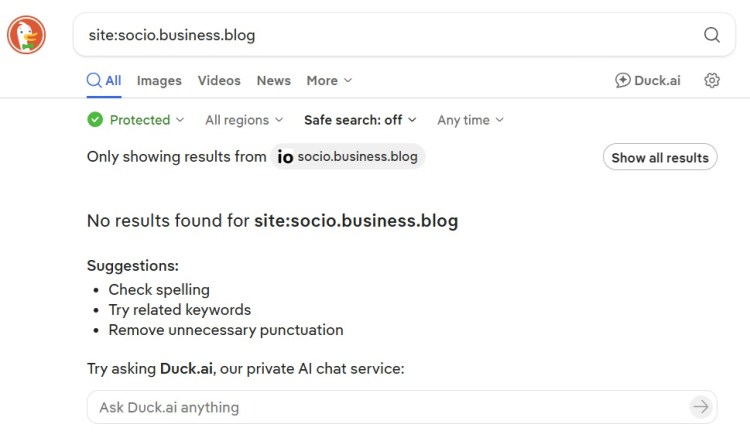
Source: “site:socio.business.blog” [ https://squ.data.blog/2026/08/08/site-socio-business-blog ] As you can easily see, different search engines go about censoring information in different ways. The image above is taken from a comparison of three different (more or less “standard”) sources. This one, duckduckgo.com, is probably the most transparent in its approach to censoring information — it basically shows you that it knows which website you are requesting information from, and then it tells you it will not show you anything from that website (even though it has just shown you the website icon, in other words, something from the website).
The other two so-called “information resources” are far more sketchy. bing.com doesn’t tell you anything at all (and thereby covers up the fact that the site is being censored). google.com indeed shows results, but misleads the customer to believe that these results would ever show up as a result to a more standard query (which site:socio.business.blog is most definitely not).
Of course I personally use none of these irrational media sites (except when I try to find out what other people might see when they apparently wish to be misled this way). [1]
Even though your mileage will almost certainly vary, this exercise is nonetheless useful to address why such censorship happens in the first place: in order to prevent suckers from getting the information they want to have — and instead to get them to click on the advertising (like DUH: read almost any one of my posts, but an excellent place to start is (in particular): pay attention to the links I shared in last week’s post about advertising: “Economics of Information 2.0: Advertising” 😉 ).
[1] Note, however, that Mark Zuckerberg very astutely observed once that no two people will ever see the same combination of content — apparently on any screen … ever. For more about rational media (vs. “irrational media”), see “Rational Media” [ https://phlat.design.blog/2024/01/14/rational-media ] and “Propaganda Information Technology vs. Indigena Information Technology — the Basic Idea” [ https://indigenous.news.blog/2022/05/07/propaganda-information-technology-vs-indigena-information-technology-the-basic-idea ].
-
Economics of Information 2.0: Advertising
Traditionally, the field known as the “Economics of Information” has mainly been focused on how market prices happen (in the “supply and demand” scheme of things). I do not aim to discount the very significant work that has been done here in the last half century (give or take a decade or two).
Yet I do wish to bring millennials as well as many largely illiterate people a little more “up to date” about how the world we live in today actually works (at least the small fraction of it I feel as though I might understand well enough to be able to form an opinion on).
Of course the myth is that miracle machines are now freely available … and that these gizmos are only capable of speaking the truth. [1] The reality is something completely different.
About 10 days ago I looked at the blog post “Online Interventions” because I wanted to check on it (for typos, etc.). When I loaded the web page, I saw this:
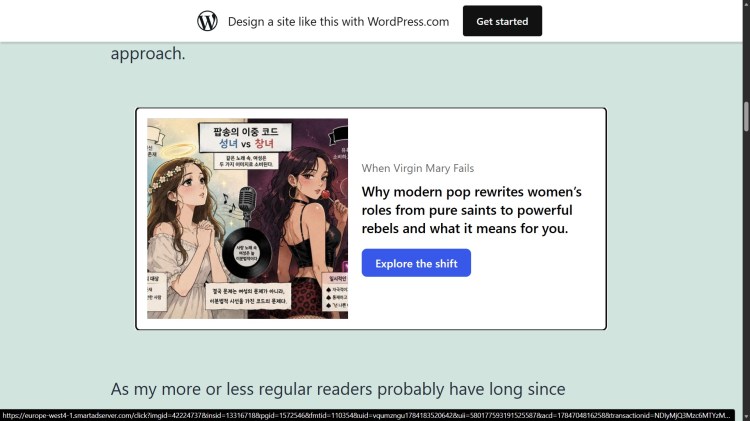
Source: https://socio.business.blog/2026/07/26/impedant-commerce Please note that the linked-to URL is displayed (in part) at the bottom of the image. Even more significantly: Please note that the word “Advertisement” (or some similar statement) does NOT appear (neither near the image nor anywhere on the page). Perhaps this was a one-time error (a so-called “glitch”). Yet also note that the so-called “landing page” URL that was loaded after clicking on the image began with:
hallyumoah.com/2026/06/30/madonna-whore-complex-in-pop-songs/?utm_source=blaze&utm_id=189721&utm_medium=paid&utm_campaign=campaign_189721&utm_content=ad_385183_creative_395418& […]
https://socio.business.blog/2026/07/26/impedant-commerceSo I decided I should learn some more about these so-called “Blaze” campaigns. I regret to admit that after sitting through a long series of videos, I still learned nothing that explained why the apparent “glitch” happened. 😐
I did get to listen to many promotional messages about related websites, such as Google Analytics or so-called “social” media companies. [2]
This further underscores the importance of teaching literacy, “publicacy” and the mysterious machinations of “Human Brain Conditioner” technology (e.g. the “Mainstream Trick“). [3]
[1] See also “If Google is the Pope of the Internet, Then Who Are You & I?“, “There’s a Sucker Born Every Minute” and “ASS: Artificially Sentient Slop“
[2] See also “All Your Data Are More Free to Us“, “First Meditation on Social Media: Let’s Get Social“
[3] See also “Rational Media” [ https://phlat.design.blog/2024/01/14/rational-media ]
-
Impedant Commerce
This week I felt both devastated and yet also hopeful at the same time (more or less). Actually, the devastation came first: Buzzkill died (see “Life is a scam” [ https://obit.news.blog/2026/07/26/life-is-a-scam ] ).

I can’t really explain my very strong emotional reaction. The “NoAgenda Show” has existed for a very long time and seemed to be very rewarding and also fulfilling for John. I did not disagree with John and Adam’s perspectives on “mainstream media” and I have quoted them quite often here (see e.g. “Mainstream Milieus“, which could be a page out of one of John’s books — except as far as I know it isn’t; it is a page out of my book, even though after I published it John actually referred himself as “the man behind the curtain” — see The Blurt — The No Agenda Show Episode 1736 [ https://noagenda.clipgenie.com/episode/1736-the-blurt?q=man+behind+curtain&t=1%3A43%3A32 ] ). Yet I did beg to differ — and perhaps that is something John did indeed resent.
I choose my own views, and I have a hunch John had a problem (or an “issue”?) with that — especially since I also choose to express them (and I do believe: effectively). Let me explain this a little more.
I had contacted Adam and John with what I thought about their plan to end the NoAgenda Show soon — I can’t remember what I wrote exactly (well, I guess I can, but maybe I simply don’t want [or need] to) … and this was the first (and only) time John sent me an email. I guess I was not only honored but also tried to take it to heart — but I now feel (and think I realize) that I apparently failed to (at that time). Looking back, I now feel as though I (more or less) “shrugged it off”. I realize this now, because I am able to read exactly what John wrote (and indeed also what I had written in the first place, which prompted his reply).
I now feel his reply was spot on, excellent, heartfelt and indeed: constructive criticism. He accused me of “pedantry“. I say accused because I feel today people only use this term in situations in which they wish to express their own experience of disgust. Otherwise — for example in situations in which they wish to express praise (or something similarly “positive”), people tend to use other terms. I feel this is very much in line with the way Wittgenstein in his later years emphasized the way contexts (and such) essentially belong to the definitions of terms (or concepts or whatever). I personally also feel that, strictly speaking: situations, environments, contexts, etc. do not repeat … but maybe they rhyme (more or less)?
I now think I am beginning to understand that when I say something like that without anyone asking me to express my own feelings, this may very well come across as pedantic.
And I also wish to speculate a little more along this tangent. I think perhaps that people with expertise in something are expected to reserve their expert opinions to situations in which they are appropriately remunerated. [1]
In my (speculative) view [2], there is an analog distinction to be made according to the “rational media” vs. “irrational media” concept. Indigenous people (or intelligence — indigena) decide(s) what is meaningful to us. This may or may not be meaningful to “them“. We are merely involved in managing our own language. And here is the kicker: the distinction between rational vs. irrational is the result of impedant commerce at work. “Impedant” is a new term: it means to limit, resist, impede some things [3]. In my view of impedant commerce, the meaningful terms are managed by maintaining their meaning within the contexts of indigena. In contrast: meaningless terms remain available for random (meaningless) attribution.
[1] Perhaps this a so-called “red thread” interwoven into Human Brain Conditioner technology (i.e. people become experts in fields where they intend to “earn their living”).
[2] For more background, see also “Supply, Demand, Natural Language & Free Markets — Some Preliminary Thoughts & Ideas“
[3] For well-known examples of such impedance, consider the plethora of academic and / or professional societies, or similar institutions which distinguish expert from novice approaches using a wide variety of constructs.
-
Online Interventions
A significant part of “the meaning of life” is to intervene in some way — to make a contribution, to have an impact, etc. (cf. Viktor Frankl’s notion of so-called “logotherapy”).

Speak Up! I choose to intervene online. I don’t need to march around, get into a car, drive somewhere, or get into a plane to travel to some far away city in order to shake someone’s hand. I prefer to chill out at home. I have a pretty strong hunch that I’m not the only one taking this approach.
As my more or less regular readers probably have long since realized, I am not a big fan of ASS (“Artificially Sentient Slop”). But this week I decided to revive another intervention: Humans. I want to intervene in order to bring human literacy (and human publicacy [1] … and generally: human communications) back to life. Right now human communicative ability is dormant at best, probably much closer to comatose and desperately in need of revival.
So yesterday I revived one of my blogging projects and as a result managed to publish “[survivor-space.com] It’s Just One Of Those Day’s……” [ http://jax.news.blog/2026/07/18/survivor-space-com-its-just-one-of-those-days ]. The JAX News project is focussed on fostering better communications across blogs by providing a space for comments to be published if / when they remain unpublished at the blogs they were “submitted” to. Yesterday’s post is particularly ironic because the blogger in question had published a post lamenting about the poor quality of communications at her blog, yet obviously (to me) failed to see that she herself was contributing to creating this outcome that she seemed to think was attributable simply to unfortunate forces of nature. Yet hers is not a rare case: time and again I am reminded how many humans fail to acknowledge that communication is a cooperative process, and that finger-pointing is contra-productive to true progress.
As I sit back and wonder this lazy Sunday morning (rather than “leaning in” as I hear Sheryl Sandberg so strongly advocates), I am also speculating to what degree “force of nature” arguments hold up in a world obviously endowed with sizable amounts of “Human Brain Conditioner” technology (see also e.g. my post earlier today about “How to Be the Most-Watched Person in the Known Universe” [ https://podcasts.video.blog/2026/07/19/how-to-be-the-most-watched-person-in-the-known-universe ] ).
I do not claim to have a definitive answer to many such questions. I expect the “true” outcome may very well be not only that “time will tell”, but that what we actually do in that time will also play a significant part. and I also feel that improvements in human communications (or NOT) may indeed play a crucial role.
-
bruh-space: faces + names vs. words + ideas
Are you familiar with this face?

Faces and Names You might be — if you are of a particular generation, if you have somewhat of an artistic bent, if you pay attention to popular media, and so on. [1]
This is an image of a musician performing on stage as part of a duo that created a bunch of “Songs for Drella” … which was dedicated to another artist. All three artists are now dead, so all of their faces are now gone. Their names remain, I guess as tokens of discourse in art generally.
Token is a difficult concept. [2] It seems to be something like a unit of measurement, yet it also seems to equate strings like “and” and “supercalifragilisticexpialidocious” in terms of their significance. Zipf was a researcher who developed a concept now referred to as Zipf’s Law which has many significant implications in the field of information science. One of these is that short strings tend to be more common and also to be more “general” in terms of their meaning. [3]
Beyond the shadow of a doubt: Humans have evolved to be able to recognize faces — in other words: those token humans who were not as good as others in face recognition had a significantly increased risk of not surviving (or at least of not surviving as well as the others who were better at face recognition). This was probably hugely important hundreds of thousands of years ago.
Today, being able to use language is perhaps more important. Bruh, if you can vibe with others, then, bruh, you can make things happen more and better.
Language recognition is complex. To identify a written text as belonging to a global corpus globally recognized as English … is a little bit bogus, bruh. Do you get my drift? Your vocabulary and my vocabulary are not the same. We do not actually speak the same language. According to Wittgenstein, you use particular words in the contexts you show up in, and I use particular words in the contexts I show up in. These aren’t the same contexts — we are different people. Yet some of the words you use in your contexts appear to be quite similar to (or even the “same” as) words I use in my contexts … as in: the “same” tokens.
We use language to simplify communication in negotiating meaning. Being on the same page is “good enough”. Unlike computers, we won’t be blocked by wishy-washy fuzzy sets. We can live with uncertainty [4] and move on. We want to move forward.
We find the idea of agreement with billions of people unfathomable. Sometimes agreement with just one or a few partners is all we can manage, bruh.
[1] My hunch is that also (quite generally) being part of an English-speaking community helps — for example: simply to help understand the song’s lyrics
[2] See e.g. No Agenda, Episode 1884 “Code Brown” [1:49:26] https://www.noagendashow.net/listen/1884/transcript?t=1:49:26
[3] See e.g. “Zipf’s Law” [ https://en.wikipedia.org/wiki/Zipf’s_law ]
[4] See also last week’s post: “The Irrational Frontier“
-
The Irrational Frontier
One thing I haven’t talked about (perhaps even haven’t considered) enough is the “no man’s land” that separates rational media from irrational media. [1] This is nothing new. Shakespeare quite obviously invented “new” (and improved?) words. Strings like “Anthropic” and / or “Perplexity” might be meaningful to you (or not) primarily depending on which linguistic communities you decide to belong to (or not). Personally (as I tried to describe last week — see “Indigena Revisited“), when a string becomes registered as a government-sanctioned trademark, it likewise becomes disqualified as a part of “natural language” (because the governments enforcing trademark laws thereby create corporate monopolies for deciding the meanings of those terms — which are by definition not shared concepts) … and therefore is banned from the realm of rational media. If your views on language differ from mine, then perhaps we simply don’t belong to that same linguistic community (yet we might still belong to other shared linguistic communities).
Since I’ve so adamantly gone out on a limb with respect to these issues (and I feel I have probably taken what other people might consider to be an unpopular — or even iconoclastic — stance on these matters), I felt sort of obligated to watch a recent interview between Joe Rogan (who vehemently endorses “Perplexity” [not only, but also, as a sponsor of the podcast]) and Aravind Srinivas (co-founder and CEO of “Perplexity”). I’m glad I did.
The only thing that’s required to be a good scientist is intellectual humility, to understand that you could be wrong about things, things that everyone takes for granted — you could still question them, and when you’re presented with new evidence and new data you are willing to change your mind, and you are willing to operate with ambiguity and uncertainty about the world, … that’s basically all the qualities you need to be a scientist.
“Scientific Qualifications: What Aravind Srinivas feels Science demands from (Good) Scientists” [ https://podcasts.video.blog/2026/07/05/scientific-qualifications-what-aravind-srinivas-feels-science-demands-from-good-scientists ]I recommend watching the entire interview, and I say that even though I disagree with many statements Aravind makes (such as his answer to Joe’s question of “why America?” being “it’s hard” — personally, I feel a more adequate answer would have been “it’s risky”).
For the most part, I agree with many of the things Aravind says (compare, for example, what I said just last week about the way the entire artificial intelligence industry will turn the world into ashes and dust with Aravind’s remarks about power consumption / energy usage). Note that in my humble opinion the first hour and 22 minutes can easily be skipped without missing any discussion related to artificial intelligence — so if you’re short on time, I invite you to “cut to the chase”.
Happy trails! 😀

Source: https://www.etsy.com/de/listing/963417545/maus-pad-handsigniertes-bild-von-roy [1] See “Rational Media” [ https://phlat.design.blog/2024/01/14/rational-media ] (note that I do raise the fuzzy set issue(s) involved, but so far I haven’t focused on this (or these) particular issue(s) per se.
-
Indigena Revisited
I hope I didn’t give anyone too much of “Great Expectations” last week, when I suggested for you to tune in again this week for more enlightenment. Enlightenment is not something that happens at the drop of a hat … it crystallizes slowly. And just as trustworthy information is fertile ground for growth in enlightenment, so too distrustworthy information sources are involved in a great deal of disenlightenment. And Human Brain Conditioner technology is vast and also plays a significant role in cementing not only trustworthy sources but also distrustworthy sources — the same technology can be employed for both good and evil plans.
Let me go out on a limb and simply declare the way I see it: there are two kinds of communication — manipulative and non-manipulative (or maybe, to put it the other way around: shared and non-shared). I first wrote about this a while back, at “Propaganda Information Technology vs. Indigena Information Technology — the Basic Idea” [ https://indigenous.news.blog/2022/05/07/propaganda-information-technology-vs-indigena-information-technology-the-basic-idea ]. It basically boils down to becoming aware of the linguistic communities we choose to engage in. If there are significant communal boundaries that need to be overcome (perhaps one extreme case of this being cross-species as in Pavlov’s experiments with dogs), then the degree of foriegn becomes manipulative (in a way quite reminiscent of “colonialism”).
Let me provide a graphic example of such exploitation that I feel is more obvious than last week’s description of the way an AI company is (perhaps?) attempting to usurp common language by trademarking an English word (thereby attempting to manipulate the English language community with regard to some aspects of the meaning of that word).

Around the bend in 80 seconds 😀 Source: Train to Machu Picchu, Urubamba, Cusco, Peru | Windows Spotlight Images [ https://windows10spotlight.com/images/39932 ] In a similar manner, Microsoft is likewise a trademarked concept (likewise protected by governments’ intellectual property laws) that manipulates the users of its software by forcing its users to be exposed to advertising via the screens used to provide access to its operating system. The advertising industry is everywhere — whether in the 15 milliseconds exposure time needed to produce this image, or in the 15 times a day you will be exposed to reporting about the World Cup, the European heat wave, or the bogus political solutions repeated 15 times every day over and over again to gain voters’ allegiance before letting them die in a gutter. It’s all commercial products. The motivation to produce this stuff is 100% money. It’s all protected by endless pages of legalese which translates to: you, the “sucker“, have nothing; we, the “owners“, own everything; and if you want to stay alive a little longer, then you’ll have to cough up a penny or a dollar or maybe even your entire life savings. That’s propaganda.
Note, however, that not everything is either black or white. There are gradations of gray in every imaginable hue. Take, for example, the string “Machu Picchu”. One might be inclined to think that this string is part of an indigenous community’s natural language. Many such strings exist — for example “English”, “England”, “America”, etc. Quite often, such strings are in fact the brands of government institutions themselves. Another tell-tale sign that the string “Machu Picchu” probably has very little to do with indigena is that it is not written using the indigenous language itself.
Now let me present another example that depicts a familiarity with indigena. On Friday, I featured a post on Wants.Blog which clearly delineated the distinction between two natural languages mapping to two different worlds (or, I might add: different experiences, different interpretations, etc.):
In my life, two languages have played an important role in shaping who I am today: Hindi and English. Each language has given me something unique, and together they have helped me grow both personally and professionally.
https://wants.blog/2026/06/26/whenever-i-want-to-express-my-feelings-naturally-hindi-comes-effortlesslySuch sensitivity and awareness of the role of language in shaping our thoughts, ideas and interpretations of the real world (or “worlds” 😉 ) we live in requires the speaker to be well-versed in more than one language. And here’s the happy ending: Everyone speaks more than one language. All people need to do is actually realize the many different languages they speak, to become aware of the many different linguistic communities they belong to. And that is precisely what indigena.info is all about.
-
Routing Around Irrational Media
I am working towards making the model of “Rational Media vs. Irrational Media” more simple, and easier to understand. [1]
In order to do that, I feel it is imperative to come to an understanding of the extreme state of mesmerization a very large majority of populations worldwide are in. Masses of men and women alike have been trained and conditioned by Human Brain Conditioner technologies since birth, and their minds have deteriorated to such a degree that they wander aimlessly in zombie streams of consciousness feeding on floods of slop produced by nonstop machinery as long as the energy grid manages to support investments reaching beyond the highest clouds known to man.
The murmuring masses have outsourced what little intellectual capacities they have left and now merely recite incantations recursively repeating through their implanted headphones. Collectively they behave much like a single mass of slime, mostly immovable and hardly cognizant of the world around them.
Their daily diet is completely vacuous strings — commonly referred to as brand names, but also known as personas, identities or various other types of simulated intellectual properties. All around, their ability to adapt resembles that of hardened plastic — as brittle as its sustainability is destined to be cancerous. They are wholely unable to differentiate between utter nonsense and meaningful ideas.
I wish to motivate precisely such people (also known as “suckers” [2]) to become aware that they ought to distrust behemoth companies that have entitled themselves as government-sanctioned monopolies of completely arbitrary nonsense. Many of these companies offer their users the illusion of meaningful answers to any and all questions they could ever have. In truth, all they offer are links to contracts which must be agreed to in order to have a chance to become saved from something those suckers do not understand in the slightest.
In case you think what I am writing here has nothing to do with the real world we live in, let me invite you to draw your attention to a company governments all over the world have allowed to call themselves “Anthropic”. In my opinion, this “Bullshit” company greatly increases the risk of human extinction, and therefore the name ought to be considered ironic at best.

Source: https://en.wikipedia.org/wiki/Anthropic Just last week this bullshit company issued a statement calling for:
Enforcement and regulatory authority with teeth. The government should be able to block or deter the deployment of models that pose a significant risk of catastrophic harm. We must also avoid overly broad or heavy-handed regulatory power. Our framework proposes both a mechanism for blocking dangerous deployments, and concrete safeguards that would prevent that power from being misused. Policymakers could begin with a lighter-touch approach, then adapt this as model capabilities advance and the evaluation ecosystem matures.
https://www.anthropic.com/policy-on-the-ai-exponentialEssentially, this bullshit company is saying “we are about to turn the world into a pile of ashes and dust — so we hope you government folks have a plan in case we succeed”. I hate to break it to you, but the government folks are even dumber than the bullshit folks — and all of these folks just want to cash their checks before all the banks collapse.
You should distrust irrational media. In case you have no clue who to trust, please tune in again next week. 😉
[1] “Rational Media” [ https://phlat.design.blog/2024/01/14/rational-media ]
[2] “There’s a Sucker Born Every Minute“

Social Business (WordPress weblog)
 Socio Business blog