-
Business Languages
After much thought, I have come to the conclusion that I want to extend my interest in “Wants” (see http://Wants.Blog ) to more professional, career oriented “business interests“.
Over the years. I have noticed that very few people seem to be aware of the fact that business actually refers to the state of being busy. Likewise, the “milieu” concept seems rather nebulous to most, even though the word is quite obviously internationally known and dates back several millennia (at least).
Therefore, I hope to shed more light on these issues by creating a new website devoted to “Milieus Networking” (see http://Milieus.Blog ). Although John C. Dvorak (see “Life is a Scam“) was really the first person to direct my attention to milieus (see e.g. “Mainstream Milieus” and other articles about the “milieu” concept), I feel that it is through the writing of Edward Bernays that the importance of the linguistic nature of business activity became much more clear and focused to me:
it is one of the functions of the public relations counsel to discover at what points his client’s interests coincide with those of other individuals or groups
Edward Bernays, “Propaganda”, p. 59and furthermore:
Such coincidence and overlapping of interests is as infinite as the interlacing of group formations themselves. For example, a railway wishes to develop its business. The counsel on public relations makes a survey to discover at what points its interests coincide with those of its prospective customers. The company then establishes relations with chambers of commerce along its right of way and assists them in developing their communities. It helps them to secure new plants and industries for the town. It facilitates business through the dissemination of technical information. It is not merely a case of bestowing favors in the hope of receiving favors; these activities of the railroad, besides creating good will, actually promote growth on its right of way. The interests of the railroad and the communities through which it passes mutually interact and feed one another.
Edward Bernays, “Propaganda”, p. 60
source: “Human Brain Conditioner: Human Nature is a Top Secret Affair“ Unlike Edward Bernays, I view business networking as an element of the interactions among people in the ways they use and implement natural language and also cultural activities and norms in their own daily life. So, in contrast to the traditional advertising model, I believe people do not orient their behavior to the advice of leaders, spokespersons, role models, etc. I believe they act according to their own convictions — albeit these convictions are expressed, as Wittgenstein was want to saying, in languages which thereby (i.e. “naturally“) sort of limited their own powers (or “ability” or perhaps “capability”) of expression (see also “The further on I go, the less I know” and other articles about “Wittgenstein“).
-
Rational Media + Business Communications
Besides trudging through Edward Bernays’ book (“Propaganda”) I am also currently on vacation trudging through mountainous terrains in central Europe — perhaps I will update with more images later, but let me start off with this image of collaboration between business and communications first:

Source: https://en.wikipedia.org/wiki/Communication I also offer (as somewhat of a preview) another quote from Edward Bernays:
The media through which a political campaign may be brought home to the public are numerous and fairly well defined. Events and activities must be created in order to put ideas into circulation, in these channels, which are as varied as the means of human communication. Every object which presents pictures or words that the public can see, everything that presents intelligible sounds, can be utilized in one way or another.
Edward Bernays, “Propaganda”, p. 103I also ask you to consider how the messaging from Edward Bernays compares with my own messaging about “Rational Media”. [1]
As I am only somewhat or even just very slightly in a “business communications” state of mind at the moment, I hope to update more about these ideas in the coming days (or at the very latest by next weekend). So please practice your patience and try to bridge the gap by reading up and maybe even by actually thinking for yourself, trying to connect the dots, and maybe even arriving at conclusions before I manage to do so myself. 😉
[1] https://phlat.design.blog/2024/01/14/rational-media
-
Our Engagement = Strictly Business + Professional Relationships
Reading “Propaganda” has been fascinating (so far). This week I have been ploughing through one of the longest chapters, which addresses issues that seem to me have been largely neglected over the past century.
The new technique of public relations counsel is serving a very useful purpose in business by acting as a complement to legitimate advertisers and advertising in helping to break down unfair competitive exaggerated and overemphatic advertising by reaching the public with the truth through other channels than advertising. Where two competitors in a field are fighting each other with this type of advertising, they are undermining that particular industry to a point where the public may lose confidence in the whole industry. The only way to combat such unethical methods, is for ethical members of the industry to use the weapon of propaganda in order to bring out the basic truths of the situation.
Edward Bernays, “Propaganda”, p. 79-80That is quite a mouthful, and I wonder whether any person today would have enough confidence to speak so boldly … perhaps besides the late great John C. Dvorak? (see “Life is a scam” [ https://obit.news.blog/2026/07/26/life-is-a-scam ] ) Bernays proposes that publics can be “managed” — whether to buy cigarettes or to follow Adolf Hitler or start wars, drop bombs, build secret laboratories … and maybe even to annihilate all of civilization. In the so-called “Western World” (primarily in the USA) so-called “private corporations” in the Twentieth Century took on the challenge, stepped up to the plate, time and again wrecked havoc, and were repeatedly ultimately “bailed out” by so-called “governments”. And yet apparently no one really wants to think about so-called “irrational exuberance” … or about whether we are satisfied with a situation in which most of the so-called mainstream headlines revolve around whether this or that so-called “leader” will be able to so-called “save” humanity … or NOT.
Almost single-handedly, Edward Bernays introduced the notion of a “truthful” leader, whom the public relations counsel could manage to behave rationally. He was able to sell this idea over and over again to people willing to become such leaders all over the globe (see also “There’s a Sucker Born Every Minute“).
At least until now. At what point will an offer to “join the circus” become viewed as something perhaps NOT completely rational?

Source: Sydney Sweeney Teams Up With Novig for Bold New “Just Sports” Campaign [ https://novig.com/blog/sydney-sweeney-teams-up-with-novig-for-bold-new-just-sports-campaign ] -
Rational – Irrational – Differently Rational
I find it very difficult to write about this topic, because most people seem unwilling to see my point of view. For most people there is only the dichotomy “rational” versus “irrational” — “differently rational” is not a category they feel comfortable with. [1]
It is evident that the successful propagandist must understand the true motives and not be content to accept the reasons which men give for what they do.
Edward Bernays, “Propaganda”, p. 52Although the word “rationalisation” exists, and also the word “rationality” and its plural form are both well-known and hardly incomprehensible, the notion of different kinds or modes of rationality still simply does not compute, make sense or anything like that.
In contrast, there are many people who maintain that most humans are irrational when it comes to decision-making.
Yet the advertising industry — and especially the quasi-scientific approach that Edward Bernays introduced it to — has become very adept at telling stories that increasingly make consumers buy it (whatever “it” is). This is based on insights that are downright predictable — decisions are not made irrationally, they are simply differently rational.
Note that while consumer behavior is obviously very well researched, virtually none of the insights gained are widely published. Competitive companies have little or no interest in sharing their own trade secrets with their own competitors.
I don’t know much about Edward Bernays, and I also never studied “public relations”. Yet I did learn about him through my work (in a field called “information science”) — and I am fascinated by his “story”. A significant part of this story is beyond the shadow of a doubt his close relationship to his “double” [1] uncle (Sigmund Freud). And I find it particularly noteworthy to point out that he and his double uncle did not develop their double relationship into a professional relationship to “treat” the psychological issues that they observed in the context of “mass psychology”; instead, they did develop a professional relationship to exploit the psychological issues they observed in the context of “mass psychology” (for mutual financial gain).

Source: “The Social Construction of Publishing“ In the century since they did so, the scientific investigation of propaganda techniques and technology has been expanded greatly, and it has gained momentum precisely because it was thereby discovered that this form of exploitation is an extremely lucrative business practice. So far, we are apparently nowhere near “peak propaganda” yet.
[1] For more about the concept of rationality, see also “Rational Media” [ https://phlat.design.blog/2024/01/14/rational-media ]
[2] I have just now made up this term on my own — I don’t know of a more “correct” term for the exact family relationship that existed between the two.
-
AI = PR
Today, “propaganda” is closely associated with dictatorship. It is the boot stamping down on faces. Here in Germany I hear it mentioned time and again in messaging about historical facts together with historical footage — usually Adolf Hitler screaming into a microphone.
Yet propaganda also has a more innocent-looking face, which is (perhaps) in fact much more insidious. This is a world of poor huddled masses, hungering for small bits and pieces of truth, which — whenever one comes within reach — they reach out, grab, hold on to and eagerly consume and thereby internalize before it can be forgotten, or forever lost. Bridget Phetasy has employed this imagery repeatedly when checking for “news” in the dumpster in her podcast titled “Dumpster Fire”. [1]
In this second kind of propaganda, which we might refer to as consumer-driven propaganda or simply “consumer propaganda”, nothing like scientific scepticism plays any significant role: there is no burden of proof, because the consumers willingly consume any messaging dished out … as it is easier to simply consume indiscriminately than to ask questions or otherwise risk starvation.
This insight is nothing new. It is a basic premise of public relations and also obviously and transparently spelled out by Edward Bernays in the third chapter of “Propaganda”:
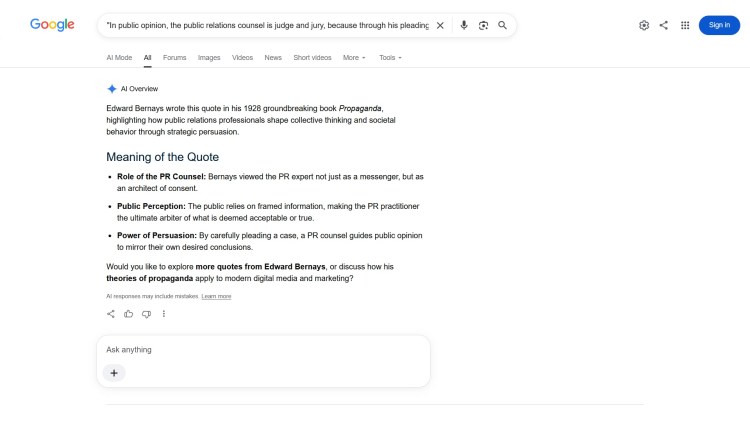
Source: https://squ.data.blog/2026/09/05/in-public-opinion-the-public-relations-counsel-is-judge-and-jury-because-through-his-pleading-of-a-case-the-public-may-accede-to-his-opinion-and-judgment Although today people have a somewhat more reserved stance when it comes to traditional advertising, few people bring a similar sceptical attitude to so-called “search results” or (as in this case) when a so-called “search engine” offers an answer from so-called “artificial intelligence” instead. On the contrary: many people use Google (or similar websites) as if they were proof of something! Especially young, naive people are particularly prone to thinking (for example) that if Google returns no matching result for a query that no such website exists anywhere on the Internet. To teach such young, naive people a little about the real world, you could simply ask them to use their favorite so-called “search engine” to search for the quote by Edward Bernays (above) and to see whether the post which I published just yesterday shows up (or NOT).
[1] See https://www.phetasy.com
-
Pavlov, Natural Language, Rubber Stamps, Repetition, …
Nature and natural language are certainly forces to be reckoned with, and so Pavlov’s experiments showing that to some extent interpretations of the real world can be influenced by what has become referred to as “behavioral conditioning” were truly groundbreaking. At the same time, we need to recognize that human natural languages are a special case — insofar as humans themselves discern many species of language within the larger grouping we might refer to generally as “human language”. Even focusing directly on spoken or written languages, humans discern a wide variety, usually having to do with the different communities they also distinguish. [1]
Therefore, Edward Bernays’ manipulative approach of coopting celebrated spokespersons to endorse and advocate for particular products or services may very well be much less effective today than in the heyday of classical propaganda. While many more stalwart companies may still try to use such methods (particularly in more outdated media such as television or similar technologies based on “brought to you by” advertising methods). The innumerable repetitions of repeated rubber-stamp impressions are today hallmarks of bogus bullshit shunned by younger generations no longer innocent enough to be suckered into believing in the sponsors’ messages polluting the channels they have turned into toxic dumps.
Instead, the more inspired and interested youth of today (and in particular, the somewhat enlightened examples) shun irrational media [2] like the plague of bygone technlogy. They put print media on par with hieroglyphics. They compare radio waves with towers of Babel. They view centralization as a leather boot.

Source: “Irrational Media’s Business Model is Propaganda“ In contrast, today young, budding communities see enormous growth potential in networks of rational media. Interlocking communities of interest each revolving around linguistic communities identifying particular aspects of daily life and thereby focus on what matters most to their own as well as communal well-being. In this world, there is simply no need for any central authority to govern affairs. If there is any problem in any one particular camp, the wonders of the adaptiveness inherent in contiually evolving natural languages will immediately route around the problem — problem solved.
[1] For more about this phenomenon, please see “Propaganda Information Technology vs. Indigena Information Technology — the Basic Idea” [ https://indigenous.news.blog/2022/05/07/propaganda-information-technology-vs-indigena-information-technology-the-basic-idea ]
[2] See “Rational Media” [ https://phlat.design.blog/2024/01/14/rational-media ]
-
Publicacy 101: Edward Bernays + Propaganda = Industrialization of Institutional Knowledge Acquisition in the Twentieth Century

During the Italian Renaissance, expert knowledge was still by and large handcrafted. The machines Leonardo Da Vinci created were, to him (I guess), just additional examples of more and more “artworks” created as piece works, contract work done as “paid gigs”.
Yet even with contemporaries such as Gutenberg, a newfangled approach was appearing: the first kindling of what Edward Bernays would later reflect upon as elements of market forces. In the span of those five centuries that separated the beginning Renaissance from the modern invention of so-called “Public Relations” (PR), numerous revolutions of scientific thought and institutions would slowly transform a world of individual faces into a faceless industrial society. But maybe Bernays did not wish to upset his audience, so instead he sold them a more human and down-to-Earth story.
Yet by the Twentieth Century, the Albert Einsteins of the world could participate in institutions such as Princeton University. Likewise, so could also what would later become popularised as “Fortune 500” companies — indeed, more and more such corporate institutions are even encouraged to do so. In those intervening five centuries, the world had fashioned innumerable marketplaces for uncountable kinds of information, and this process of institutionalisation is (I believe) what the first chapter of Edward Bernays’ “Propaganda” is all about.
Over the course of the Twentieth Century, I feel the role of personal brands (such as Albert Einstein or some prominent leader of a publishing corporation) diminished, and instead the role of corporate brands increased … such that the knowledge, expertise and talent that had in previous centuries been concentrated in individuals such as Da Vinci and Gutenberg was gradually transferred to institutional organizations, as these organizations increasingly acquired the increasingly loyal (to the company or corporation) support of expert workers, talented designers and so on. Ultimately, we no longer needed to be able to assess the quality of machines by evaluating the workmanship contributed to every individual part. Neither would we (reasonably) be so foolish as to trust the endorsement of any product from any celebrity (as Bernays argued). Increasingly, reasonable people would trust corporate brands if and when the corresponding corporations appropriately managed all the factors involved in the production of goods and services they produced.
By the turn of the millennium, there were so many corporations (and corporate brands) that in almost any market segment several corporations would stand in direct competition with one another. Increasingly, the distinguishing characteristic (or “Unique Selling Proposition”) of any successful brand will become more a matter of appropriately suiting the consumer (rather than some more general “warm and fuzzy” feeling such as happiness or some simple albeit abstract concept of excellence).
The comparatively simplistic approaches used in the Twentieth Century are simply no longer well-suited to addressing the complexities facing both consumers and producers today. Never before has the world been so immensely globally interconnected. We are no longer simply “afflicted” by global pandemics — we now obviously produce them, too.
“Shopping” is one of the most widely used commercial concepts [source: en.wikipedia.org/wiki/Shopping.com ] -
Let’s Kill “Social Media”
In the early 2010s, teens traded in their flip phones for smartphones and the phone-based childhood began: their social lives moved on to social media.
Jonathan Haidt, “How screens stole childhood — and how to get it back” (“TED Talk”, April 2026)Jonathan Haidt and his colleagues have been on a long-standing concerted campaign to criminalise some murky concept of “Social Media” for many years — perhaps already close to a decade. Contrast this with some critical statements made in a review of his most recent book:
First, this book is going to sell a lot of copies, because Jonathan Haidt is telling a scary story about children’s development that many parents are primed to believe. Second, the book’s repeated suggestion that digital technologies are rewiring our children’s brains and causing an epidemic of mental illness is not supported by science.
Candice L. Odgers, “Is social media really behind an epidemic of teenage mental illness?” in “Nature”, Vol. 628, p. 29 (4 April 2024 [ https://www.nature.com/articles/d41586-024-00902-2 ] )
“Social-media platforms aren’t always social” Further, Candice L. Odgers concludes:
Haidt, a social psychologist at New York University, is a gifted storyteller, but his tale is currently one searching for evidence.
ibid.The way I see it, Mr. Haidt can hardly be referred to as a scientist at all, as he cannot seem to define the thing (“social media”) he apparently hopes to aim at in using the crosshairs of his misguided finder. Indeed: I have yet to meet anyone who can provide an adequate, useful, so-called “operational” definition of this illusory term. I believe so much hot air and hogwash have been spread so far and wide since it was first used (I believe by Mark Zuckerberg) that it should be entirely banished from any lexicon intending to be somewhat scientific in nature.
Today, the term is nothing more unusable nonsense.
Anyone who continues to use this term ought to be referred to as a popular (i.e. “populist”) quack, charlatan, and perhaps worst of all: propagandist.
What I really want to know is: Who are these quacks, charlatans and propagandists working for? Obviously, someone must be paying these quasi-scientific thinkers to dream up these stories, get on stages to present them, and act like they are doing anything meaningful … besides misleading the public at large down rabbit holes to nowhere.
Let me offer my own very speculative and so far still completely undocumented hunch.
I think it is funded by no other than the invisible college of Silicon Valley global leading companies … those with abnormally high concentrations of billionaires and trillionaires who seek to blame some scapegoat phenomenon for innumerable social problems — they all want to blame someone else. They all find “social media” to be a very useful concept because nobody can define what it is (and therefore, their own “unicorn” many-times-over company cannot be blamed). So they pay these bigwig quacks and charlatans exorbitant expense accounts to go on never-ending whirlwind tours of storytelling scary ghost-stories over and over again … thereby feeding a frenzied public with ever more outrageous scapegoat bullshit to hack around on.
Personally, I myself feel strongly vindicated by the fact that Ogden’s critical review appeared in a leading “rational media” [1] scientific journal.
[1] See “Rational Media“[ https://phlat.design.blog/2024/01/14/rational-media ]
-
Economics of Information 2.0: Censorship
Just to remind you, last week I started off with:
Traditionally, the field known as the “Economics of Information” has mainly been focused on how market prices happen (in the “supply and demand” scheme of things).
“Economics of Information 2.0: Advertising“And then I talked a bunch about how (predominantly online) advertising today has changed the world from what it was before advertising became so important into what it is today (which is much more dominated by nearly all-encompassing advertising schemes).
Now let’s turn our attention to the role of censorship:

Source: “site:socio.business.blog” [ https://squ.data.blog/2026/08/08/site-socio-business-blog ] As you can easily see, different search engines go about censoring information in different ways. The image above is taken from a comparison of three different (more or less “standard”) sources. This one, duckduckgo.com, is probably the most transparent in its approach to censoring information — it basically shows you that it knows which website you are requesting information from, and then it tells you it will not show you anything from that website (even though it has just shown you the website icon, in other words, something from the website).
The other two so-called “information resources” are far more sketchy. bing.com doesn’t tell you anything at all (and thereby covers up the fact that the site is being censored). google.com indeed shows results, but misleads the customer to believe that these results would ever show up as a result to a more standard query (which site:socio.business.blog is most definitely not).
Of course I personally use none of these irrational media sites (except when I try to find out what other people might see when they apparently wish to be misled this way). [1]
Even though your mileage will almost certainly vary, this exercise is nonetheless useful to address why such censorship happens in the first place: in order to prevent suckers from getting the information they want to have — and instead to get them to click on the advertising (like DUH: read almost any one of my posts, but an excellent place to start is (in particular): pay attention to the links I shared in last week’s post about advertising: “Economics of Information 2.0: Advertising” 😉 ).
[1] Note, however, that Mark Zuckerberg very astutely observed once that no two people will ever see the same combination of content — apparently on any screen … ever. For more about rational media (vs. “irrational media”), see “Rational Media” [ https://phlat.design.blog/2024/01/14/rational-media ] and “Propaganda Information Technology vs. Indigena Information Technology — the Basic Idea” [ https://indigenous.news.blog/2022/05/07/propaganda-information-technology-vs-indigena-information-technology-the-basic-idea ].
-
Economics of Information 2.0: Advertising
Traditionally, the field known as the “Economics of Information” has mainly been focused on how market prices happen (in the “supply and demand” scheme of things). I do not aim to discount the very significant work that has been done here in the last half century (give or take a decade or two).
Yet I do wish to bring millennials as well as many largely illiterate people a little more “up to date” about how the world we live in today actually works (at least the small fraction of it I feel as though I might understand well enough to be able to form an opinion on).
Of course the myth is that miracle machines are now freely available … and that these gizmos are only capable of speaking the truth. [1] The reality is something completely different.
About 10 days ago I looked at the blog post “Online Interventions” because I wanted to check on it (for typos, etc.). When I loaded the web page, I saw this:

Source: https://socio.business.blog/2026/07/26/impedant-commerce Please note that the linked-to URL is displayed (in part) at the bottom of the image. Even more significantly: Please note that the word “Advertisement” (or some similar statement) does NOT appear (neither near the image nor anywhere on the page). Perhaps this was a one-time error (a so-called “glitch”). Yet also note that the so-called “landing page” URL that was loaded after clicking on the image began with:
hallyumoah.com/2026/06/30/madonna-whore-complex-in-pop-songs/?utm_source=blaze&utm_id=189721&utm_medium=paid&utm_campaign=campaign_189721&utm_content=ad_385183_creative_395418& […]
https://socio.business.blog/2026/07/26/impedant-commerceSo I decided I should learn some more about these so-called “Blaze” campaigns. I regret to admit that after sitting through a long series of videos, I still learned nothing that explained why the apparent “glitch” happened. 😐
I did get to listen to many promotional messages about related websites, such as Google Analytics or so-called “social” media companies. [2]
This further underscores the importance of teaching literacy, “publicacy” and the mysterious machinations of “Human Brain Conditioner” technology (e.g. the “Mainstream Trick“). [3]
[1] See also “If Google is the Pope of the Internet, Then Who Are You & I?“, “There’s a Sucker Born Every Minute” and “ASS: Artificially Sentient Slop“
[2] See also “All Your Data Are More Free to Us“, “First Meditation on Social Media: Let’s Get Social“
[3] See also “Rational Media” [ https://phlat.design.blog/2024/01/14/rational-media ]

Social Business (WordPress weblog)

