
Today, “propaganda” is closely associated with dictatorship. It is the boot stamping down on faces. Here in Germany I hear it mentioned time and again in messaging about historical facts together with historical footage — usually Adolf Hitler screaming into a microphone.
Yet propaganda also has a more innocent-looking face, which is (perhaps) in fact much more insidious. This is a world of poor huddled masses, hungering for small bits and pieces of truth, which — whenever one comes within reach — they reach out, grab, hold on to and eagerly consume and thereby internalize before it can be forgotten, or forever lost. Bridget Phetasy has employed this imagery repeatedly when checking for “news” in the dumpster in her podcast titled “Dumpster Fire”. [1]
In this second kind of propaganda, which we might refer to as consumer-driven propaganda or simply “consumer propaganda”, nothing like scientific scepticism plays any significant role: there is no burden of proof, because the consumers willingly consume any messaging dished out … as it is easier to simply consume indiscriminately than to ask questions or otherwise risk starvation.
This insight is nothing new. It is a basic premise of public relations and also obviously and transparently spelled out by Edward Bernays in the third chapter of “Propaganda”:
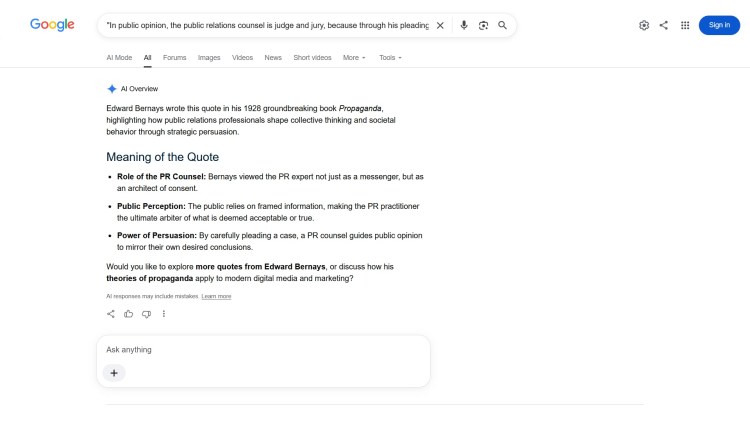
Although today people have a somewhat more reserved stance when it comes to traditional advertising, few people bring a similar sceptical attitude to so-called “search results” or (as in this case) when a so-called “search engine” offers an answer from so-called “artificial intelligence” instead. On the contrary: many people use Google (or similar websites) as if they were proof of something! Especially young, naive people are particularly prone to thinking (for example) that if Google returns no matching result for a query that no such website exists anywhere on the Internet. To teach such young, naive people a little about the real world, you could simply ask them to use their favorite so-called “search engine” to search for the quote by Edward Bernays (above) and to see whether the post which I published just yesterday shows up (or NOT).


