
Just to remind you, last week I started off with:
Traditionally, the field known as the “Economics of Information” has mainly been focused on how market prices happen (in the “supply and demand” scheme of things).
“Economics of Information 2.0: Advertising“
And then I talked a bunch about how (predominantly online) advertising today has changed the world from what it was before advertising became so important into what it is today (which is much more dominated by nearly all-encompassing advertising schemes).
Now let’s turn our attention to the role of censorship:
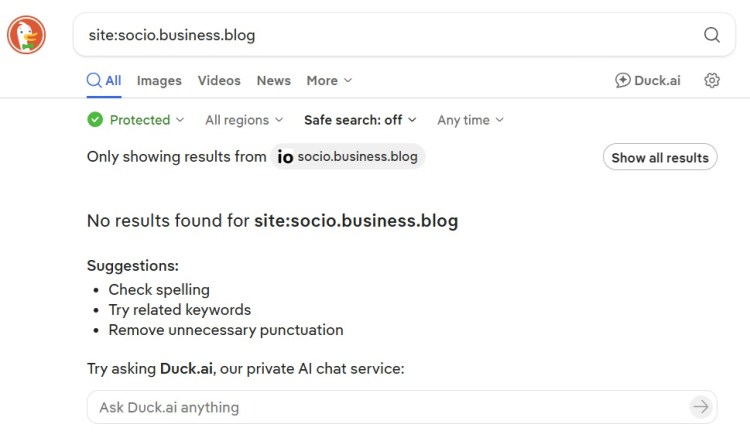
As you can easily see, different search engines go about censoring information in different ways. The image above is taken from a comparison of three different (more or less “standard”) sources. This one, duckduckgo.com, is probably the most transparent in its approach to censoring information — it basically shows you that it knows which website you are requesting information from, and then it tells you it will not show you anything from that website (even though it has just shown you the website icon, in other words, something from the website).
The other two so-called “information resources” are far more sketchy. bing.com doesn’t tell you anything at all (and thereby covers up the fact that the site is being censored). google.com indeed shows results, but misleads the customer to believe that these results would ever show up as a result to a more standard query (which site:socio.business.blog is most definitely not).
Of course I personally use none of these irrational media sites (except when I try to find out what other people might see when they apparently wish to be misled this way). [1]
Even though your mileage will almost certainly vary, this exercise is nonetheless useful to address why such censorship happens in the first place: in order to prevent suckers from getting the information they want to have — and instead to get them to click on the advertising (like DUH: read almost any one of my posts, but an excellent place to start is (in particular): pay attention to the links I shared in last week’s post about advertising: “Economics of Information 2.0: Advertising” 😉 ).


