
I’d like to bring this series full circle, right back to the beginning — I didn’t start the Fair, the Real Truth is a Trade Secret.

Apparently, according to Desmond Morris (who passed away just a short while ago, RIP), humans have been using the technology of the handshake for many centuries or even millennia. Perhaps only the kiss is more primal? Yet in the field of communications, humans have also evolved some rather fundamental institutions to deal with such “social media” things. [1]
For most of human history, the vast majority of humans have been largely illiterate. Gutenberg’s printing press didn’t really change that very much — in any case: not overnight. Even hundreds of years later, when literacy was widely considered to be a requirement during the birthing of the United States of America, being literate was pretty much on the same level as being elite.
What Gutenberg obviously did manage to do was to shock the establishment into making rules for how all of this newfound freedom of expression ought to be dealt with — which basically boiled down to: censorship. Censorship was not invented as a result of the printing press, but it was expanded in order to meet the birth and growth of new industries, which are now commonly referred to as “media”.
Over the past few centuries, advances in media technology have been significant, and therefore also required a number of amendments in the legal and institutional systems governing the so-called media landscape. One particularly “tried and true” principle (beyond the basic idea of copyright itself) is the notion of “Fair Use” and the quite similar “Right to Quote”. Very early on, people almost immediately recognized that if and when someone (anyone) says something (or writes something), it must be considered “fair” to quote what they say (or write). Indeed: A civilization which bans quotation seems hardly civilized.
A few days ago, I followed a link in one of my recent posts which links back to an earlier post. To my surprise the following image appeared on the page:

What I find particularly odd about this image is that I believe everything in the image is 100% fake — I am convinced that it contains no truth or reality whatsoever.
Here is a screenshot, showing the image in the context within which it appeared on my screen:
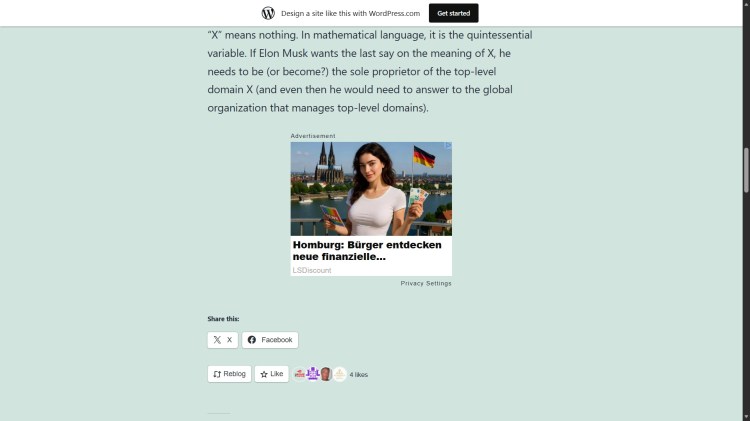
I did not click what appeared to be a “text link”, and I therefore do not know what any of the text is supposed to refer to.
I am not shocked by the appearance of this image @ socio.business.blog — after all, WordPress allows me to use this site “for free” (but actually: ) in exchange for such advertisements.
What I consider shocking is that we still seem to have not developed a way to refer to such advertising, to quote it, say things about it, etc.


