
A couple weeks ago, I pondered the question “What is a Milieu with No Location?” [ https://indigenous.news.blog/2025/02/12/distributed-milieus-what-is-a-milieu-with-no-location ]
This week, I heard an interview with Silke Borgstedt (“Geschäftsführerin” at Sinus-Institut) — she was invited as a guest to a local news program in order to explain what insights her company might be able to provide in the context of elections (in Germany, there is a major election happening right now). The homepage of the Sinus-Institut website declares “Only those who understand what moves people can also move them”.
There are some interesting parallels between the work of the Sinus-Institut and my own work with milieus. First, they are apparently not location-based. The focus is not on which people are actually co-located at a particular place, but rather the local aspect is a cultural phenomenon that is much more a matter of psychographics.
Second, the concepts used are (instead) language-based. In the explainer-video available via the Sinus-Institut website, the narrator explains that these “Sinus-Milieu” terms are indigenous to each country, yet that the corresponding groups they identify may have more in common with each other than the groups have with other people in each country’s local population — in other words, the affiliations between these groups transcend national boundaries.
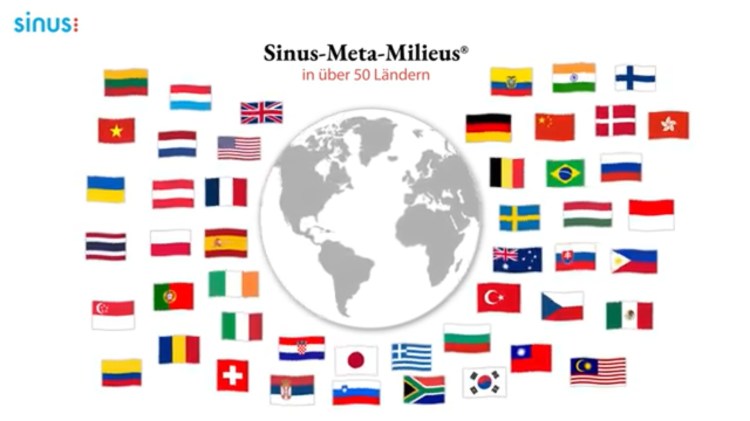
Of course, there are many marketers who might find the prospect of appealing to such global target audiences very lucrative. In my opinion, the rationality of using rational media [1] to appeal to global audiences is one of the main reasons why natural languages are so reliable as the most basic information technology world-wide.

 Socio Business blog