
I recall hearing Michael Jackson’s “Man in the Mirror” being played over and over again on the radio. I didn’t know the title of the song back then, and I actually seemed to hear it as “Man in the Middle”. Every now and then I would think “what is he saying about middlemen?” It probably took me several decades of not paying much attention to it before I learned much more about it (and at some point, I did succumb to looking up the lyrics). Today, I want to delve into how my own misunderstanding may actually have been somewhat prescient.

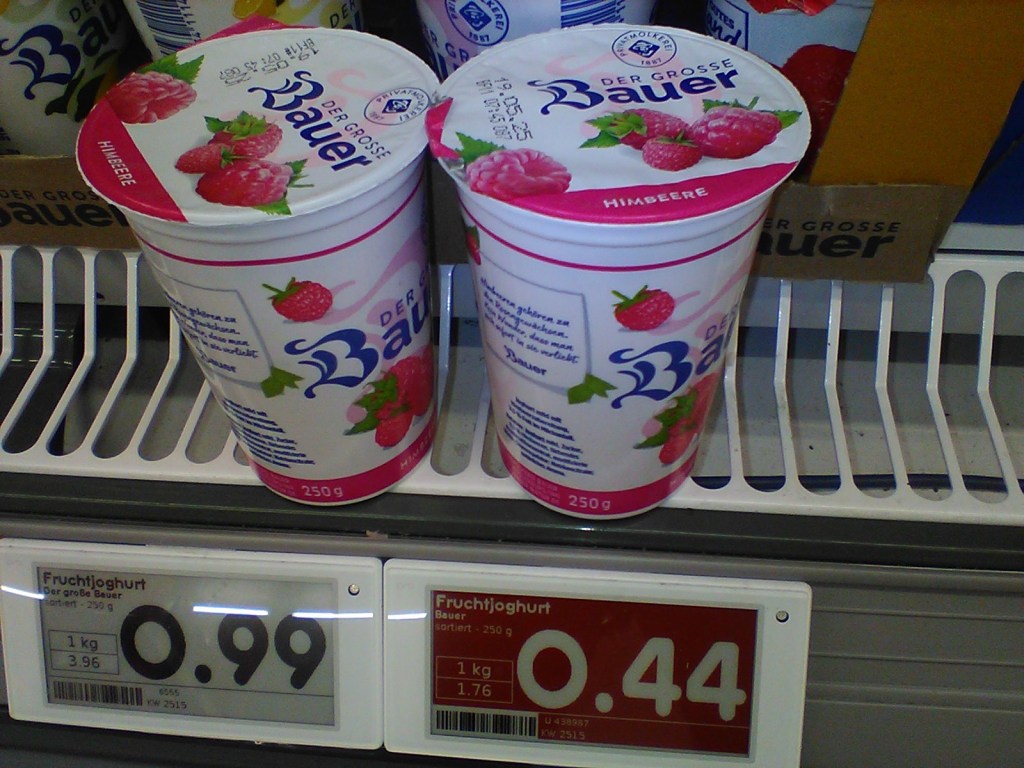
I took the photo above (right) at a retail store today. Let me explain.
One of my local grocery stores sometimes has a promotion they do on “Shopping Sundays”, offering everything in the store at 10% off. On those days, I like to go and stock up on staples that are normally never on sale. One such staple which no-one but me ever seems to want is skim milk. In Germany, there is a special kind of milk which is sort of non-perishable — meaning it can be kept for several months (without requiring refrigeration). As milk prices (as also many other groceries highly dependent on the price of oil) have significantly increased in price in recent years, I was hoping to be able to pick up some savings today.
Nope. There was not a single liter of such milk available. 😯
Well, before leaving empty handed, I decided to look around some more in case something else I might want happened to be on sale. I found the yogurt pictured above. I had taken the two items pictured (and depicted as “on sale” at less than half price) to the cashier and was surprised when the cashier rang up the full price. The cashier suggested I bring them back and called the store manager. I talked it over with the store manager and it seems that there was no way for me to know which price actually applied. Some of the items were being offered at full price, and some were being offered at less than half price. Even the store manager couldn’t tell which was which without scanning the bar codes individually and informing me which items were on sale and which items were being sold at full price. Seeing the great opportunity, I now decided to buy the three items the store manager was able to identify as “on sale” (versus about 30 that were not). Both the store manager and the cashier were actually helpful, and I can see how such frustrations must tax their patience on a daily basis.
Later it occurred to me that the same retailer has another location across town, and since skim milk is indeed a significant staple in my household, I decided to visit the other location to see if my luck might be better there,
Nada. The other location was also completely out of stock. I had asked the store managers at both stores, and both said stocks were completely empty and wouldn’t be replenished until next week (and then the sales promotion would be over).
Several things then occurred to me which link together the “man in the mirror” story with the “human in the middle” story.
These “Sunday shopping” special offers are limited to the city limits. This retail chain has locations all across the country. If the margins on some staple goods are already quite thin, then it might make sense for the national retailer to not replenish stocks in my local store that was offering additional savings (perhaps at expense of the national retailer’s account).
In this way, promotions which are advertised regionally but are constrained by logistics decisions made across regions may very well succeed in getting people to the store, and the brunt of the “failure”, disappointment and frustration is born by the local consumers and retailers (local store managers).
I imagine that much of the same principles apply in many other scenarios, too. When politicians decide to go to war, that is no skin off of their own backs. They send soldiers out onto the battlefields to fight with each other. They send drones to drop bombs on civilians. They increase prices across the board, but they don’t pay a single cent themselves.
“Everyday people” (as Sly and the Family Stone would sing) are living in the real world. Michael Jackson could sing as much as he wanted about a fictional apparition he saw in his reflection, living out some kind of confrontation with his own self-image. In contrast people in the real world are forced into confrontations without any clear or straightforward ability to make a change to their own situations.
I guess the most significant insight that can be gained from this contrast is that irrational media (i.e., brand names) should be expected to create such “bait and switch” schemes and to follow the dictum that “there’s a sucker born every minute” every day. [1]
[1] See “Rational Media” [ https://phlat.design.blog/2024/01/14/rational-media ]

 Socio Business blog