
I think perhaps reliability is actually a matter of a communally shared belief. Community members may actually consider something to be reliable because other members of the community believe in (more or less) the same thing. [1]
This past week a few things appeared on my radar which reminded me of how central the notion of reliability is to much of human behavior. There are probably far too many instances of how what we consider to be reliable information affects our behavior in various nuanced ways … this may very well be such an intricate matter that it cannot be measured reliably outside of strictly controlled laboratory conditions.
Two events in particular intrigued me — probably mostly due to how much the corresponding milieus are major influences on my everyday life.
Firstly, I heard an interview on the radio with a representative from Wikimedia / Wikipedia (or whatever person was invited to speak on the radio station). The person mentioned that Wikipedia requires (at least) two reliable sources for any information allowed. It was not actually specified what qualifies as an “information unit” — i.e., whether every single sentence counts as a separate information unit, or whether this applies only to every single wikipedia page. Yet this was not the first thing I thought of when I heard these remarks (which were presumably made to pitch the show in an anti-radical way how much the wikipedia project cements the “establishment” media landscape).
What I thought of first of all is the reason why wikipedia.org pages rank so prominently on Google’s so-called “search” engine. For many years now my answer to this question has been a sort of vague impression, along the lines of “maybe wikipedia.org is awarded a reliability bonus because Google wants to guarantee that at least one result could be considered reliable“. Yet when this person so vehemently underscored the degree to which wikipedia.org only allows observations made via establishment media sources, a light bulb turned on in my head: the reason why Google supports Wikipedia is that the conditions required by Wikipedia’s management positively affect Google’s “bottom line”.

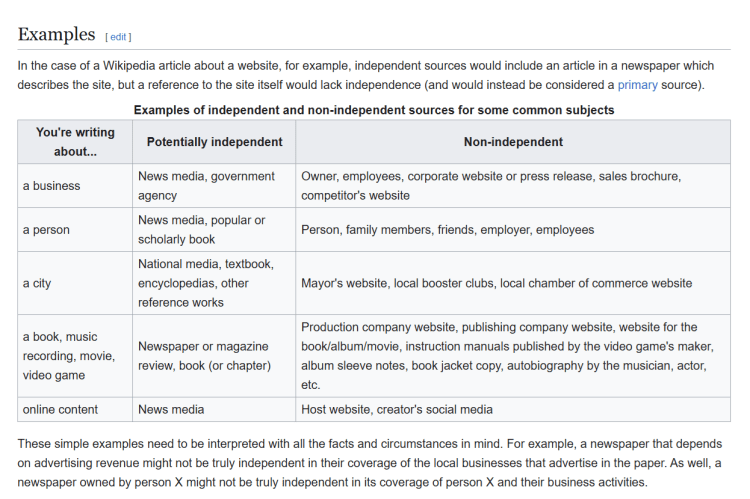
The documentation describing how wikipedia.org is regulated is quite vast — and ironically, its own rules would prohibit me from citing Wikipedia pages as sources of reliable information about Wikipedia. For example, the page about “independent sources” presents the following overview [2]:
All in all, my conclusion is that Google and Wikipedia are collaborateurs par excellence. Not only attention but also cold hard cash flows like milk and honey between these two organizations. In contrast, you and I (see “If Google is the Pope of the Internet, Then Who Are You & I?“) are left to eating the dogs, eating the cats, eating whatever scraps we can manage to get our grubby little fingers on with the mere click of a mouse (see also “When the Hitler-Youth Woke Up, They Found They Were Not Only Being Mesmerized, But They Were Also Being Starved to Death“)
The other event which appeared on my screen is much less clear to me — except in one regard: apparently, WordPress has lately become embroiled in a battle over its trademark(s). My only takeaway from this so far is that it is yet another case to document how “irrational media” are not reliable (see “Rational Media” [ https://phlat.design.blog/2024/01/14/rational-media ] ).

 Socio Business blog